
The Indian Canvas #35: India plans 52 surveillance satellites. Who builds the radar inside?
India's armed forces plan a 52-satellite surveillance constellation, 31 of them to be built by private firms. In Seattle, Kapta Space raised US$24 million for cheaper radar that tracks moving targets from orbit. India is not empty on radar: PierSight and Sisir Radar already build space radar payloads. The gap I would test is narrower, moving-target radar from orbit, and I found no Indian company working on it. That is a hypothesis, and it may sit behind classified work I cannot see.

Stock photo of clouds seen from an aircraft. Radar can image through cloud. This is not a satellite image.
A 52-satellite plan, with a private share
The Times of India reports that the Space Based Surveillance Phase-III programme, approved by the Cabinet Committee on Security in 2024 at Rs 26,968 crore, will put a constellation of 52 satellites in low and geostationary orbit, with 21 built by ISRO and 31 by private domestic firms, and deployment scheduled for 2025 to 2029. The article says Operation Sindoor exposed blind spots and that planners want to detect threats deep inside an adversary's territory. It describes a programme and a schedule. It does not name the private builders or say who supplies the radar.
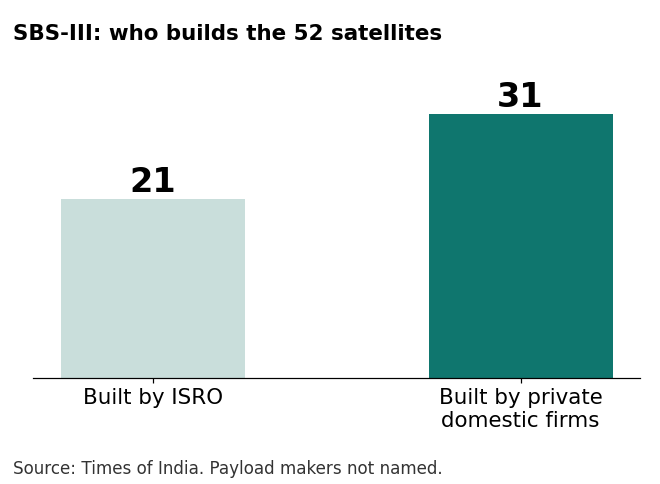
Chart by me from the Times of India figures. The axis starts at zero.
The money is also moving at the edges. PIB reported on 24 September that the Technology Development Board signed Rs 63.84 crore of RDI Fund support, extended through optionally convertible debentures, for GalaxEye, on a project costing Rs 247.69 crore to take its OptoSAR satellite, radar plus optical, from technology readiness level 6 to 9. Mint reports that Pixxel won a Rs 1,200 crore In-SPACe contract to build surveillance satellites by 2029, and that GalaxEye lost contact with its first optical satellite, Drishti, on 7 July. ThePrint reports that ICEYE plans to make its radar satellites in India, beginning with subsystems, and is in talks with the armed forces. Those talks are not an order.
What Kapta Space is trying
Payload reports that Kapta raised a $24 million Series A led by Washington Harbour Partners and Bison Ventures, taking total financing to $30 million since 2022. It says the money funds production of moving target indication radar payloads for classified missions it won this year. Its CEO says two demo missions will lead to flight heritage in 24 to 36 months. The company's claim is a new kind of electronic steering that can keep track of moving targets over land, air and sea at much lower cost, power and complexity than conventional electronically scanned arrays, cheap enough to fly in the hundreds. SpaceNews describes it as radar to help the US military track moving targets from orbit. Nothing has flown, so the cost claim is a claim.
The difference matters. Synthetic aperture radar makes a picture of a place. Moving target radar picks out things that move across it and keeps following them.
India is not empty, but moving targets from orbit is another question
Indian space radar makers do exist. PierSight, founded in 2023, says on its own site that it builds application-specific SAR systems, demonstrated its Varuna maritime SAR system in December 2024, had proof-of-concept contracts from the US and Indian coast guards, and launched a SAR payload for defence operations in June 2026. Its release says it joined the consortium selected by IN-SPACe for India's first public-private Earth observation constellation, with Pixxel, Dhruva Space and SatSure. All of that is company-reported. Sisir Radar, per Business Standard, raised a $7 million Series A led by 360 ONE Asset with Shastra VC, builds L- and P-band SAR payloads, says it has won two iDEX challenges for the Indian Air Force, and targets a private L-band SAR satellite launch in 2026. The launch had not happened when I checked, and I did not verify the date.
What I did not find is an Indian company building spaceborne radar that tracks moving targets on land or in the air. I did not check what PierSight's maritime products do beyond imaging ships, so I will not say it does not. ISRO and DRDO labs may be ahead of what is public, and classified work is invisible to me. "I did not find one" is the most I can say.
Why this could fail
For moving-target radar there is effectively one buyer, the armed forces, buying through slow procurement. Kapta's own first missions are classified and US-funded. An Indian entrant would need a defence sponsor before it needs a product. Kapta says flight heritage is 24 to 36 months away, and the SBS-III schedule runs to 2029, so a company starting now would probably miss most of this constellation and aim at the next one. Prices are not public, so I will not guess a number.
What I would do first
Start from what exists: ask two of the private SBS-III builders and one of PierSight or Sisir Radar who supplies their radar, and where they feel the gap. If the answer is that radar payloads are covered and nobody asks for moving-target tracking, there is no idea here beyond what these firms already sell. If a builder says they would buy a moving-target payload and cannot, the idea is a payload supplier with a defence sponsor.
Sources and photo credits
Times of India, PIB, ThePrint, Mint, Payload, SpaceNews, PierSight, PierSight release, Business Standard. Photos on Unsplash with no stated location: cover by Alec Favale, round grey satellite antenna at night (a ground dish, not a space radar); top of article by Lisha Riabinina, a view of the earth from space, which shows clouds through an aircraft window. This is a research view, not a proven business.
Responses
No responses yet - yours could be the first.
Get the notes
Occasional emails about what I'm building, what worked, and what broke.