
The Indian Canvas #33: India's biogas targets keep rising. Who makes the membranes inside the upgraders?
India's biogas blending targets keep rising, and every cubic metre of compressed biogas has to be upgraded before it is sold. In Switzerland, UniSieve just raised US$9 million for a new class of hybrid membrane, though not for biogas. India is not empty: Thermax, Clarke Energy and Genrich Membranes are already in membrane upgrading. The gap I would test is narrower: who can make durable hybrid membranes in India at module scale. That is a hypothesis.
Stock photo of an industrial pipe. It is not a biogas plant or any company named here.
The blending target sets the volume
The Press Information Bureau says the Union Cabinet approved GOBARdhan on 6 August 2026 with an outlay of Rs 23,731 crore over FY2026-27 to FY2035-36, and that it aims to raise compressed biogas (CBG) output nearly ten-fold, to around 5 million standard cubic metres a day (MMSCMD). It was launched on 1 October. Separately, the Hindu BusinessLine reports the blending obligation for CNG and household piped gas: 1 per cent in FY26, 3 per cent in FY27, 4 per cent in FY28 and 5 per cent from FY29. FY26 came in at 1.05 per cent, and 217 plants with about 1,773 tonnes a day of capacity had been commissioned by 31 July.
The Hindu quoted officials in June that CBG sales were about 0.66 MMSCMD in April and 0.63 in May, close to 2 per cent of the 34 to 35 MMSCMD of CNG and household gas. The same article cites the ministry's portal: 324 plants under construction and 1,261 not yet started.
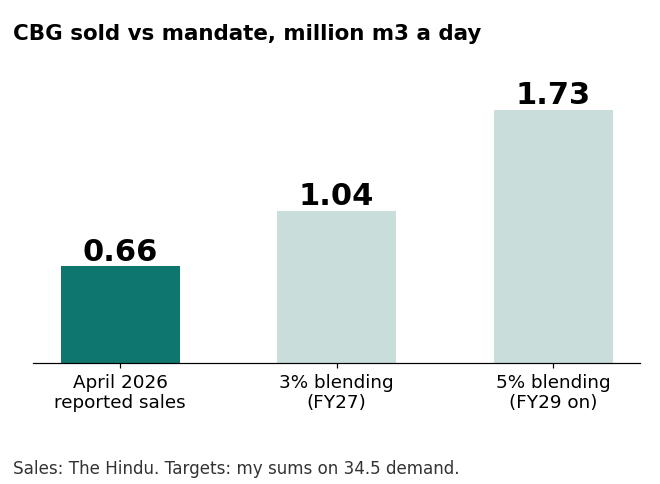
Chart by me. The first bar is the officials' figure. The other two are my sums: 3 and 5 per cent of 34.5 MMSCMD, assuming demand stays flat. The axis starts at zero.
My reading: on flat demand, the FY29 target needs roughly two and a half times today's CBG volume. All of it has to be upgraded to pipeline quality. Membranes are one of several ways to do that, and I did not find what share of Indian plants use them.
What UniSieve shows
UniSieve's own press release says the Zurich company raised US$9 million on 8 October in a Series A led by the Orano Venture Fund, managed by Supernova Invest, with Amadeus APEX Technology Fund, Founderful, Zürcher Kantonalbank and Guenat Holding. Total funding is US$25 million. It says it has brought hybrid membranes to pre-commercial maturity in two uses, olefins and point-source carbon capture. Founderland adds that the membranes embed metal-organic frameworks and zeolites in polymers, that the company claims up to 90 per cent less energy than thermal separation (a claim that depends on the application), and that a Polish chemicals producer, Qemetica, has tested its carbon capture membranes since September 2024. The hard part, the release says, was making these materials into durable membranes that can be manufactured at industrial scale.
Biogas upgrading is not on UniSieve's list. I use it only as a model of what a better membrane company looks like.
India is not empty, and the maker is unclear
Thermax says its Ne0 unit commissioned a 21 tonne-a-day membrane upgrading plant in Maharashtra, with 96 per cent methane purity and 97 per cent recovery. Clarke Energy says it commissioned its first membrane-based upgrader in India in October 2025, at a Chennai waste site: 600 Nm3 an hour, two-stage membranes, replacing a pressure swing adsorption unit, with methane purity above 97.4 per cent at part load. Neither source says who makes the membranes inside. Genrich Membranes of Pune says it is the only Indian company making hollow-fibre gas-separation membranes with indigenous technology, which is its own claim and which I could not check independently.
For harder separations I did not find an Indian company selling hybrid membranes, and that is not proof there is none. What I did find is research. IIT Bombay lists a technology for hollow-fibre membranes with ZIF-8, a metal-organic framework, on graphene oxide in a polymer. Its page reports CO2/CH4 selectivity up to about 80, which is the pair biogas upgrading separates, and also lists water filtration and biomedical uses. It is a listed lab technology, and I found no licence or product from it.
On the CO2 side, Carbon Clean commissioned a 2 tonne-a-day pilot near Mumbai in October, but it uses a liquid solvent, not membranes. TraceXero installed a prototype at the National Council for Cement and Building Materials in June, and its post does not say what separation method it uses.
Where this could work, and where it may not
The idea I would test: license or build hybrid hollow-fibre membranes in India and sell modules to the companies that build upgraders, such as the ones above, rather than to plant owners. Those builders already have buyers and need membranes that last. It could fail for plain reasons. Raw biogas carries moisture and hydrogen sulphide, which Genrich itself says hurt membrane life. A lab selectivity number may not survive module-scale manufacturing. And imported membranes may already be cheap and good enough.
What I would do first
Ask three upgrader builders and three CBG developers which membranes they use today, where they come from, what a replacement module costs, how often it is replaced, and what failed in the first year. Then ask IIT Bombay's technology office what a licence would involve. If buyers say imported membranes are fine and cheap, the opening is only in the harder industrial separations, and the CBG mandate is not the reason to start. A price to test, my assumption: a module priced against the replacement interval, not against the cheapest import.
Sources and photo credits
PIB, Hindu BusinessLine, The Hindu, UniSieve, Founderland, Thermax, Clarke Energy, Genrich Membranes, IIT Bombay, gasworld, TraceXero. Photos on Unsplash with no stated location: cover by Martin Baron, storage tanks sit in a green field (steel tanks beside farmland, not a biogas plant); top of article by Yuriy Vertikov, two red-handled valves above a black pipe. This is a research view, not a proven business.
Responses
No responses yet - yours could be the first.
Get the notes
Occasional emails about what I'm building, what worked, and what broke.