
The Indian Canvas #31: India is asking industry for drones and depot upgrades. Who sells the forecast that tells the forces what runs short?
India is asking industry about the physical side of military logistics: drones, depot upgrades, spares. These are requests and proposals, and I did not find an award for any of them. In the US, Gallatin AI has raised US$50 million to sell software that forecasts what units will run short of. The Indian Army already built its own tracking platforms, and at least two small Indian vendors claim forecasting products. So this is not empty, but I found no tender that asks private firms for the planning layer.
Stock photo of an empty warehouse hall. It is not connected to any company or force named here.
What India is asking for, and what it built itself
The Economic Times reported on 8 January that the Army launched DIME, a pan-Army platform built jointly with the government's geo-informatics institute BISAG-N, giving near real-time visibility of logistic items, dashboards, exception alerts and what the Army calls predictive stock analytics. Akashvani reported in May that the Army launched Q-FORCE, an app that integrates logistics and inventory platforms. Both are the Army's own descriptions; I have not seen an audit of either.
Then the items that ask industry for something. Outlook India reported on 5 August a Ministry of Defence request for information on 2,715 logistic drones. The New Indian Express reported on 30 August that the Air Force leans on a network of 930 Indian firms, in-house 3D printers and digital twins, with about 62,300 indigenised spares so far. Raksha Samachar reported on 25 September that an Army expression of interest seeks proposals from industry partners and consultants to modernise 12 regional ordnance depots it describes as about 60 years old. On 12 October the PIB announced an MoU between the Indian Army and the Food Corporation of India to use its infrastructure during operational contingencies.
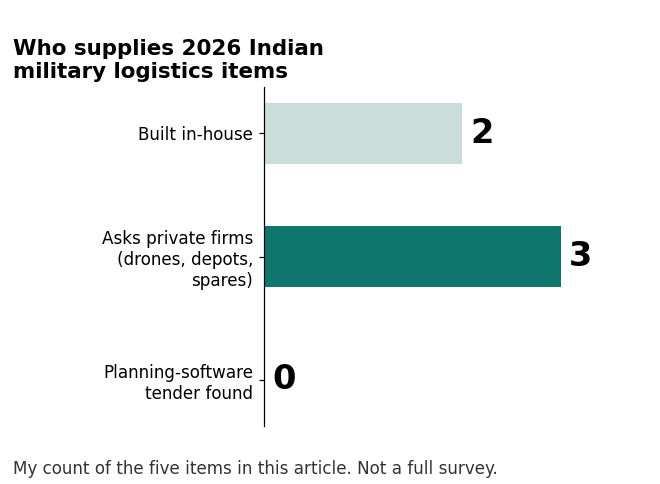
Chart by me. I classified DIME and Q-FORCE as built in-house, and the drone request, the spares network and the depot request as asking private firms. The FCI MoU is left out because it is between two government bodies. The zero means I found no such tender, not that none exists.
What Gallatin sells
In its announcement of 8 October, Gallatin says it raised a US$50 million Series A from new and existing investors including 8VC and Silent Ventures. Axios reports a US$70 million total, all equity. Its product, Navigator, is described by the company as decision support for military sustainment, and Axios describes it as AI that gives sustainment insights and plans supply distribution. The CEO told Axios that much logistics data is "clipboard and pen and paper".
The contracts are specific. A US Army PORTAL Phase II SBIR award on 11 March is for a planning prototype built on demand forecasting and optimisation. A III Armored Corps contract followed on 11 June. The US Defense Innovation Unit published its own notice of a joint sustainment contract award in July. The company's releases are its own account; the DIU notice is the owning source for the DIU award.
India is not empty, but it is early
Quantos Systems, registered in Raipur, sells what it calls closed-loop readiness intelligence for Indian defence, air-gapped and deterministic. Tosh Defence markets SAJAG, a predictive maintenance and spares-demand platform that its page says is in active development; I could not confirm where the company is based. I saw no customers, contracts or results for either, so these are claims on websites.
The Army also appears to be working on it itself. DIME's predictive analytics are the Army's own description, and a LinkedIn post I saw mentioned an Army-linked supply chain intelligence project with IIT Ropar, which I could not confirm. My reading: a startup selling the Army a forecasting tool faces a buyer with a home-grown system. Whether DIME and Q-FORCE stop at visibility is something I could not test from outside.
Two smaller doors
Not a Gallatin clone sold to the Army on day one. First, the firms that make and repair spares for the Air Force. They live on forecasts of what the force will order and are private companies who can buy software like any other manufacturer. Second, the depot modernisation request, which asks industry partners and consultants for proposals, so a planning module could ride inside someone else's bid. A price to test, my assumption: a monthly fee per supplier plant, set against the cost of one stuck production line.
The risks are real. Government payment cycles are long, data may not leave a secure network, and a services firm may be a better fit than a software one.
What I would do first
Read the depot request in full and see whether it names forecasting. Then talk to five small suppliers on the Air Force list and ask how they learn what will be ordered next. If they say they wait for the tender, there is a product. If the Army insists on its own stack and data, this is a services business.
Sources and photo credits
Economic Times, Akashvani, Outlook India, New Indian Express, Raksha Samachar, PIB, Gallatin announcement, Axios, Gallatin PORTAL, Gallatin III Armored Corps, DIU, Quantos, Tosh SAJAG. Photos on Unsplash with no stated location: cover by Brian Wangenheim, a large empty warehouse; top of article by Anastasiia Skai, an empty warehouse with a green floor. This is a research view, not a proven business.
Responses
No responses yet - yours could be the first.
Get the notes
Occasional emails about what I'm building, what worked, and what broke.