
The Indian Canvas #32: Indian utilities tender drones for long power lines. Is there room for an airship that flies for 10 hours?
Indian utilities are tendering drones to patrol power lines, and the work ahead is large. In France, HyLight raised EUR 13 million for a 12-metre airship that flies at about 25 metres for 10 hours, a company claim. India is not empty: drone inspection is crowded, and at least one Indian firm, Airbotix, announced an airship drone for inspection. I found no Indian airship with customers or results, so that stays a hypothesis.
Stock photo of a transmission tower. It is not connected to any company named here.
Utilities are tendering drones, and the corridors are long
On 8 October the Bihar State Power Transmission Company listed a tender for drone inspection and patrolling of important transmission lines, with an estimated value of Rs 6.85 crore and bids due on 22 October, according to its TenderDetail listing. The Hindu reported that AP-Transco invited DGCA-compliant drone service providers for a two-year pilot covering about 23,000 towers and 8,500 km of 400 kV, 220 kV and 132 kV lines, with patrolling to be extended to 33,000 km depending on the pilot. The Times of India reported in June that Karnataka's KPTCL drones inspected more than 3,370 km of lines and over 11,000 towers and flagged more than 1.5 lakh defects, and that outages on the inspected corridors fell from 519 to 73. Those are the utility's own figures, and the article does not say over what period or how much the drones caused.
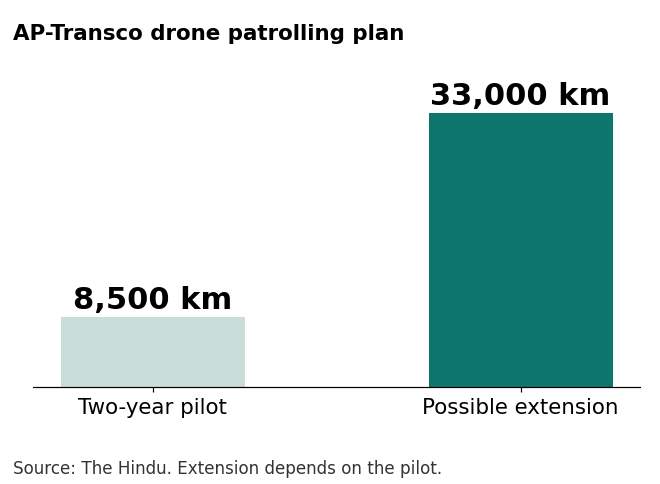
Chart by me from the Hindu figures. The axis starts at zero. The extension is a possibility, not a commitment.
My reading: if the pilot works, the pilot is about a quarter of the line length AP-Transco names. Repeated inspection of long corridors is something these utilities are tendering for, with drones. I did not check whether any contract has been awarded.
What HyLight does that a drone does not
Tech Funding News reports that HyLight raised EUR 13 million, with Rubio Impact Ventures, DRW, Teampact Ventures, Y Combinator and Ring Capital, after a seed of about EUR 3.7 million in 2024. The HyLighter is 12 metres long, gets lift from helium and is powered by a hydrogen fuel cell, so it is not a hydrogen-lift airship. The company says it flies 10 hours, covers 350 km, carries 10 kg of sensors including LiDAR, cameras and methane detectors, and flags more than 50 kinds of grid defects. It reports more than 750 flight hours, four airships and a plan for up to 15, and names Enedis, SNCF Reseau, Terega and NaTran as clients. All of this is company-reported.
The same article gives the caution: helicopters still do most of the flying, and airships cover only about 8% of Enedis' plan for 2026. Whether utilities will sign contracts big enough to keep 15 airships busy is the open question. It also lists a Finnish rival, Kelluu, which raised a EUR 15 million Series A in April 2026.
India is not empty
Drone inspection is crowded. Skylark Drones sells an analytics platform for utility inspection. Hornbill sells GridWise for transmission-line inspection. Lesoko offers drone inspection of lines from 33 kV to 765 kV. AiRotor markets long-distance beyond-visual-line-of-sight patrol on its blog, which is marketing and not evidence of a contract. I would not start a short-range drone inspection company in India.
On airships: Airbotix announced in a May 2023 LinkedIn post, reported by Urban Air Mobility News, trials of an airship drone for persistent surveillance and inspection, which it calls the first of its kind in India. That is the company's claim, and I found nothing since on customers or flights. Red Balloon Aerospace builds balloons, aerostats and airships, but Inc42 says it is aiming at the stratosphere, about 20 km up, not low-altitude line inspection. So an Indian low-altitude inspection airship exists at the announcement stage. A funded one with utility customers I could not find, and that is not proof there is none.
Where endurance could matter, and where it may not
This is a real gap only if endurance matters. A drone covers a few km per sortie and a 350 km airship suits long, empty corridors: Himalayan and North-East lines, long gas pipelines, remote railway stretches. If utilities are content with drone teams spread across the grid, an airship is a solution looking for a customer. I did not check what India's drone rules require for beyond-visual-line-of-sight flying or for handling hydrogen, and I would before building anything.
What I would do first
Do not start with a prototype. Ask three transmission companies and one pipeline operator which corridors their drone teams struggle with, how many km a month they actually fly, and what they pay per km. A price to test, my assumption: a per-km fee close to the drone rate for long corridors, since buyers will compare with tenders like the Bihar one. If drones cover everything adequately, India is a drone market and the airship idea waits.
Sources and photo credits
TenderDetail, The Hindu, Times of India, Tech Funding News, Urban Air Mobility News, AiRotor, Inc42. Photos on Unsplash with no stated location: cover by Mariola Grobelska, a high voltage power line against a blue sky; top of article by Yihan Wang, power lines and a metal pylon against a white sky. This is a research view, not a proven business.
Responses
No responses yet - yours could be the first.
Get the notes
Occasional emails about what I'm building, what worked, and what broke.