
The Indian Canvas #137: Who Drives the Delivery?
On 20 October, a Beijing company most Indians have never heard of raised nearly $400 million to delete a job India is still creating. Neolix builds RoboVans - small, slow, driverless electric vans that run delivery routes with nobody inside. The Series E was led by Boyu Capital and what Chinese media identify as the National Artificial Intelligence Industry Investment Fund, with Alibaba's AEF NextGen fund among the participants; it follows a $600 million-plus round last year. Investors are not buying a prototype. They are buying the company that, by its own account, already runs the largest commercial autonomous delivery fleet on earth.
The numbers behind that claim are worth sitting with. In February, Neolix said its fleet had crossed 100 million real-world kilometres with 16,000 vehicles deployed across 15 countries. By September, launching its European headquarters in Luxembourg, it reported roughly 27,000 RoboVans deployed, 230 million autonomous kilometres logged, and more than a million fresh autonomous kilometres added every day. In China it holds operating permits in over 300 cities, counts SF Express, JD Logistics, China Post, ZTO and YTO among its customers, and says it wins about 70% of the country's autonomous-delivery tenders. In Qingdao it runs more than 1,200 vans as RoboVan-as-a-Service: a logistics customer does not buy the vehicle, it buys the delivery run. The payer, notice, is not a curious consumer. It is a logistics company doing arithmetic on cost per parcel.
Why did the winning autonomy product turn out to be the boring one? Because a RoboVan is the easiest version of the hardest problem: no passengers to frighten, low speeds, fixed routes, forgiving payloads, and a business buyer who measures savings in paise, not in wow. Neolix's mapless driving stack - no high-definition maps to build and maintain - is what turns that into a franchise: a new city becomes a deployment, not a research project. Europe is being sold the same machine on a different pain: a structural driver shortage. The pitch to a Dutch or German logistics firm is not that robots are clever. It is that the driver you cannot hire already exists.
Nine and a half million runs a day
Now look at the Indian side of the ledger. India's quick-commerce platforms alone crossed 9.5 million deliveries a day this August, according to Datum Intelligence estimates - Blinkit 3.4 to 3.6 million, Zepto 2.4 to 2.6 million, Instamart 1.3 to 1.45 million, with Flipkart Minutes, Amazon Now and BigBasket behind them. The top three were doing just over 4 million a day in March 2025; the business more than doubled in seventeen months. The platforms draw on a gig workforce NITI Aayog projects will grow from 77 lakh in 2020-21 to 2.35 crore by 2029-30. Issue #133 of this series asked who owns that rider's bike. Neolix's question is ruder: what happens to the rider when the bike no longer needs one?
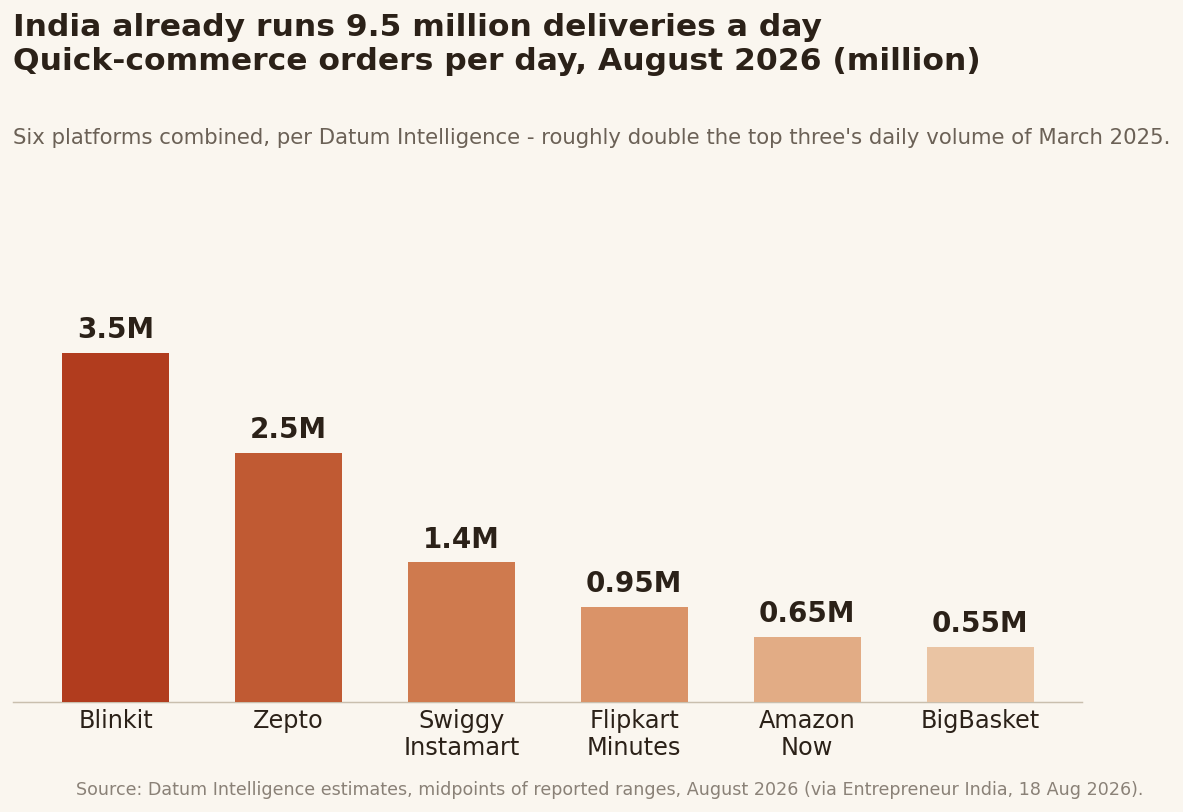
Average daily quick-commerce orders in India, August 2026, per Datum Intelligence estimates. Platform figures are the midpoints of reported ranges.
The regulatory contrast is stark. China handed Neolix permits in 300-odd cities. India has no framework for a vehicle with no driver at all - and is meanwhile legislating in the opposite direction: the Centre has proposed mandatory automatic steering support, emergency lane-keeping and driver-drowsiness warnings for taxis and other transport vehicles built from October 2029. That is a rulebook for a driver who is present, alert and in charge. The lawbook assumes the seat is occupied; the technology is arriving to empty it.
Start where the roads are private
The honest obstacles first. Indian urban traffic - the unmarked lanes, the mixed two-wheelers, the hand-signal negotiation at every junction - is the hardest autonomy environment on the planet, and even Neolix's operations show fragility: it suspended its Abu Dhabi fleet for weeks this March when the Iran war made the Gulf's streets unpredictable. A company that pauses for missiles will pause for a Mumbai monsoon. And India's vehicle law does not yet know what a driverless delivery van is.
So here is my hypothesis, and it is a hypothesis. India's robovan moment will not begin on open roads but on captive ones: industrial parks, ports, airport cargo zones, large campuses - and above all the quick-commerce trunk route, the night-time run from city warehouse to dark store, fixed path, low speed, no passengers, brutal cost discipline. That is Qingdao's RaaS shape with the road risk engineered out. The test I would run is concrete: one quick-commerce operator, one city's replenishment routes, fifty vans, and measure the cost per run against the truck-and-driver it replaces. The market, as always in this series, is not empty: Bengaluru's Ati Motors already sells autonomous tugs hauling materials inside factories, and Minus Zero has shown an autonomous concept built for Indian chaos. The capability is here. It is waiting for the buyer who counts paise per parcel.
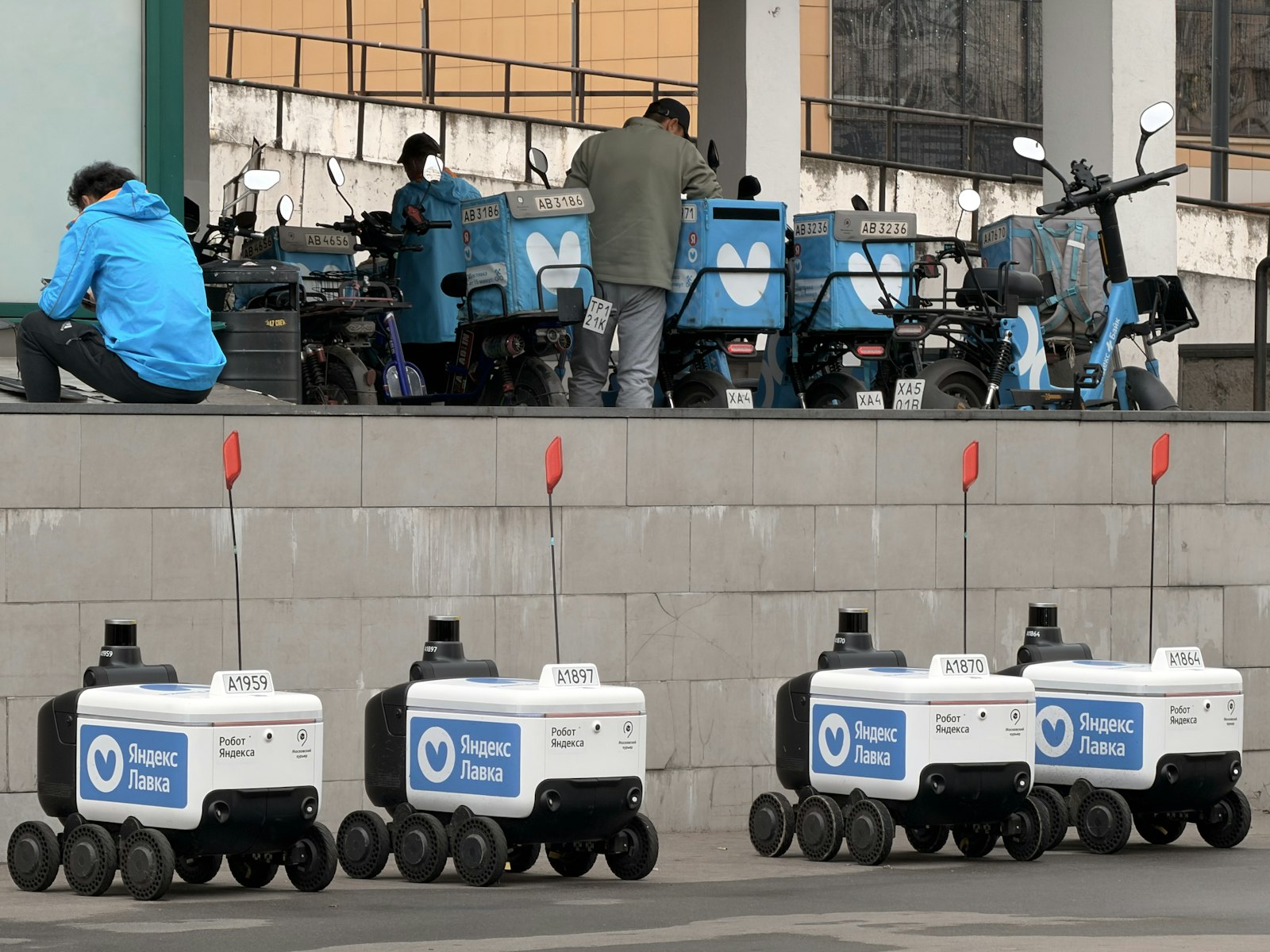
Yandex Lavka delivery robots parked in front of human couriers and their scooters. Photo: Aleksandr Anisin / Unsplash
China's lesson is not that India should import robovans. It is that the autonomy business that finally worked was the unglamorous one: no passengers, fixed routes, sold by the run to a business with a spreadsheet. India has the fastest-growing delivery demand in the world, a gig workforce it is still expanding, and a lawbook written for a driver. One of those three facts will bend. The van is already built; the route is already mapped by 9.5 million daily orders. What is missing is the first Indian operator brave enough to let the driver's seat go empty.
Sources: TechNode on the Series E (20 Oct 2026); Neolix: 100M autonomous km (19 Feb 2026); Neolix: European HQ and fleet scale (14 Sep 2026); Reuters on the Abu Dhabi suspension (5 Mar 2026); Entrepreneur India / Datum Intelligence on quick-commerce orders (18 Aug 2026); PIB / NITI Aayog: India's Booming Gig and Platform Economy (27 Jun 2022); The Hindu BusinessLine on the 2029 ADAS mandate (22 Oct 2026); The Indian Canvas #133 - Who Owns the Delivery Rider's Bike?.
Responses
No responses yet - yours could be the first.
Get the notes
Occasional emails about what I'm building, what worked, and what broke.