
The Indian Canvas #133: Who Owns the Delivery Rider's Bike?
On 12 October, a Lagos company called MAX announced that climate financier Nithio had extended its Series B3 to $29 million. MAX sells no vehicles in the way a showroom does. It hands a commercial rider an electric two-wheeler, a battery subscription, insurance, maintenance and a payment plan, and the rider pays the machine off out of daily earnings. The bike finances itself while it works.
The full stack is worth a look, because MAX has quietly assembled all of it. Founded in 2015 as Metro Africa Xpress, it now runs what it calls Africa’s first integrated electric vehicle and battery subscription platform: partnerships with manufacturers Spiro and NOVR, a Spiro fleet of nearly 7,000 units under a 10,000-unit first phase, and an energy network of 288 battery cabinets across 143 swap locations, partly powered by 1 MWp of its own solar. Riders, whom MAX calls Champions, have completed more than 380,000 battery swaps, now running near 77,000 a month. The company says its solar hubs deliver energy at half the cost of Nigeria’s Band A grid tariff, and that a Champion’s energy and maintenance costs run more than 40% below a petrol bike at current pump prices. Those are the company’s numbers, not mine, but the swap counter is hard operational data, and 380,000 swaps is not a pilot.
The underwriting model is the earnings, not the salary slip
Here is the part I find genuinely interesting. A commercial rider in Lagos cannot walk into a bank. He has no salary slip, no CIBIL equivalent that matters, no collateral anyone wants. But he has something better: a verifiable daily cash flow, earned on the very asset he is paying for. MAX’s platform wraps driver onboarding, vehicle subscriptions, third-party financing, digital payments, fleet telematics and risk management into one system, which means the lender can see the collateral earning every day. The instalment comes out of the fare, not out of savings. Miss work, and both sides feel it immediately; work well, and the bike becomes yours. That is a fundamentally different answer to “who should own a working vehicle” than a loan, a lease or a rental.
India has the riders. It also has three rival answers.
Now bring this home, because India is the largest two-wheeler market on earth and its electric segment is suddenly enormous: a record 14 lakh electric two-wheelers were sold in FY2026, 57% of all EV sales in the country, and 2026 is tracking towards 2 million. The rider base is just as big. NITI Aayog estimates 77 lakh gig workers in 2020-21, projected to reach 2.35 crore by 2029-30. Every Zomato bag and Blinkit order arrives on a two-wheeler someone has to own, finance or rent.
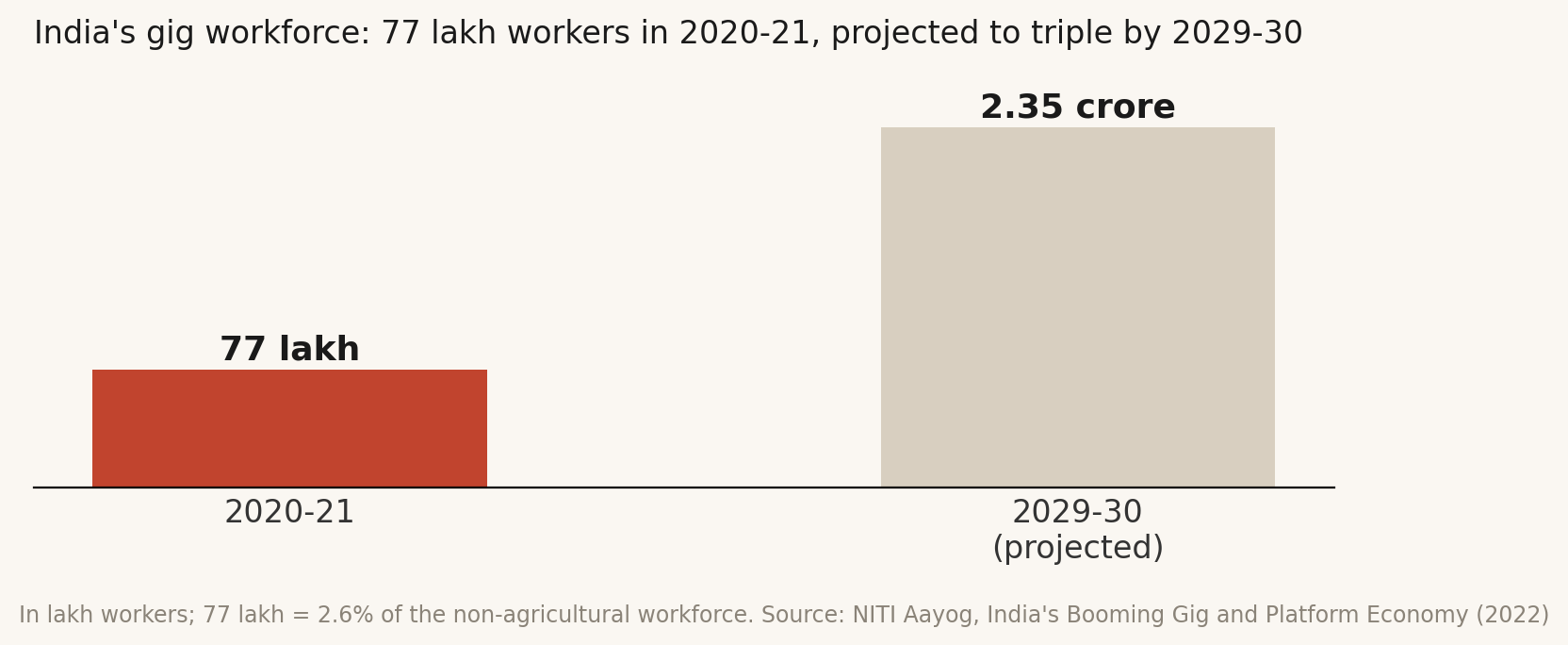
India’s gig workforce: 77 lakh in 2020-21, projected to reach 2.35 crore by 2029-30. Source: NITI Aayog (2022).
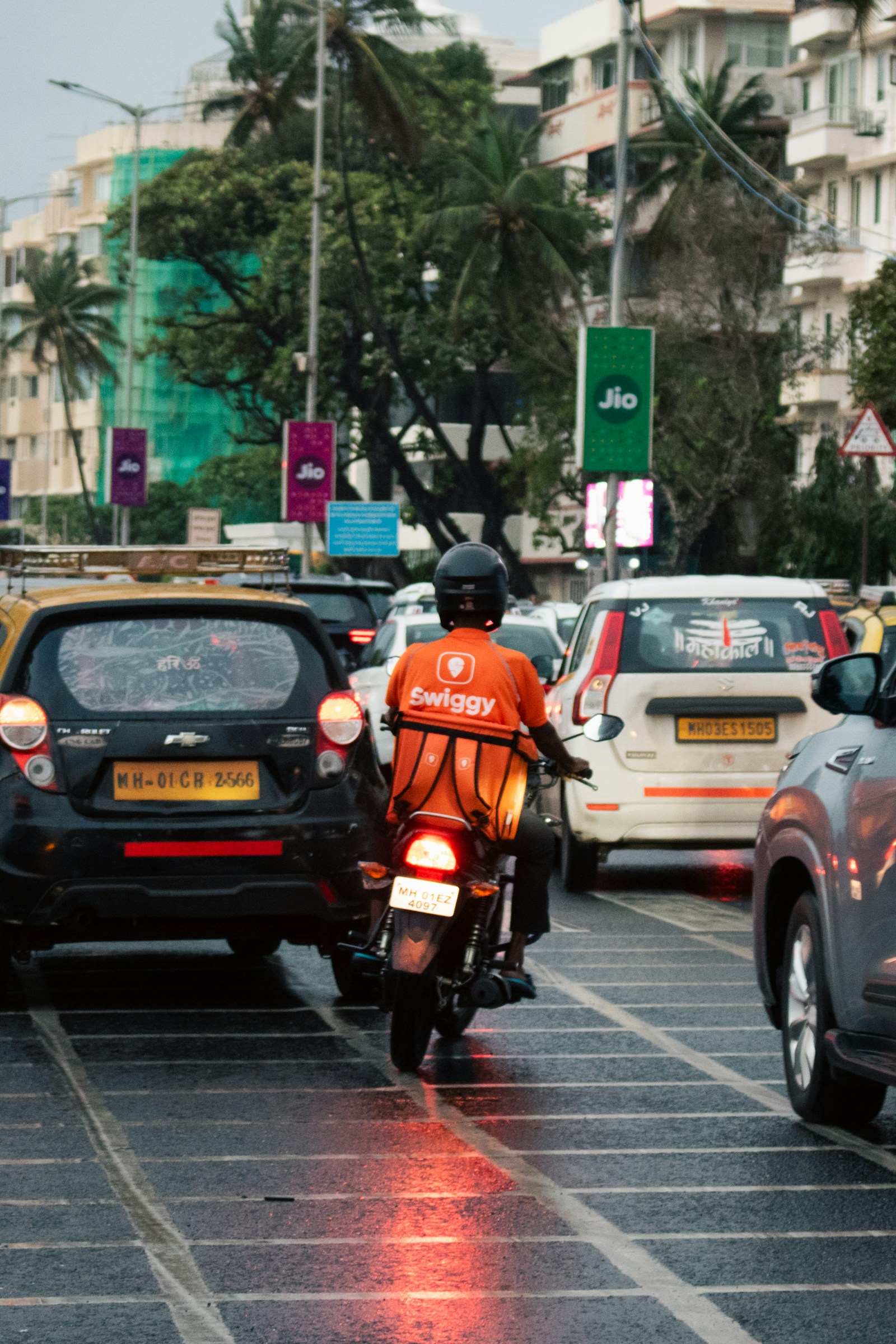
A gig delivery rider at work in Mumbai; the asset he rides is also the collateral. Photo by Zoshua Colah on Unsplash.
And the market, as always in this series, is not empty. Gurugram’s Zypp Electric rents electric two- and three-wheelers to delivery workers and calls itself India’s “Gig Economy OS”; it reported Rs 449 crore in revenue and is openly courting pre-IPO investors. Battery Smart, which bills itself as India’s largest battery-swapping network, for electric two- and three-wheelers and topped up its Series C with roughly Rs 100 crore on 17 October. SUN Mobility and Yuma Energy are building the same swap rails. Notably, Zypp and Battery Smart have partnered since 2022: the rental company’s riders swap on the other’s network.
Rental, swap or financing: who ends up owning the rider?
Look at what each Indian model does with ownership. Zypp keeps the bike on its own balance sheet; the rider rents and never accumulates anything. Battery Smart keeps the battery; the rider may own the frame but rents the energy. The MAX answer is different: the rider is buying the asset, instalment by instalment, out of the earnings the asset generates, and one day owes nothing. India has EV-financing NBFCs circling this space, but I can find no Indian operator offering MAX’s full shape: vehicle, battery, swap energy and earn-to-own financing in one subscription.
Here is my hypothesis, and it is a hypothesis: the model that wins India’s gig rider is the one that answers two questions at once: what does the rider pay per kilometre today, and what does the rider own when the payments stop. Rental answers the first and fails the second. A loan answers the second and fails the first for anyone without a credit history. MAX’s wager is that telematics on the earning asset replaces the credit file, and that is exactly the kind of wager India’s 77 lakh gig workers make worth testing. The test is concrete: take a Gurugram delivery rider, price the monthly outgo under rental, swap-plus-loan and earn-to-own, and see which leaves him with both the lower cost per kilometre and the keys. If it works in Lagos at 77,000 swaps a month, someone in Gurugram should be running the numbers.
Sources: Nithio investment announcement; MAX; British International Investment on MAX; Autocar Professional on FY2026 e-2W sales; NITI Aayog gig economy report (PIB); The Hindu on NITI projections; Zypp Electric investor page; Entrackr on Battery Smart’s Series C top-up; The Week on India’s battery-swapping boom.
Responses
No responses yet - yours could be the first.
Get the notes
Occasional emails about what I'm building, what worked, and what broke.