
The Indian Canvas #136: Who Files the Claim?
On 15 October, a New York company called Chariot Claims raised $10 million to sell something the legal system always assumed was free: the filing of the claim. Not arguing the case, not writing the law. Just the act of showing up - at scale, for millions of people who were owed money and never collected. Its own announcement opens with the number that explains the company: only 4% of consumers harmed by privacy violations, hidden fees or false advertising ever file a claim. For a large company, that math makes breaking the law cheaper than obeying it. Chariot's entire business is changing that math.
The machine it built is worth understanding, because it is a genuinely American invention. For two decades, US consumer contracts have quietly killed the class action: sign up for a phone plan or a credit card and you agree to arbitrate disputes individually, never as a group. One person's $40 overcharge is not worth any lawyer's hour, so the overcharge wins by default. Mass arbitration turns the trick around. If the contract forces every claim into individual arbitration, Chariot files thousands of individual arbitrations at once - each one real, each one expensive for the company to answer. The company says it now processes more than 200,000 pre-qualified claims a month, mostly against Fortune 500 companies, and estimates its consumers recover an average of $460 each - against $32, the average payout in class action settlements analysed by the US Consumer Financial Protection Bureau. The round was led by Silverton Partners, takes the company to $15.7 million raised, and was explicitly framed as ammunition: Chariot says defendants in its cases have already sent it threats and cease-and-desist letters. Being sued by your targets is, in this category, a traction metric.
The economics underneath are simple. A small legal claim is an asset, like an unpaid invoice, but one nobody collects because collection costs more than the claim. Class actions solved this by bundling claims into one case and one fee; arbitration clauses broke the bundle. Chariot re-bundles with software instead of procedure: AI spots a pattern of misconduct, matches affected consumers to it, qualifies them in minutes, covers the acquisition cost upfront, and hands thousands of ready claims to partner law firms working on contingency. When the per-claim cost of paperwork falls toward zero, claims worth $40 become collectable. The payer, note, is not the consumer. It is the defendant, through settlement, and the law firm's contingency cut.
India's uncollected claims
Now hold this up to India, where the same arithmetic runs through a different machine. India does not have America's arbitration-clause problem, because Indian consumer contracts were never enforced that way. What India has instead is a queue. Answering a question in the Lok Sabha this July, the government put total pendency before consumer commissions at 5,93,109 cases: 4,48,687 at district level, 1,27,507 at state level, 16,915 before the national commission. Alongside the backlog sits a staffing hole - 864 sanctioned posts of presidents and members vacant across state and district commissions. For the average Indian consumer, the claim is worth less than the day it takes to file it. So the refund never comes, the misleading fee never gets challenged, and the company's spreadsheet records the same lesson the American one does: enforcement is theoretical.
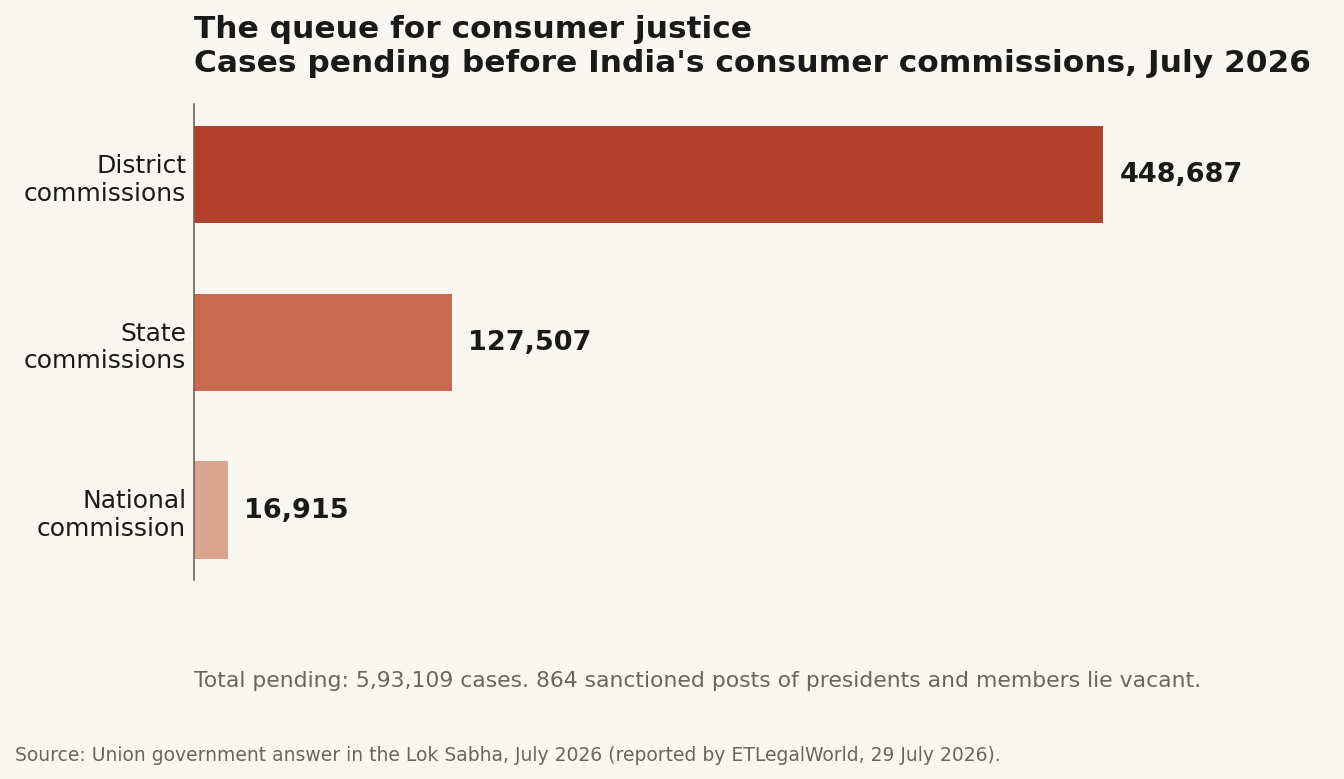
5,93,109 consumer cases were pending before India's consumer commissions in July 2026; 4,48,687 of them at district level. Data: Union government answer in the Lok Sabha, July 2026.
And yet the rails are newer than the backlog suggests. The Consumer Protection Act, 2019 already recognises representative complaints - one or more consumers filing on behalf of "numerous consumers having the same interest". On 1 January 2025 the government rolled out e-Jagriti, a single national platform that merged the old e-Daakhil filing portal and the commissions' case systems into one interface: OTP registration, digital filing, virtual hearings, real-time tracking. By mid-November 2025 it had 2.81 lakh registered users - 1,400 of them NRIs filing from abroad - with 1.35 lakh cases instituted and 1.31 lakh disposed. The pipe works. What is missing at the top of the pipe is the plaintiff.
The state is not a startup
India's actual answer to the 4% problem so far has been to make the state the class action. The Central Consumer Protection Authority can investigate, order recalls and levy penalties without any individual filing anything - it fined Rapido Rs 10 lakh in September for misleading fare prompts and dark patterns, as The Hindu reported. That is real enforcement, and this series cheers it. But one office in Delhi picks the big, visible flies. It will never chase the Rs 499 subscription that would not cancel, the airline refund stuck for nine months, the hidden convenience fee multiplied by a crore transactions. Below the regulator's line of sight, the American logic still holds: no filer, no case.
The market, as always here, is not empty - it is just aimed elsewhere. Presolv360 and Sama run online dispute resolution for banks and platforms, and SEBI operates SMART ODR for securities-market disputes. That is dispute resolution sold to institutions, to clear their queues. Nobody sells it to the consumer, to fill the commission's queue with their claim.
So here is my hypothesis, and it is a hypothesis. The Indian Chariot will not arbitrate - there is no arbitration clause to weaponise - it will file. Take one narrow, documentable category where the claim is small, common and provable: stuck airline refunds, say, or uncancellable subscriptions. Build the intake that qualifies a consumer in minutes, generate the e-Jagriti filing automatically, batch the cases, and charge a contingency on recovery - the company pays nothing upfront, the platform earns when the refund lands. The test I would run is small: one category, 1,000 filings, and measure how many settle before hearing and how long money takes to move. If the settlement rate looks anything like the American pattern - defendants pay to clear volume - an Indian founder should be able to make money giving the 96% their day in court, without the day.

A stack of case files marked with sticky tabs. Photo by Tanja Tepavac on Unsplash.
The obstacles are honest ones. Consumer commissions cannot absorb a sudden flood any better than a hospital can; contingency fee arrangements sit awkwardly with Indian legal-profession rules; and a platform that files for consumers must not become the ambulance-chaser the system rightly distrusts. But notice what Chariot's funding round really says: in America, collecting on small claims is now a venture-backed industry because the claims were always assets - someone finally built the collector. India's pile of uncollected claims is larger, the filing rail is brand new, and the law already lets one consumer carry thousands. The seat is empty.
Sources: Chariot Claims Series A announcement (15 Oct 2026); LawSites (16 Oct 2026); ETLegalWorld on the July 2026 Lok Sabha answer (29 Jul 2026); PIB: consumer protection roundup (Jan 2026); Consumer Protection Act, 2019 (Dept of Consumer Affairs); The Hindu on the CCPA Rapido penalty (16 Sep 2026); Presolv360; Sama; SEBI SMART ODR.
Responses
No responses yet - yours could be the first.
Get the notes
Occasional emails about what I'm building, what worked, and what broke.