
The Indian Canvas #130: Fifty Crores for a Maybe
Picture a founder in Hyderabad's Genome Valley. She has a molecule that kills a drug-resistant bacterium in mice, a small team, and eighteen months of money left. To go further she needs what investors call discovery money: several years of expensive experiments before anyone can say whether the compound is even a drug. In Bengaluru or Hyderabad, she can raise crores for a software company in a weekend. For a molecule, the room goes quiet.
That quiet room is where Indian drug discovery goes to die. India is the world's pharmacy by volume - it is the largest supplier of generic medicines in the world, around a fifth of global supply - but new chemical entities and new biological entities, the molecules that begin as nobody's copy, barely feature in what the industry funds. The reason is arithmetic, not talent. Bringing one approved drug to market takes an estimated 10-15 years and over a billion dollars, and roughly nine out of ten candidates that enter clinical trials fail, as a 2022 review in Acta Pharmaceutica Sinica B lays out. The earliest stretch, from a promising hit to a clinical candidate, is the riskiest and the least fundable. Venture capital will underwrite risk it can model. It cannot model a molecule.
On 30 September, the Department of Pharmaceuticals opened the second call under its Promotion of Research and Innovation in Pharma & MedTech scheme - PRIP - and quietly added a third door. Alongside the existing early-stage track (up to Rs.5 crore) and later-stage track (up to Rs.100 crore), there is now a Discovery Track: up to Rs.50 crore per company for startups and MSMEs chasing new chemical and biological entities at the earliest technology readiness levels. The catch is the design: the money arrives only if bona fide institutional investors co-fund at least 25% of the project. The state is not offering a grant. It is offering to be your co-investor - after a private investor has looked at your science and reached for their own wallet first.
That ordering is the whole idea, and it is worth pausing on.
The anatomy of the bet
PRIP was approved by the Cabinet in 2023 with a Rs.5,000 crore outlay and, per the scheme's official FAQ, now runs until FY2029-30. It has two halves. Component A builds seven Centres of Excellence at the National Institutes of Pharmaceutical Education and Research (Rs.700 crore) so that academic labs can carry the load. Component B (Rs.4,250 crore) is the industry-facing half, and it is organised as a ladder:
Early stage - TRL 1-3 projects climbing to TRL 5, up to Rs.5 crore per project. Projects costing up to Rs.1 crore are fully funded by the government; above that, the applicant co-funds half of the excess.
Discovery track - TRL 1-3 NCE/NBE projects climbing toward TRL 6, up to Rs.50 crore, conditional on at least 25% co-funding from institutional investors.
Later stage - TRL 4-6 projects, up to Rs.100 crore, with the government's share capped at 35% of the approved cost and the applicant carrying the remaining 65%.
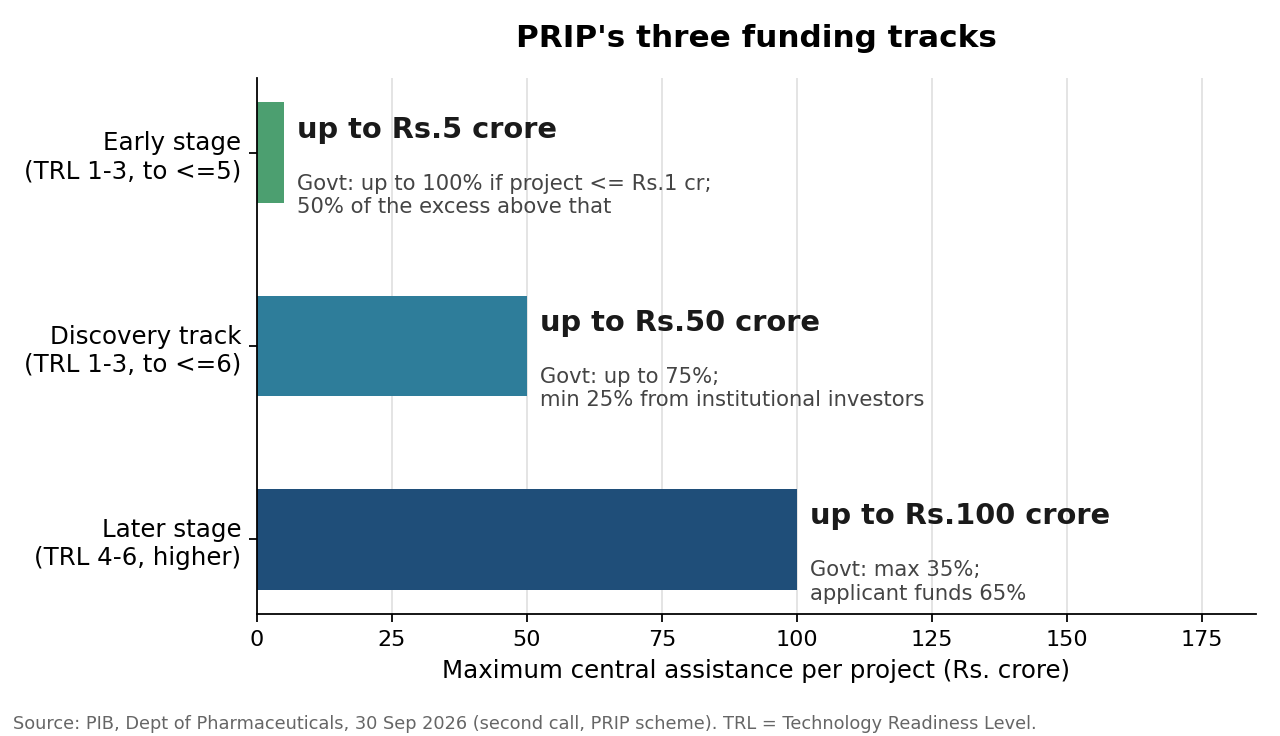
Read the ladder as a risk gradient. The smallest, earliest cheques are almost free money. As the cheques grow, the applicant's own exposure grows faster. Money is released in four milestone-linked instalments, the last of which - at least 15% - comes only as reimbursement after the work is done.
And then there is the clause that makes PRIP unusual among Indian schemes: benefit-share. A successful beneficiary doesn't just say thank you. It either pays the government a fixed or tiered percentage of the net sales of the PRIP-funded product, or - and this is the option I find genuinely striking - it issues the Government of India compulsorily convertible preference shares equal to the assistance disbursed, which convert into equity at first commercialisation. If the molecule becomes a medicine, the taxpayer becomes a shareholder. India has spent decades writing cheques it never sees again. Here, written into the guidelines of 1 October 2025, is a scheme that asks for a piece of the upside.
Does the money actually move?
The scheme's first call offers an early answer. On 30 September the department announced that 41 projects have been approved for around Rs.1,600 crore in assistance, which the government expects will pull in a further Rs.3,020 crore of private co-investment - roughly Rs.4,620 crore of total R&D spend. The portfolio mixes the familiar and the young: Biocon, Bharat Biotech, Sun Pharma, Wockhardt, Zydus, Mankind alongside startups like Pandorum Technologies, Cellogen Therapeutics, Aurigene Oncology and Bugworks Research. Nineteen of the 41 projects belong to startups and MSMEs. Twenty-seven are new-medicine programmes. Six fall under a strategic priority framework - neglected tropical diseases, rare diseases, antimicrobial resistance against India-priority pathogens, outbreak and pandemic threats, and vaccines - covering work on dengue, influenza, and next-generation TB vaccines.
Two honest caveats. These are the government's announced approvals, and the Rs.3,020 crore of private money is an expectation of co-funding drawn in, not an audited inflow. And approval is not outcome: most of these programmes, by the base rates of drug discovery, will fail somewhere between the bench and the pharmacy. That is not a scandal. It is the shape of the business.
The mirror across the Pacific
The world's most studied answer to this same valley of death is America's BARDA - the Biomedical Advanced Research and Development Authority, set up in 2006 to develop and procure vaccines, drugs and diagnostics for chemical, biological, radiological and nuclear threats, pandemic flu and emerging infections. BARDA's core instrument is the federal development contract: it pays companies, mostly on milestone-based contracts, to carry countermeasures through advanced development, and its portfolio has earned 116 FDA approvals, licensures or clearances, according to the programme's own tally. (Its DRIVe arm does experiment with both non-dilutive and dilutive funding, but the centre of gravity is the contract.)
The contrast with PRIP is the interesting part. BARDA is a buyer: the government specifies what it wants to exist - an anthrax antitoxin, a pandemic vaccine - contracts for its development, and often ends up procuring the product itself. PRIP is a co-investor: the applicant brings the project, a private investor must vouch with real money, and the government takes a capped share of the costs in exchange for a slice of the eventual sales or a convertible equity stake. One model socialises the risk of making things the market won't make for national security. The other tries to teach a market to exist at all. I wrote recently about the state as co-investor in the context of deep-sea exploration; the register here is different - less sovereign capability, more venture discipline.
What could go wrong
Plenty, and it is worth saying plainly. Nine in ten clinical candidates failing is the average - discovery-stage assets fail even more often, so most Discovery Track cheques will buy knowledge, not medicines. The 25% institutional co-funding filter could screen out exactly the scrappiest academic spin-offs the scheme says it wants, if investors simply refuse to look at preclinical Indian science. A government holding CCPS in startups is a government that will one day have to make exit decisions it has no experience making. And Rs.5,000 crore, while real money in Indian R&D terms, is - by my arithmetic at current exchange rates - less than the average estimated cost of bringing one new drug to market.
These are my readings of the design, not verdicts from the data - the Discovery Track is weeks old and the first call's projects are years from judgement.
The wager
Still, I keep coming back to the founder in Genome Valley. For twenty years, the honest advice to someone like her has been: license early, sell to a multinational, or move. PRIP is a bet that the advice can change - that if the state absorbs part of the valley of death, and insists that private capital walk in beside it, an Indian company might carry its own molecule all the way from a petri dish in Kochi or Hyderabad to a pharmacy shelf. The cheque is up to Rs.50 crore. The condition is that someone with their own money must believe first. That is not a subsidy. It is a dare.
Sources
PIB: PRIP Scheme opens new opportunities for startups, MSMEs and industry (28 Aug 2026)
Department of Pharmaceuticals: PRIP Scheme Guidelines (1 Oct 2025)
ASPR: Center for the Biomedical Advanced Research and Development Authority
BARDA: FDA approvals, licensures & clearances for BARDA-supported products
Responses
No responses yet - yours could be the first.
Get the notes
Occasional emails about what I'm building, what worked, and what broke.