
The Indian Canvas #152: Who Pays When the City Floods?
On 15 October 2026, the Regional Meteorological Centre in Chennai declared the onset of the northeast monsoon, five days earlier than its normal date, and put six districts on orange alert for up to 20 centimetres of rain, The Hindu reported the next day. The state's revenue minister told reporters that nearly 98 percent of monsoon preparedness works were complete, his department's own assessment, and the chief minister inspected desilting works at the Captain Cotton Canal and the Otteri Nullah. This October routine is familiar in Chennai: the drains are cleared, the pumps are checked, and then the season shows the city what its relationship with water actually costs. It is the right moment to ask a question every flooded Indian city answers in its own way: who pays?
The bill from 2005
The reference event for urban flooding in India remains the Mumbai flood of 26 July 2005. According to a Swiss Re assessment published in July 2025, the city received 944 millimetres of rain in a single day, nearly 40 percent of its annual rainfall, with peak intensity of 80 millimetres an hour falling on a drainage system designed for 25. Swiss Re describes a city whose surface was by then nearly 90 percent concretised, with the Mithi river, its natural overflow channel, severely encroached. It puts the event's death toll at more than 1,000; the city itself recorded at least 400 deaths, as Bloomberg's later account notes. The economic loss was estimated at Rs 13,500 crore, about 3 billion US dollars at the time. The insured loss, part of that total, was Rs 2,250 crore. By my arithmetic, about five of every six rupees lost in that flood had no insurer standing behind them.
That ratio is the quiet centre of this story. Swiss Re estimates that if the same event struck with 2025's exposure, the insured loss alone would be around Rs 20,000 crore, and it prices a nationwide insured flood loss of that size, across all events in a year, at a return period of roughly 50 years. Smaller but still severe insured losses arrive far more often on its as-if basis, which reprices historical events at 2025 exposure: an event above Rs 2,500 crore every two to three years, above Rs 5,000 crore every five. Over the past two decades in India, Swiss Re says, floods have accounted for about 67 percent of economic losses from natural catastrophes and 66 percent of natural-catastrophe fatalities. Chennai's own benchmark came in December 2015, when floods killed more than 400 people, as the Asian Development Bank's project record notes; Swiss Re prices the insured loss of a Chennai 2015 repeat at about Rs 10,500 crore in 2025 terms.
The ledger that never made the records
The official death counts capture only a fraction of what the rain does. A peer-reviewed study published in Nature on 12 November 2025, by Tom Bearpark, Ashwin Rode and Archana Patankar, matched high-resolution rainfall, tide and mortality records for Mumbai. It estimated that rainfall caused more than 8 percent of the city's monsoon-season deaths between 2006 and 2015, a burden an order of magnitude larger than official statistics document. Bloomberg's report on the study puts that at 2,718 deaths per monsoon season over the decade, roughly on par with cancer deaths in those months. The causes its account lists include drowning, electrocution and disease outbreaks, with conditions such as diarrhoea, tuberculosis and hypertension reported as worsening during severe flooding. More than 80 percent of the estimated mortality burden fell on slum residents. Children faced the largest increase in risk, women more than men, and in the study's historical record the risk rose sharply on days when heavy rain coincided with high tide.
I want to be careful about what this number is. It is a statistical estimate of excess deaths, built by comparing mortality on wet and dry days across a decade of records; it is not a list of names from flood reports, and it describes 2006 to 2015, not the present. That is also what makes it matter. Most of this burden never entered any disaster ledger at all, and it fell overwhelmingly on slum residents.
Why the water wins
The physics is not mysterious. The National Disaster Management Authority's own primer states that urbanisation raises flood peaks by 1.8 to 8 times and flood volumes by up to 6 times, because paved catchments move water in minutes rather than hours. The NDMA published national guidelines for managing urban flooding in 2010. The rainfall side is shifting too: a study in Nature Communications, cited in the Swiss Re assessment, found a threefold increase in widespread extreme rain events above 150 millimetres a day across central and western India between 1950 and 2015.
Mumbai's BRIMSTOWAD, the stormwater master plan, shows how hard the paying is. It was conceived after the 1985 floods and formally proposed in 1993, then left unfunded until the 2005 disaster revived it, according to the project's documented history. The revived project had absorbed Rs 2,007 crore by 2017, the Hindustan Times reported that year, and was still unfinished in 2019. In May 2025, a Maharashtra minister was still demanding a white paper on Mumbai's flood-control spending.
So who pays today? Start with what the 2005 ratio measures. By my arithmetic from Swiss Re's figures, five-sixths of that flood's loss had no insurer behind it. That aggregate says nothing about who ultimately paid it. What it shows is how little of the bill private insurance absorbed. Insurers take a second slice, with severe urban flood losses recurring every few years on the as-if basis above. The taxpayer pays after the fact: the Ministry of Home Affairs opened a recovery and reconstruction funding window within the national and state disaster response funds in August 2024. And capital money exists, but in Chennai it arrives as three different financing instruments: a 251-million-dollar ADB loan with 8.88 million dollars in attached grants for flood protection in the Kosasthalaiyar basin, where 1.9 million people are exposed, and, separately, Rs 200 crore of Greater Chennai Corporation bonds listed on the NSE in May 2025, reported as funding stormwater drainage. The loan is repayable debt against future public revenues; the grants are non-repayable, though attached to that specific project; the bond's interest is a standing claim on the corporation's revenues. These examples fund construction. None of them is a named, recurring charge for protection, of the kind the next city shows.
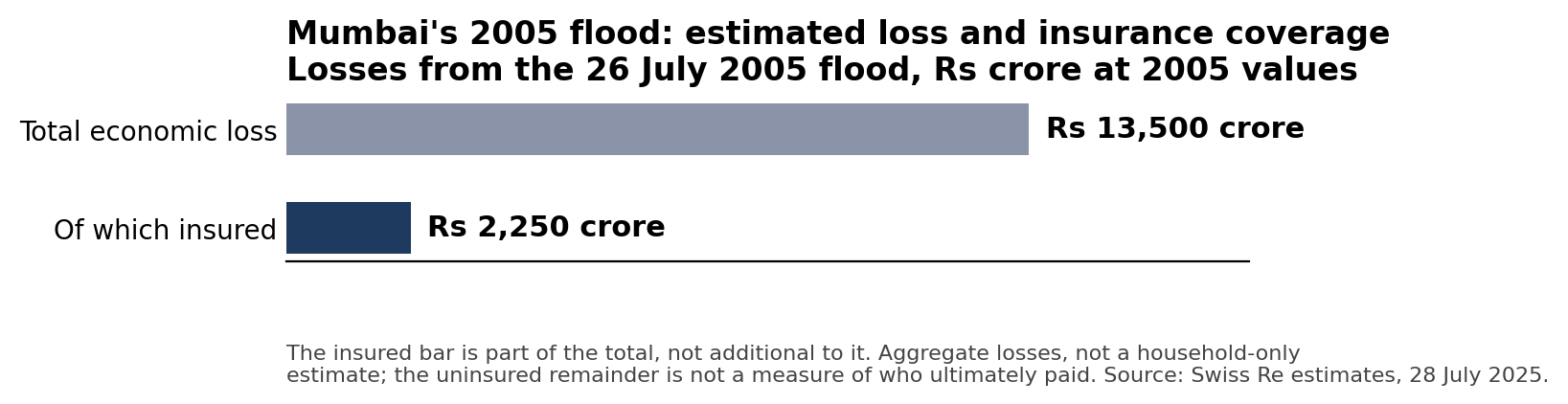
Data: Swiss Re estimates, 28 July 2025.
The city that sends itself a bill
Copenhagen structured the same problem differently. In 2011, the largest of four severe cloudbursts in six years caused damage totalling more than 6 billion Danish kroner. The city's answer, adopted in 2012 and documented by the European Environment Agency, was a Cloudburst Management Plan: about 300 surface projects planned over 20 to 30 years, alongside sewer expansion, built to an explicit standard. The plan's stated service standard is to limit average surface water above ground level to 10 centimetres for a rainfall event with a one percent annual probability, except in areas designated for flood control; it separately retains a ten-percent-annual-probability service level for sewer discharge to ground.
The design matters less than the invoice. In the plan's socio-economic assessment, measured in present value over a hundred years, inaction was priced at 16 billion kroner in damage. A traditional sewers-only build was costed at 20 billion kroner, a net social loss of 4 billion even after avoided damage. The combined plan, large pipes plus parks, squares and streets shaped to hold and move water, was costed at 13 billion, a net gain of 3 billion. Copenhagen chose the second, then named the payers in advance. Separately from that hundred-year arithmetic, the plan divides construction costs, estimated at 2015 prices, among named payers: the utility's water charges cover the cloudburst pipes and the hydraulic share of the surface works, homeowners pay for their own anti-flood valves, and the city pays for the urban improvements. On the plan's own planning estimate, a household using 110 cubic metres of water a year would pay about 890 kroner more annually. It also counted the expected benefits honestly: property values near the new green spaces were projected to rise by about 1.4 billion kroner.
This is a design, not a guarantee: a one-percent-annual-chance event can arrive next year, and the plan's results are still accumulating. What the design does is link a recurring revenue line to a written protection standard, and move money before the rain rather than after it. The first of the new generation of spaces, Tåsinge Plads, was finished in 2015: a square whose sunken landscape can delay and absorb the rain falling on 4,300 square metres around it, keeping that water out of the sewers on cloudburst days. The plan protects against today's rain as well as the heavier rain projected for later in the century.
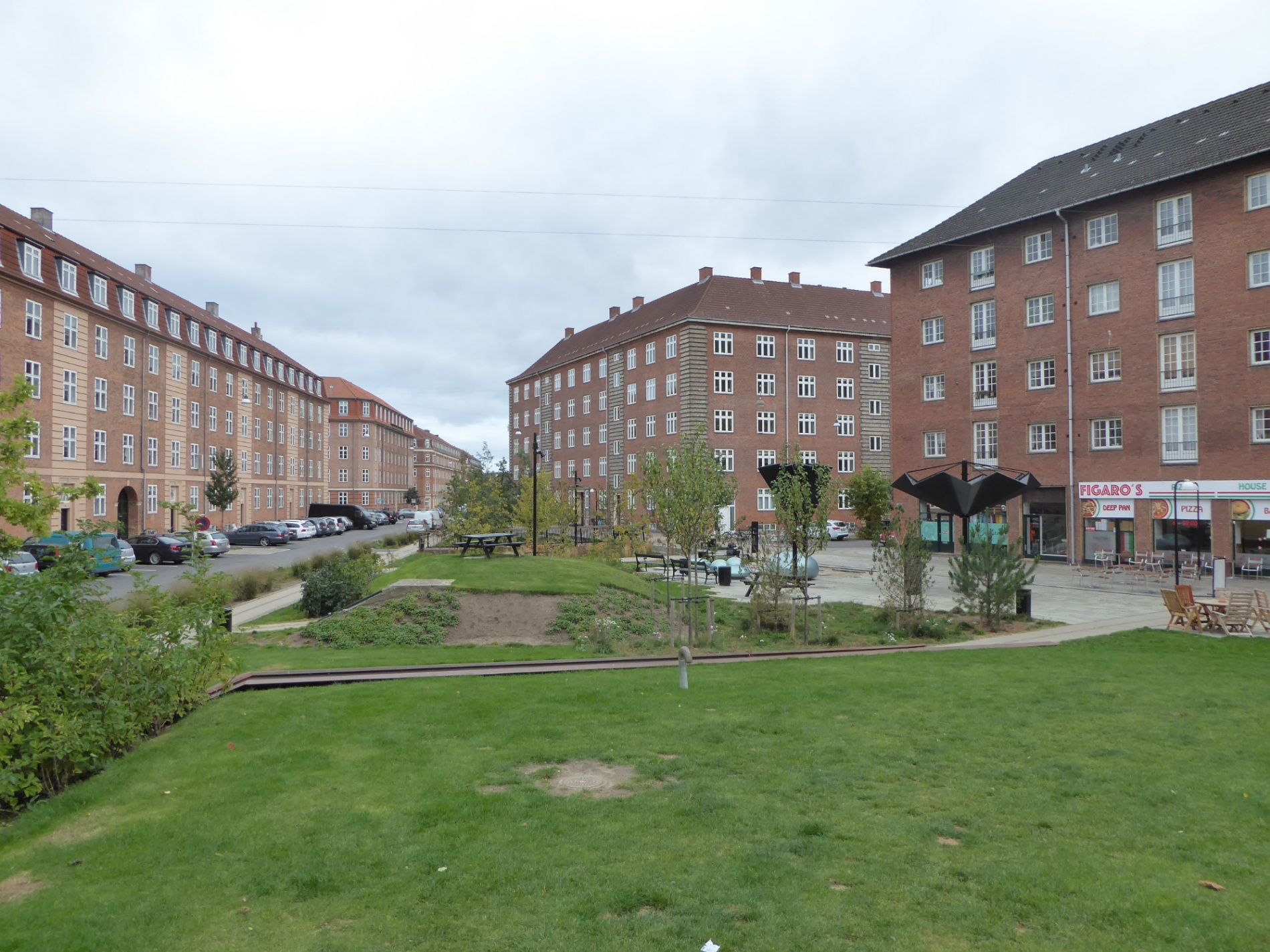
Tåsinge Plads, Copenhagen, photographed 6 October 2016. Photo: Leif Jørgensen, CC BY-SA 4.0, via Wikimedia Commons.
What transfers, and what does not
The transferable part is the principle, not the mechanism. The plan's design names a recurring payer, water charges, sized against damage the city expects to avoid, and writes down a measurable protection standard. Whether an Indian city may levy a stormwater charge, on whom, collected by which body and with what exemptions, are legal and administrative questions this article cannot settle. Nor is a charge a substitute for borrowing: Chennai's bonds raise lump sums for construction, a charge would raise a stream, and a large programme can combine both. The differences matter as much as the model. A flat charge could be harder for low-income households in Chennai without exemptions, and the Nature study found Mumbai's rainfall mortality concentrated among slum residents, the households least able to absorb either floods or fees. Scale cuts the other way too: Copenhagen's 300 planned projects serve one municipality, while a single Chennai river basin holds 1.9 million exposed people. What the early northeast monsoon puts in front of the city this month is the same question either way. Floods are paid for twice over, once in prevention and once in recovery, and Copenhagen's lesson is only this: both deserve a named payer, and only one of the two has to be a surprise.
Sources
The Hindu, 16 October 2026: Northeast monsoon arrives early in Tamil Nadu
Swiss Re, 28 July 2025: Billion-dollar Rain: Why India can't afford to ignore urban flood risk
Nature, 12 November 2025: Mortality impacts of rainfall and sea-level rise in a developing megacity
Bloomberg, 12 November 2025: Extreme rains kill 2,700 in Mumbai every year and cost $1.2 billion, study says
NDMA: Urban Floods primer and Management of Urban Flooding guidelines, 2010
ADB: Integrated Urban Flood Management for the Chennai-Kosasthalaiyar Basin Project
Hindu BusinessLine, 26 May 2025: Chennai Corporation lists municipal bonds worth Rs 200 crore on NSE
Hindustan Times, 31 August 2017 and 3 July 2019: BRIMSTOWAD spending and unfinished status; project history; Free Press Journal, 28 May 2025: white-paper demand
Ministry of Home Affairs, 20 August 2024: Recovery and Reconstruction Funding Window under SDRF/NDRF
European Environment Agency, Climate-ADAPT: The economics of Copenhagen's Cloudburst Management Plan
Klimakvarter Østerbro: Tåsinge Plads project page
Cover photo: a flooded Chennai street during the December 2015 floods. Photo: Destination8infinity, CC BY-SA 4.0, via Wikimedia Commons; displayed cropped by the site template.
Responses
No responses yet - yours could be the first.
Get the notes
Occasional emails about what I'm building, what worked, and what broke.