
The Indian Canvas #153: Who Pays to Take the Garbage Away?
Delhi's municipal corporation has drafted a monthly charge for household garbage. The draft bye-laws, reported by the Hindustan Times on 25 October and still to go before the MCD House for approval, set residential charges between Rs 40 and Rs 300 a month depending on property size and colony category. Restaurants with more than fifty seats would pay Rs 5,000 a month, hostels Rs 3,000, and the schedule would climb 5 percent every January. In Mumbai, the BMC told the Times of India in October that it is weighing a monthly processing charge of its own - but only on housing societies large enough to count as bulk waste generators that hand their wet waste back to the city. Neither is an invoice yet. Both are attempts to answer the question behind these proposals: who pays to take the garbage away?
Delhi's earlier rollback
The duty to pay is not new. National waste rules have told every waste generator since 2016 to "pay such user fee for solid waste management, as specified in the bye-laws of the local bodies" - the 2026 rules repeat the same words. Delhi's own bye-laws have carried a garbage user charge since 2018. The MCD's attempt to actually levy the charge in April 2025 was rolled back by June, after widespread opposition from residents, and an official told HT that implementation of the older charges "proved difficult". Behind the local standoff sits a national system. Urban India generated 1,62,468 tonnes of municipal solid waste a day, and states reported processing 1,30,484 tonnes of it - about 80 percent, against 16 percent in 2014 - according to figures the government released on 11 December 2025. What does a tonne of it cost? Mumbai's officials put the figure at nearly Rs 3,500 per tonne: about Rs 2,500 for collection and transport, Rs 893 for processing. By that arithmetic - ours, from the same officials' numbers - the truck takes about 71 percent of the money and the plant gets a quarter.
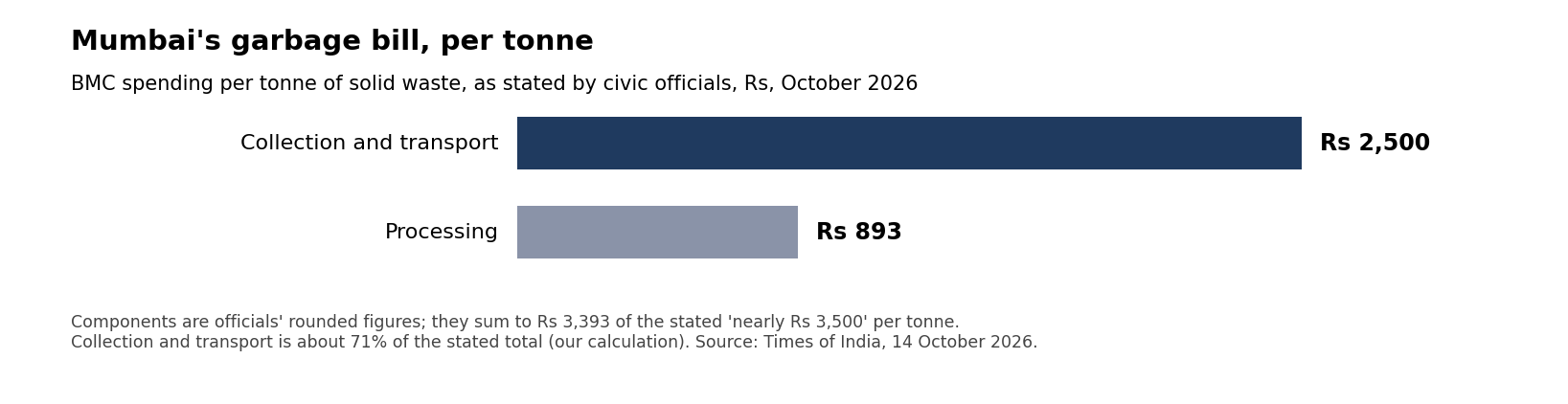
Data: Times of India, 14 October 2026.
The workforce off the ledger
Between the doorstep and the dumpsite works a force paid from a different pocket entirely: informal waste pickers, whose income comes from reselling what they recover rather than from municipal wages. Pune shows what it looks like when the bill and the wage are the same rupee. Under an agreement signed on 24 August 2008, SWaCH - a cooperative of self-employed waste pickers - began running door-to-door collection for the Pune Municipal Corporation, funded directly by a user fee the collecting picker keeps, on top of earnings from selling recyclables. In a 2015 description of the model, SWaCH reported covering 4 lakh households across 122 of Pune's 144 wards. The fee there is not an add-on; it is the wage. That is the part of the bill debate most easily missed: how a municipality designs its charge decides whether the picker who already sorts the city's waste shares in it.

A man collects discarded plastic bags from the Yamuna in Delhi to sell for recycling, photographed in October 2007. Photo: Koshy Koshy, CC BY 2.0, via Wikimedia Commons.
Old duty, new teeth
If the duty to pay is a decade old, what did this year's rules actually change? The Solid Waste Management Rules, 2026 - notified on 27 January and in force since 1 April, superseding the 2016 rules - add the machinery of collection. Segregation is now four streams - wet, dry, sanitary and special care, up from three. The rules turn price against mixing: the sanitary landfill fee for unsegregated or recoverable waste "shall be higher than the collection, transportation and waste processing costs" - the rules' own comparison, priced against what handling that load properly would have cost. Large generators - premises of 20,000 square metres or more, or 40,000 litres of daily water use, or 100 kilograms of daily waste - must process their wet waste on site or buy Extended Bulk Waste Generator Responsibility certificates from the local body for the full quantity they do not process, on a centralised national portal. Delhi's tiered fee and Mumbai's bulk-generator charge are cities beginning to write the bye-laws that make the decade-old duty collectible.
The country that priced the bag
South Korea built its answer over a decade, in layers, starting with price. In 1995 it introduced the volume-based waste fee: general waste leaves the house only in official prepaid bags, while recyclables are collected free. In the first four years, national household waste generation per person fell from 1.33 kilograms a day in 1994 to 0.96 in 1998, and the recycling rate rose from 15.3 percent to 34.9 percent, according to government statistics compiled for a UN platform. (The fall is about 28 percent, by the same statistics.) The bag fee was the first layer, not the only one: food-waste separation became mandatory in 1997, and in 2005 Korea banned food waste from landfill altogether, a timeline the BBC laid out in September. Radio-tagged bins that weigh food waste - about 130 won a kilo in Seoul, the Guardian reported in December 2025 - served more than 8.6 million households nationwide in 2025, per government figures cited by the BBC. The long-run result: South Korea recycled 2.6 percent of its food waste in 1996 and nearly 97 percent in 2023 - the Guardian, citing the environment ministry, put 2023 at 96.8 percent of 4.81 million tonnes. No single layer did that alone; the price came first, and the mandates and the metering built on it.
The test
Notice what Delhi's draft is and is not. Korea's charge is a price per bag; Delhi's is a flat monthly amount by colony category - it funds the service, but it does not charge by the bag or the kilo: two homes of the same size in the same colony category pay the same monthly amount whether or not they sort, penalties aside. That is a design choice, and it can still change in the House. Three things will decide what India's cities actually buy with their new bye-laws. First, collection: whether the fee survives contact with the same politics that killed the April 2025 attempt within two months - the A-to-H tiering, charging Vasant Vihar more than the unauthorised colonies, is the corporation's answer. Second, destination: whether the money reaches the Rs 893-a-tonne processing end of the system, or funds more trucks at Rs 2,500 a tonne. Third, the picker: whether the charge flows through cooperatives of the SWaCH kind, where the fee is the collector's wage, or past the people who already sort the city's waste for what they can sell. The duty to pay has been on the books for ten years. What Delhi drafts this month, and what the House approves, will determine how the proposed charges are collected.
Sources
Hindustan Times, 25 October 2026: MCD solid waste management draft bye-laws propose up to Rs 300 monthly waste fee - residential and commercial fee schedule, colony-category tiers, 5% annual escalation, 2018 bye-laws baseline, April 2025 levy rolled back June 2025, bulk-generator obligations, draft pending before MCD House.
Times of India, 14 October 2026: BMC mulls flat-wise monthly processing charge on residential bulk waste generators - BMC cost of nearly Rs 3,500/tonne (Rs 2,500 collection and transport, Rs 893 processing); 7,000 tonnes/day; bulk-generator thresholds; proposal not finalised.
Press Information Bureau, 11 December 2025: Swachh Bharat Mission - Urban progress - states reported 1,62,468 TPD generated, 1,30,484 TPD processed (80.31%) vs 16% in 2014; 7,783 processing facilities; legacy dumpsite remediation.
Ministry of Environment, Forest and Climate Change: Solid Waste Management Rules, 2026 (notified 27 January 2026, in force 1 April 2026) and Solid Waste Management Rules, 2016 (rule 4(3), the pre-existing user-fee duty) - four-stream segregation, landfill penalty pricing, EBGWR certificates, centralised portal.
SWaCH Pune: history and 2015 model note - 2008 MoU with PMC; user-fee-funded door-to-door collection by waste-picker cooperative; 4 lakh households, 122 of 144 wards as of the 2015 note.
Urban SDG Knowledge Platform: Volume Based Waste Fee System - Korea household waste per person 1.33 kg/day (1994) to 0.96 (1998); recycling 15.3% to 34.9% (1998).
BBC, 17 September 2026: New York has a food waste problem. South Korea has already solved it - policy timeline (1995 bag fee, 1997 mandatory separation, 2005 landfill ban); food waste recycling 2.6% (1996) to nearly 97% (2023); 151,934 smart bins serving 8.61 million households per 2025 government figures.
The Guardian, 18 December 2025: The smart bins measuring food waste in South Korea - 96.8% of 4.81 Mt food waste recycled in 2023; about 130 won/kg in Seoul.
Cover photo: waste pickers on Delhi's Ghazipur landfill, photographed in 2013. Photo: FacetsOfNonStickPans, CC BY-SA 4.0, via Wikimedia Commons; displayed cropped by the site template.
Responses
No responses yet - yours could be the first.
Get the notes
Occasional emails about what I'm building, what worked, and what broke.