
The Indian Canvas #154: Who Pays When the Paycheque Stops?
On 11 August 2026, in a written reply to the Lok Sabha, the Ministry of Rural Development restated the centre's floor for India's poorest elderly: Rs 200 a month. That is the central assistance under the Indira Gandhi National Old Age Pension Scheme, and it goes to a person aged 60 to 79 from a below-poverty-line household; at 80, it rises to Rs 500. States add their own top-ups, which the same reply says range from Rs 50 to Rs 3,800 a month, and about 5.7 crore elderly people draw a pension under the National Social Assistance Programme and similar state old-age pension schemes. One more line in that August answer carries the weight: "no proposal to revise the rate of assistance under NSAP is under consideration of the Government." Rs 200 a month is Rs 2,400 a year - our arithmetic. The question that floor cannot answer is the one every Indian worker eventually faces: who pays when the paycheque stops?
Three Indias grow old
The answer differs sharply with employment history and scheme eligibility. The first India is the government's own. In the Reserve Bank's description, the Old Pension Scheme paid a pension fixed at half of the last drawn salary, with nothing deducted from pay - an unfunded, pay-as-you-go promise. New central government civilian recruits who joined on or after 1 January 2004 were moved instead to the National Pension System, a market-linked defined-contribution account. Then, on 1 April 2025, a third option took effect: the Unified Pension Scheme, operationalised by the pension regulator on 20 March 2025 and reported by The Hindu. Under the regulator's rules, the assured payout is 50 percent of the average basic pay of the final twelve months, payable after 25 years of qualifying service and proportionately less from a minimum of 10, with a minimum guaranteed payout of Rs 10,000 a month after 10 years. The regulator itself marks the assurance as subject to conditions: the full payout assumes a benchmark corpus - what the account would hold under the default investment pattern with regular and timely contributions and no partial withdrawals - and an optional final withdrawal of up to 60 percent of the corpus, whichever of the individual or benchmark figure is lower, reduces the assured payout proportionately, though the shortfall can be replenished to restore it. Contributions are 10 percent of basic pay and dearness allowance from the employee, a matching 10 percent from the government, and an estimated 8.5 percent more into a pool corpus. Separately, a lump-sum payment of one-tenth of the last drawn basic pay plus dearness allowance for every completed six months of qualifying service is paid at retirement; the rules attach the payout reduction to the withdrawal, not to this service-based sum. About 23 lakh central employees were estimated in 2025 to be eligible to choose between it and the NPS.
The second India is formal-sector private employment. The Employees' Provident Fund Organisation counts nearly 8 crore active members and more than 78 lakh pensioners, per the Labour Ministry in June 2025. Its pension arm carries a minimum of Rs 1,000 a month, a floor the government committed to in 2014.
The third India is the informal workforce - farmers, vendors, construction hands and gig riders. Since August 2021 the state has been counting them: the e-Shram registry of unorganised workers crossed 30.68 crore registrations by 3 March 2025, the Press Information Bureau reported, with women 53.68 percent of registrations. Registration is not pension enrolment, though. For these workers the flagship offer is the Atal Pension Yojana: join between 18 and 40 (income-tax payers have been barred since October 2022), contribute for at least 20 years, and at 60 the government guarantees a pension of Rs 1,000 to Rs 5,000 a month depending on the slab you bought. As of April 2025 it had 7.65 crore subscribers and a corpus of Rs 45,974.67 crore, per a PIB backgrounder from May 2025; women were about 48 percent of subscribers. And for those who never managed to save, the August answer leaves the central assistance for below-poverty-line Indians aged 60 to 79 at Rs 200 a month.
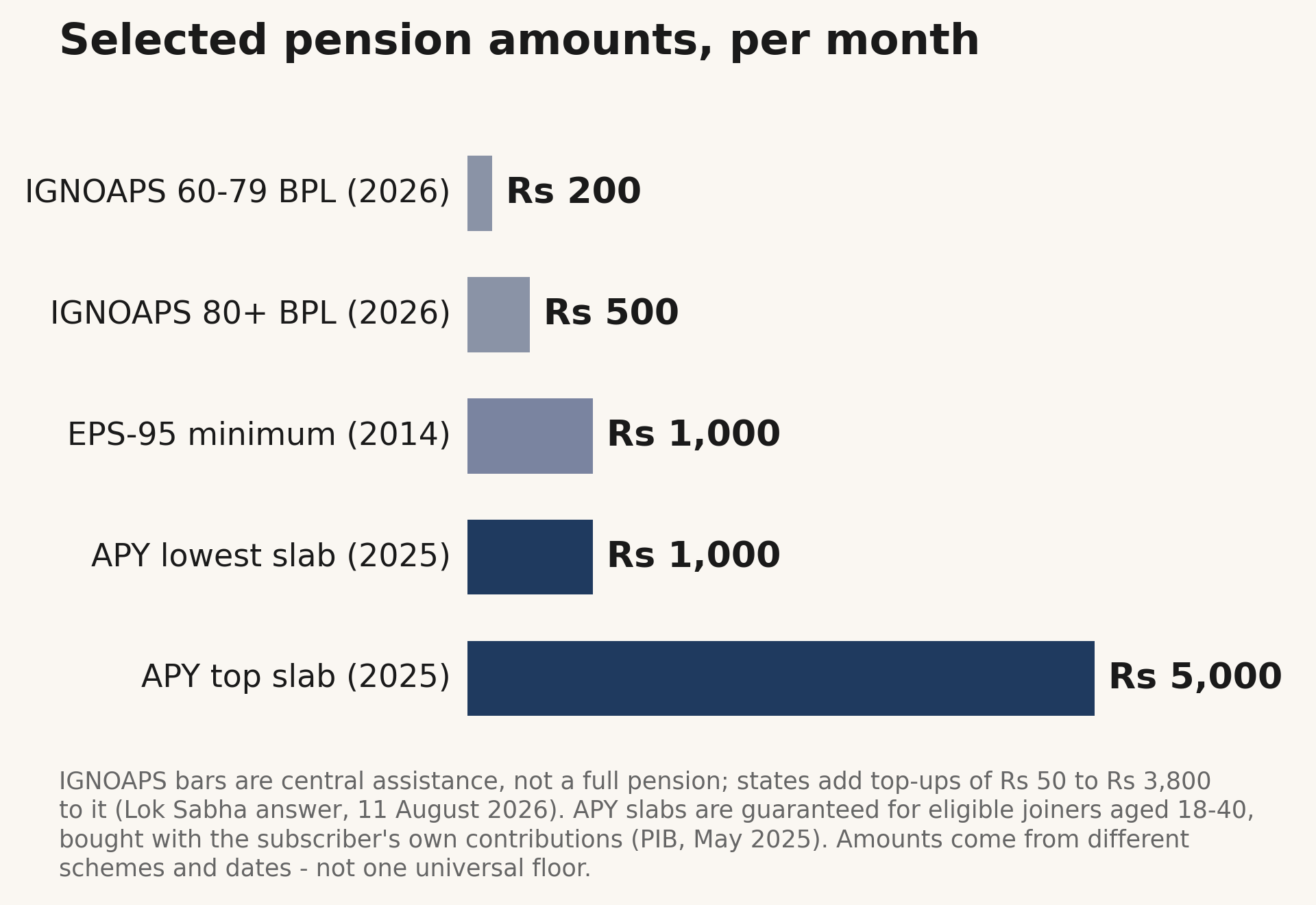
Data: Lok Sabha answer of 11 August 2026; PMO (2014); PIB (May 2025). IGNOAPS bars are central assistance, not a full pension; amounts come from different schemes and dates - not one universal floor.
The U-turn and the compromise
Five states - Rajasthan, Chhattisgarh, Jharkhand, Punjab and Himachal Pradesh - announced they would take their employees back to the old pay-as-you-go pension, and in September 2023 a study in the Reserve Bank's own Bulletin priced that nostalgia: the cumulative fiscal burden of reverting to the old scheme could be as high as 4.5 times that of the NPS, its authors modelled, with the additional burden reaching 0.9 percent of GDP annually by 2060. "States' reverting to OPS would be a major step backwards," they warned, undermining past fiscal reforms. The Unified Pension Scheme is the centre's reply to that revolt: an assured payout, but one the employee and employer fund together, rather than a promise billed entirely to taxpayers not yet named.
The 30-crore ledger
The harder problem is the third India: workers without regular pension contributions. The machinery to reach them now exists. The e-Shram registry gives 30.68 crore workers a Universal Account Number; separately, the pension regulator's combined NPS-and-APY corpus crossed Rs 16 lakh crore with over 9 crore subscribers in October 2025, per PFRDA, which has also launched a platform-workers model for gig staff and a consultation on overhauling payouts. These figures measure different things and cannot be added to estimate unique pension coverage, and a registry entry is not a pension account. APY enrolment is voluntary, and the pension it guarantees tops out at Rs 5,000 a month, reachable only after the subscriber's own contributions for 20 to 42 years depending on the age of joining.
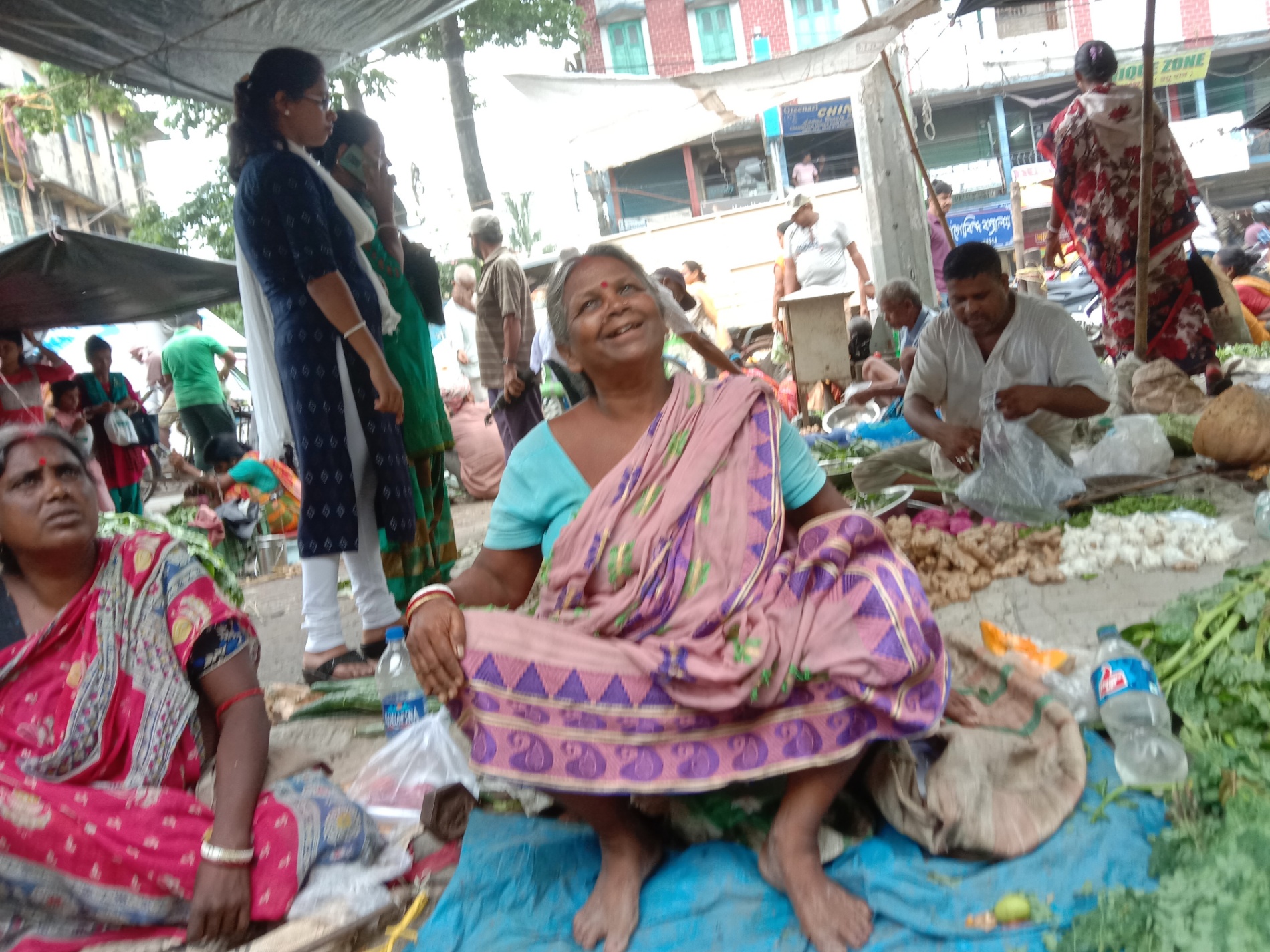
An elderly woman selling vegetables at Chanditala bazaar, West Bengal, photographed in June 2022. Photo: Billjones94, CC BY-SA 4.0, via Wikimedia Commons.
The country that changed the default
Britain faced its own version of the problem: private-sector workers, especially the young and low-paid, simply did not save. Its answer, under the Pensions Act 2008 and phased in from October 2012, was automatic enrolment: every eligible employee is put into a workplace pension by default, contributions deducted unless they actively opt out, with a statutory minimum that reached 8 percent of qualifying earnings (at least 3 percent from the employer) by April 2019. Eligible does not mean everyone - the self-employed and workers earning below the threshold sit outside the mandate. The results, per the Department for Work and Pensions: participation among eligible employees had sagged to a low of 55 percent - 10.7 million people - in 2012; by 2022 it was 88 percent, 20.4 million. The private sector drove the rise, up 44 percentage points to 86 percent, and workers aged 22 to 29 went from 24 percent participation to 84. The DWP credits automatic enrolment with the rise. India has built the rails for a similar nudge - Aadhaar, e-Shram's account numbers, auto-debit - but APY enrolment remains voluntary.
The clock
The question is not abstract for long. The government estimates 11.5 percent of Indians are already 60 or older in 2026. The UNFPA's India Ageing Report 2023, working from a 2022 base, projects that share will reach over 20 percent by 2050, and that the elderly will outnumber children aged 0 to 15 by 2046; the 80-plus cohort alone is expected to grow about 279 percent between 2022 and 2050. The same report found that more than 40 percent of India's elderly are in the poorest wealth quintile, and 18.7 percent have no income of their own. Who pays when the paycheque stops - the worker, the employer, the taxpayer, or a fund built decades earlier - is a question India is still answering scheme by scheme. In the August 2026 answer, the central assistance for eligible below-poverty-line Indians aged 60 to 79 was Rs 200 a month, before state top-ups.
Sources
Lok Sabha Unstarred Question No. 3797, answered 11 August 2026: Pensions for IGNOAPS - Rs 200/month (60-79, BPL) and Rs 500 (80+, BPL) central assistance; state top-ups Rs 50-3,800; 5.7 crore beneficiaries under NSAP and similar state schemes; no revision under consideration as of that answer; 11.5% of population 60+ in 2026.
PFRDA: Unified Pension Scheme - assured payout of 50% of last-12-month average basic pay at 25 years' qualifying service, proportionate from a minimum of 10 years, marked "subject to conditions"; minimum guaranteed payout Rs 10,000/month; employee 10% contribution, matching government 10%, estimated 8.5% to the pool corpus; benchmark corpus defined on regular and timely contributions with the default investment pattern and no partial withdrawals; final withdrawal up to 60% of individual or benchmark corpus (whichever is lower) reduces the assured payout proportionately, with an option to replenish the shortfall; separate lump-sum payment of 1/10 of last drawn basic pay plus DA per completed six months of qualifying service.
The Hindu, 20 March 2025: PFRDA notifies assured pension scheme for government employees - UPS in force 1 April 2025; 23 lakh central employees estimated eligible; NPS default for new central civilian recruits since 1 January 2004.
RBI Bulletin, 18 September 2023: Fiscal Costs of Reverting to the Old Pension System by the Indian States - An Assessment - cumulative fiscal burden of OPS reversion could be as high as 4.5 times that of NPS; additional burden reaching 0.9% of GDP annually by 2060; five states had announced reversion; OPS described as an unfunded pay-as-you-go pension fixed at 50% of last drawn salary with no deduction from salary.
PFRDA, 9 October 2025: NPS and APY cross Rs 16 lakh crore in AUM and 9 crore subscribers - including the platform-workers model and overhaul consultation.
PIB backgrounder, May 2025: Atal Pension Yojana - 7.65 crore subscribers and Rs 45,974.67 crore corpus as of April 2025; guaranteed slabs Rs 1,000-5,000 for joiners aged 18-40; income-tax payers excluded since 1 October 2022; minimum 20 years of contributions; women about 48%.
Labour Ministry, June 2025: EPFO bank empanelment release - nearly 8 crore active members; 78 lakh pensioners.
PMO, 2014: Minimum pension of Rs 1,000 per month under EPS-95.
PIB, March 2025: Over 30.68 crore unorganised workers registered on e-Shram - as on 3 March 2025; women 53.68%.
UNFPA India, 27 September 2023: India ageing, elderly to make up 20% of population by 2050 - from a 2022 base; elderly outnumbering children aged 0-15 by 2046; 80+ growth of about 279% (2022-2050); over 40% of the elderly in poorest quintile; 18.7% without income.
UK Department for Work and Pensions, 22 November 2023: Workplace pension participation and savings trends: 2009 to 2022 - participation among eligible employees from 55% (10.7M) in 2012 to 88% (20.4M) in 2022; private sector to 86%; ages 22-29 from 24% to 84%; minimum 8% of qualifying earnings (3% employer) from April 2019.
Cover photo: an elderly man in a turban and shawl on a street in rural India, photographed in December 2025. Photo: The open draft, CC BY-SA 4.0, via Wikimedia Commons; displayed cropped by the site template.
Responses
No responses yet - yours could be the first.
Get the notes
Occasional emails about what I'm building, what worked, and what broke.