
The Indian Canvas #74: A pollen-sensor start-up moves into factories, and Rajasthan's stone dust is the test
A Utah company that built sensors to count pollen is now selling the same idea to factories that need to know what dust their workers breathe. Rajasthan is the place in India where that question has a body count. My view is that the gap there is not another sensor. It is a reading someone can trust, and a buyer who has a reason to pay for it.
A pollen company goes looking for factory dust
Pollen Sense, based in Provo, Utah, announced on 14 October that it had finished a $2.4 million pre-seed round, raised in stages over several years. An allergy physician and angel investor, Dr Praveen Buddiga, led it. The company says it has sold more than 350 sensors across two device generations, with more than 160 of its current APS400 model deployed in North America, Europe, Southeast Asia and South America. Its sensors photograph individual airborne particles and an AI model names them, which is different from the usual approach of estimating a total dust level. All of that is the company's own account.
What is new is the target. Pollen Sense now wants to sell a product called Airevo for workplace exposure monitoring. It says more than 150 environmental health and safety professionals are on a waitlist, and that a new dust-monitoring algorithm is part of its next phase of development. So the sensor has real sales behind it, but the factory product is only now being rolled out, by the company's own description. A waitlist is interest, not revenue. I also searched four pages of its site for the word silica and did not find it, so I would not assume the system can tell silica dust from any other dust.
Rajasthan counts the sick, not the dust
The state's own silicosis portal shows 31,619 certified cases across its 33 districts as of 7 October 2026, every one of them marked as paid. Eight districts hold 24,542 of them, about 78 percent. Jodhpur alone has 7,532.
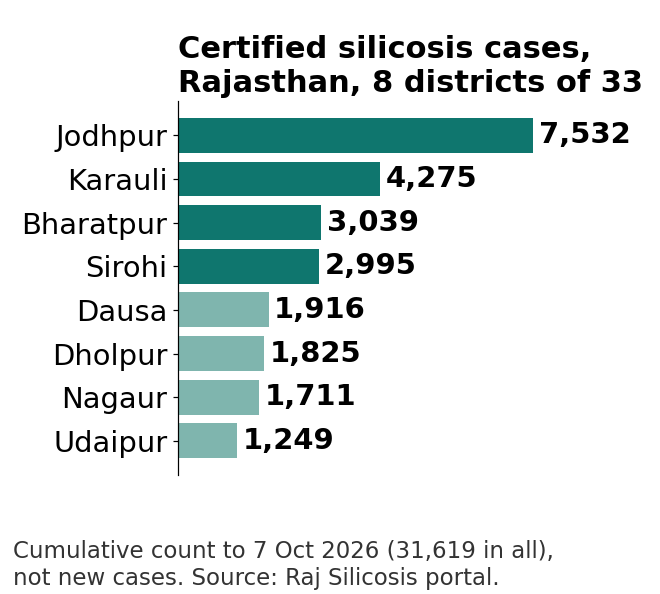
The chart is a running total built up over years, so it says where the disease is concentrated, not whether it is getting better or worse. The New Indian Express explainer from September gives other numbers that I could not reconcile with the portal: about 122,000 people screened, 7,082 confirmed, and more than 12,000 applications waiting, with medical boards in 11 districts not working for lack of radiologists. A state official quoted there says the average age of a victim is about 34, and that certified patients often die within six to seven years.
The money flows after the damage. A certified patient gets a one-time Rs 3 lakh in rehabilitation assistance and a monthly pension, according to the same explainer. The assistance I read about is tied to certification, not to measurements of the air at the unit. The explainer says the factories department covers around 11,000 establishments but has inspectors in only 19 of the state's 41 districts, and that some units can list only five to ten workers on paper and fall outside the larger laws. It also reports that dust-control methods such as wet drilling and wet cutting are mostly confined to big units. In August 2024 the Supreme Court directed the National Green Tribunal to oversee silicosis-prone industries across India and told the National Human Rights Commission to oversee compensation, according to the judgment.
Indian dust sensors already exist
This is not an empty field. Respirer Living Sciences sells an ambient particulate monitor with real-time data. SensurAir, which says it was incorporated in 2021 and incubated at IIT Madras, sells low-cost air quality monitors and says they cost a tenth of conventional methods. Aimtech Systems sells Dustroid, a particulate monitor that can switch on dust suppression such as mist cannons when a threshold is crossed. I could not find any of them selling silica-specific readings or working inside Rajasthan stone units, but I did not see their customer lists either, so that is a limit of what I found.
On the silica side, Trolex, a UK maker, says its AIR XS is the first and only product in the world that detects and distinguishes respirable crystalline silica in real time. That is a company claim. The page lists no price.
A cheap reading can be badly wrong
The strongest warning I found is a 2025 University of Adelaide pilot in South Australian quarries. It tested three real-time personal dust monitors against the standard filter-and-weigh method. One of them, a Trolex XD1+, which is not the silica monitor above, read 80 to 89 percent too low in the field. Another over-read by 51 percent for one job and under-read by up to 48 percent for others. After the authors fitted correction factors to each site, the estimates matched the reference well, but they conclude that site-specific calibration is essential and that the dataset is small.
For a start-up, that matters more than the hardware. If an optical sensor is wrong by half in one yard and right in the next, a sensor alone cannot support a compliance claim or a payout decision.
The version I would test
I would not sell a box. I would sell a reading that has been checked against a lab. A start-up would put cheap optical sensors at the cutting and grinding stations of one stone cluster, take periodic filter samples to a lab to find out how far each sensor is off, and report a corrected number each week. The sensors can also be wired to the wet-cutting water supply, so the reading shows whether the water is actually on.
India changes the design in three ways, and all of this is my own judgment. Power and heat are unreliable in a stone yard, so the devices need battery or solar backup and a design that survives dust. Owners will not welcome an alarm that stops work, so the product has to prove something the owner wants proved, such as compliance during an inspection. And the unit of sale is a cluster, not a single five-worker shed.
It could fail in several ways. Calibration costs may eat the margin. Small units may disconnect any sensor that gets them in trouble. Government departments may buy the cheapest particulate monitors through a tender and call the job done. And the units with the most workers at risk may be the ones that are hardest to bill.
The first customer is probably not the five-worker unit
Pollen Sense shows that a particle-identification sensor can be sold, and Adelaide shows the weakness: raw readings need local checking. Neither shows that anyone in India will pay. My guess is that the first payer is an organised stone processor or mine lessee that has to show compliance after the Supreme Court's 2024 ruling, or a state department that has few inspectors and needs evidence. That is a guess, and I found no one who has bought it.
The cheap way to find out is a two-month trial in one cluster, such as one of the top districts above. Run ten sensors next to lab samples, see how often the corrected number holds, and ask five unit owners and the district inspector whether they would pay for it in writing. If none will, the sensor is not the missing piece, and neither is this idea.
Sources and photo credits
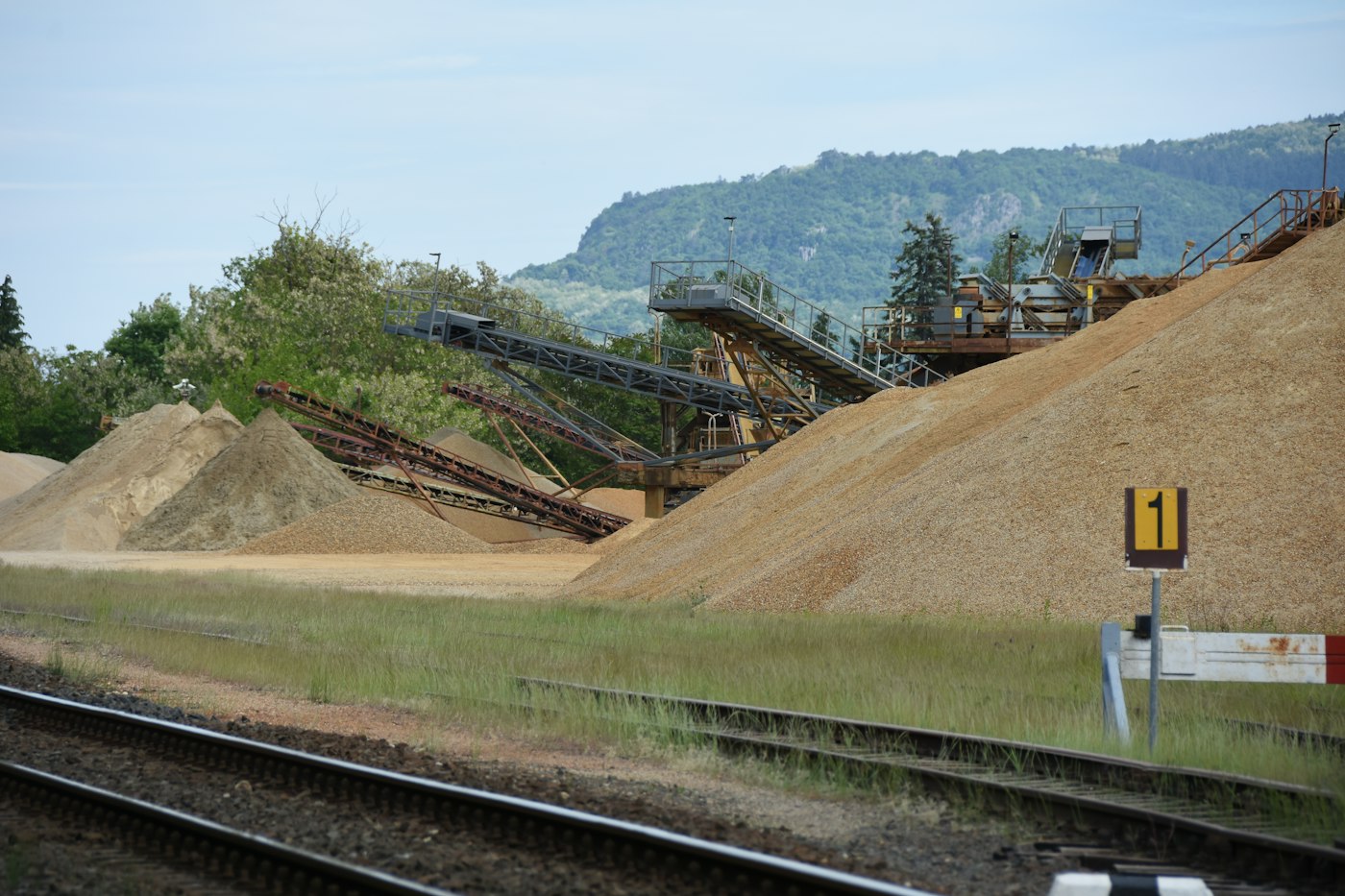
Pollen Sense: its funding announcement, 14 October 2026 and its site. Rajasthan: Silicosis portal summary report, 7 October 2026 and New Indian Express, 14 September 2026. Court: PRASAR v Union of India, Supreme Court, 6 August 2024. Accuracy: Tefera and others, University of Adelaide, 2025. Indian and global suppliers: Respirer, SensurAir, Aimtech Systems and Trolex. Photos, both shown only as illustrations of quarries and not as Indian sites: cover, aerial view of a sand and gravel quarry by Flyxpress Warszawa; top of article, sand piles and machinery at a quarry by Csaba Gyulavári. Both on Unsplash, and neither photo page states a location. Chart: my own, from the portal figures above.
Responses
No responses yet - yours could be the first.
Get the notes
Occasional emails about what I'm building, what worked, and what broke.