
The Indian Canvas #34: India has 97.8 crore health IDs. Who is reading the hospital chart?
India has 97.8 crore health accounts, but the notes a nurse writes about an admitted patient sit inside each hospital's own system. US startup Healthleap raised US$38 million to read every inpatient's chart each night and flag patients who may have an unrecorded condition. India is not empty: Indian firms read charts for discharge summaries and vital-sign trends, and one sells AI nutrition plans. I did not find an Indian product that screens inpatients from their notes. That is a hypothesis, and the US payment model behind Healthleap may not carry over.
Stock photo of someone writing in a notebook. It is not a clinician or a hospital record.
A health ID base is not a chart base
The Hindustan Times reported from the health ministry's Arogya Manthan on 26 September that at least 97.8 crore ABHA health accounts exist, with over 121 crore health records linked and more than 5.6 lakh facilities registered. The same report says the National Health Authority and IISc built a Secure Data Environment, which the ministry describes as a way for approved entities to work on de-identified data for research and "responsible AI innovation".
Healthcare Business Today reports that the linked records are mostly vaccination certificates, screening entries and scheme claims loaded in bulk by government programmes, not notes written at a clinic. It also reports that five states hold roughly 45 crore of the first 100 crore records, and that the Scan and Share service had issued 23.21 crore tokens by 18 June 2026 against more than 93 crore accounts. I could not check those figures against the ministry, so treat them as that outlet's reporting.
My reading: the 121 crore figure is the wrong number for anyone building clinical AI. The useful text is what doctors and nurses write about one admitted patient over several days, and that lives in the hospital's own system.
What Healthleap does
TechCrunch reports $38 million in seed and Series A funding: an $8 million seed co-led by Sequoia Capital and First Round Capital, and a $30 million Series A led by Hummingbird Ventures. Founded in South Africa in 2022, it plugs into a hospital's electronic health record, uses language models to pull mentions such as weight loss or trouble swallowing from clinicians' notes, adds labs and vitals, and writes a risk score into the care team's workflow each morning. It says it does not diagnose and only highlights patients for review. I take no view here on whether the scores are clinically right.
All of the following is company-reported. The CEO told TechCrunch the platform is in more than 50 hospitals, up from three a year earlier, while the company's own funding announcement says more than 20, so the count is not settled. Contracts run three years and are priced by licensed bed count. At one Penn Medicine hospital, it says, the malnutrition programme produced $23.8 million a year in financial impact: $6.3 million in extra reimbursement and $17.5 million from shorter stays. The announcement also says US hospitals can claim about $11,000 for each severe malnutrition diagnosis.
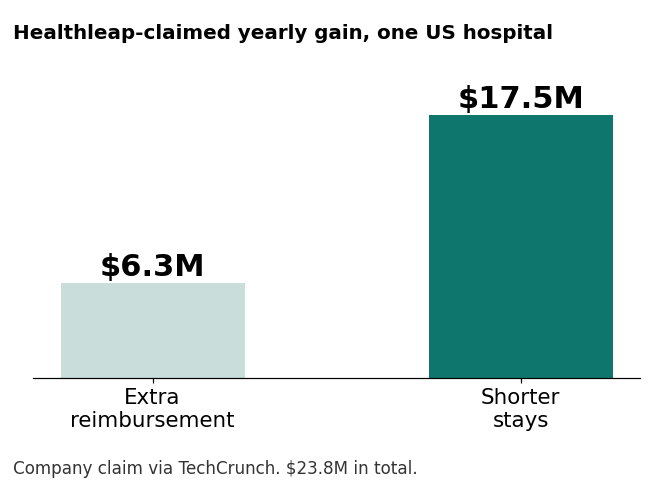
Chart by me from the TechCrunch figures, which are Healthleap's claims. The axis starts at zero.
My reading: roughly three quarters of the claimed gain came from shorter stays, not from billing. That matters for India, where I did not check whether any payer pays more for a documented diagnosis. If none does, an Indian version has to sell stay length and fewer complications.
India is not empty, but I did not find this exact product
I looked for Indian products that read inpatient notes to flag patients at risk, and did not find one. That is not proof there is none. What sits close:
Assistha sells an inpatient workflow assistant for Indian hospitals. It pulls handwritten records, scans, hospital-system data and audio dictation into a discharge summary for the doctor to review. It reads the chart for documentation, not for screening. ASTA HealthTech in Bengaluru says in a press release that it is building a model on bedside-monitor vital signs and has deployed in 10+ hospitals, all company-reported, and vitals are not notes. Deepaarogya sells hospital records software for Indian clinics with AI agents for discharge, nutrition and clinical drafting for staff to review, which is also not a nightly screen. Abroad, Junum already sells malnutrition decision support inside US electronic health records, so the category has competitors.
Why the US model may not travel
The data problem is the other half. Indian hospital notes may be handwritten, short and mixed across languages, which is the problem Assistha builds for. A startup here would probably have to fix note capture first and screen on top, a longer road than Healthleap's, which says it works inside US electronic records.
On who is ready: an Indian School of Business study of 20 hospitals with NABH Digital Health Standards, reported by Express Healthcare, found the use of digital records in clinical decisions rose from 3.00 to 4.37 on a five-point scale after certification. Those are survey scores in a sample weighted to small and medium hospitals, so I would use it only as a hint about where readable notes might exist.
What I would test
Pick one buyer: a 200 to 500 bed private hospital with a working records system. Ask whether its notes are typed and in what language, then ask the quality head which missed-risk problem costs them most days. Run a retrospective count with their team: for past discharges, how many had low intake or weight loss written in the notes but no dietitian review? A price to test, my assumption: a per-bed annual fee set against the cost of one extra hospital day. If the notes are too thin to read, the business is note capture, and Assistha is already there.
Sources and photo credits
Hindustan Times, Healthcare Business Today, TechCrunch, Healthleap, Assistha, ASTA HealthTech release, Deepaarogya, Junum, Express Healthcare. Photos on Unsplash with no stated location: cover by Nappy, a close-up of a hand holding a stethoscope; top of article by Rodrigo Rodrigues, person writing in a notebook with a pen (cropped). Neither is a patient record or a named hospital. This is a research view, not medical advice or a proven business.
Responses
No responses yet - yours could be the first.
Get the notes
Occasional emails about what I'm building, what worked, and what broke.