
The Indian Canvas #30: India is funding biologics plants. Who sells the purification step inside them?
India is paying for biologics capacity: a Gujarat plant budget doubled to Rs 300 crore, and the government has put Rs 10,000 crore behind biologics. In New Zealand, Precision Chroma raised US$7.3 million to change the purification step inside such plants. Indian companies already make resin, so this is not an empty field. I could not find an Indian one working on the process change itself.
Stock render of laboratory glassware. It is not connected to any company named here.
The plants are being funded first
The Press Information Bureau says Union Budget 2026-27 announced Biopharma SHAKTI, an outlay of Rs 10,000 crore over five years for domestic production of biologics and biosimilars, with more than 1,000 accredited clinical trial sites. Machine Maker reports that Varenyam Biolifesciences, a subsidiary of Bharat Parenterals, passed a board resolution on 11 August 2026 to widen its Savli plant in Gujarat to biologics and biosimilar contract manufacturing for the US, EU and other regulated markets, and to raise Phase 1 capex from Rs 150 crore to Rs 300 crore. Completion is targeted for the second quarter of 2028, subject to approvals. Separately, PharmaBiz reported that Shilpa Biologicals would launch SB HiMax at CPHI Milan on 6 to 8 October, a service meant to take suitable antibody programmes from gene to clinical supply in as little as nine months. That timing is the company's own claim.
In an Indmedia opinion piece, Sachin Joshi of PharmNXT Biotech argues that the next gap is the inputs, not the plants: bags, connectors and filters, and the validation needed to qualify a new supplier. It is one founder's view.
My reading: a plant that opens in 2028 has to choose its purification supplier before then. Every biologics line buys consumables again and again, so the supplier is chosen once and paid for repeatedly.
What Precision Chroma changes
In its announcement the company says the usual route clarifies bioreactor harvest by centrifugation and depth filtration before Protein A chromatography, which adds unit operations, consumables, equipment and possible product loss. It replaces randomly packed beads with ordered agarose packed-bed structures made with 3D-printing techniques, designed so cells and debris pass through while the antibody binds. The aim is direct capture from unclarified harvest and, in its words, potentially eliminating clarification steps, on existing chromatography systems. The seed round, announced on 11 October, was led by M Ventures, the venture arm of Merck KGaA, with Bridgewest Ventures, Icehouse Ventures and the Aspire NZ Seed Fund. The company was founded from University of Canterbury research and is based in Christchurch.
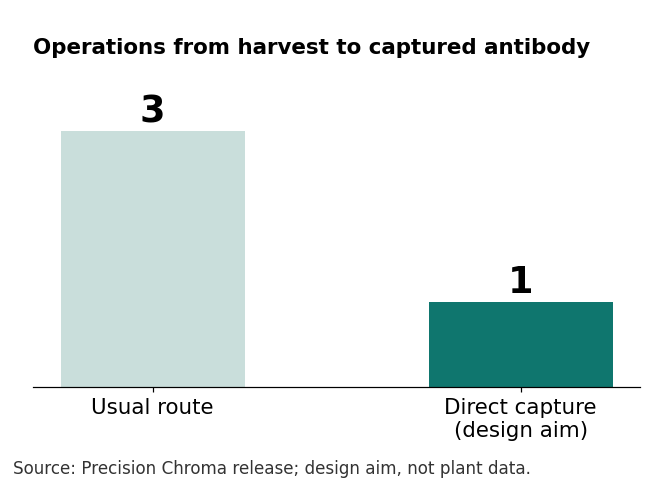
Chart by me, counting the operations the release names: centrifugation, depth filtration, Protein A. The right bar is the company's design aim, not plant data.
Everything on performance is company-reported. The release says funding goes first to research and process-development products, with larger columns and a longer path to GMP manufacturing use. I saw no customer names or yield data. The decision it points at is for a plant: buying this would remove a step from the flow sheet, not swap one resin for another.
India is not empty at the resin level
ProtPure, from Anand in Gujarat, says it was set up in May 2023 and makes agarose chromatography media in its own semi-automated facility. On its own site it claims a capacity of 600 litres of agarose resin a month, repeat orders from Indian biopharma companies, and that it is bootstrapped; I could not check any of that independently. Its mAb page lists ion-exchange, hydrophobic and size-exclusion resins for intermediate and polishing steps, and does not list a Protein A capture resin. Oncosimis sells mAbOn-A, a Protein A resin it describes as high capacity, which is a company claim I could not test. HiMedia also lists agarose-based affinity resins in a catalogue. YMC India's page for ChromaCon's CaptureSMB, a two-column process that its page says saves up to 60% of Protein A resin, shows that Indian buyers can also get a process change through equipment, though that one still starts from clarified feed.
What I looked for and did not find: an Indian company selling a purification format that captures directly from unclarified harvest. A few searches do not prove none exists. That gap is a hypothesis, and I would test it by asking before building.
Why it may be slower than cheaper resin
A cheaper Protein A resin is a replacement play. A plant must requalify it and regulators will want comparability data, which slows any one-for-one swap. A process change can be stickier, since a step removed shows up in every batch, but only the supplier has measured the benefit so far. For an Indian startup the realistic path is the one Precision Chroma has chosen: sell to research and process-development labs first, where qualification is light, and earn a place in the plant later.
The risk is large. Chromatography media is deep tech with long sales cycles, nothing like seed-stage software. A three-year runway may only reach pilot scale, and a global supplier could sell into the same Indian plants.
What I would do first
Talk to ten process-development heads at Indian biosimilar makers and contract manufacturers. Ask how many steps sit between harvest and Protein A, what they spend per batch on consumables there, and what it would take to trial a new resin on a 10-litre run. A price to test, which is my assumption: research-scale columns at a modest premium to imported equivalents, because labs may pay for speed of supply. If nobody will run a trial without a full validation package, the product has to be built for the plant, and that is a bigger company than a seed round.
Sources and photo credits
PIB, Machine Maker, PharmaBiz, Indmedia, Precision Chroma announcement, NZ Entrepreneur, ProtPure about, Oncosimis products, YMC India CaptureSMB. Photos on Unsplash with no stated location: cover by Peter Herrmann, an old industrial plant interior, which is not a biologics plant; top of article by Allison Saeng, a render of laboratory glassware. This is a research view, not a proven business.
Responses
No responses yet - yours could be the first.
Get the notes
Occasional emails about what I'm building, what worked, and what broke.