
The Indian Canvas #37: India Curtailed 8 TWh of Solar in One Quarter. Who Will Make the Line Sensors?
India curtailed more than 8,000 GWh of solar between April and June 2026, and the renewable energy secretary blames late transmission lines. On 17 September, Iceland's Laki Power announced a EUR 6 million Series A led by the NATO Innovation Fund for a sensor that sits on a live line and powers itself from it. India is not empty here: the first 400 kV dynamic line rating project, for Power Grid, already uses battery-free sensors, but made in Slovenia. The gap I would test is an Indian-made sensor, and whether a transmission utility or a solar developer pays for it. That is a hypothesis.
Stock photo of a utility pole, not a high-voltage transmission line and not from India.
Solar that could not leave the plant
The Times of India quotes the new and renewable energy secretary, Santosh Kumar Sarangi, saying delays in transmission lines are primarily responsible for curtailment, not too much renewable capacity. In the first quarter of this financial year, about 8,133 GWh of solar was curtailed, which the paper puts at about 1.5 days of national electricity consumption. His answer is to build the lines faster and add battery storage. He also says solar-heavy lines are typically used for only six to eight hours a day.
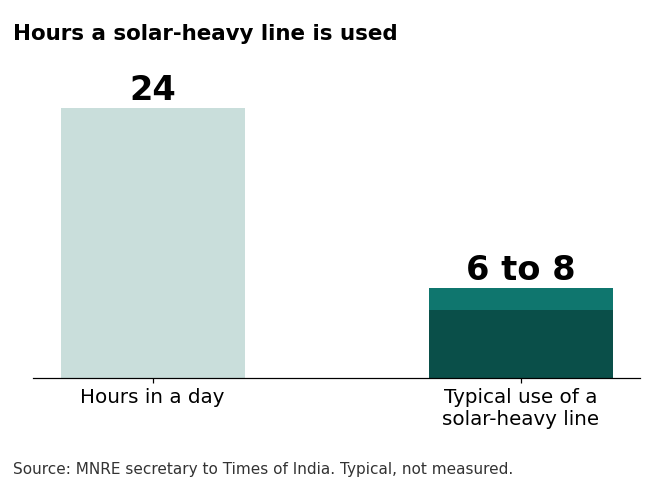
Chart by me from the secretary's figure. The axis starts at zero. It is a typical figure he gave, not a measurement.
That chart matters for what comes next. A line sensor helps when a line is full. It does nothing for the hours when the sun is down, which is why storage is part of the answer. A Kearney report covered by pv magazine India says annual transmission additions missed National Electricity Plan targets, by as much as 50 per cent in some years, and that the plan needs 67,263 circuit km of new lines by FY2030-31. A Kearney partner says dynamic line rating and similar technologies can add 20 to 30 per cent more throughput on existing lines, and co-located storage can free up to 60 per cent of tied-up capacity. Those are a consultancy's estimates.
What dynamic line rating is
Lines are rated for the worst weather. Dynamic line rating measures the conductor and the weather and lets the line carry more when it is cool or windy. Power Peak Digest reports that Karnataka's transmission utility KPTCL issued a letter of intent in June for a pilot on a 220 kV line in Bengaluru, aiming for up to 25 per cent more capacity. The same article cites IRENA's 2020 range of 10 to 40 per cent more ampacity, depending on weather. The KPTCL figure is a target. I found no result yet.
What Laki Power sells
Laki's own press release says the round was led by the NATO Innovation Fund, with existing shareholder ReykVC, and calls it the fund's first investment in Iceland. The NIF announced it too. Laki says one device clamped on the conductor combines cameras, weather and line sensors, onboard compute and satellite links, and draws up to 300 W from the line itself. It says it can detect ice and wildfire risk, watch the line and measure how much current it can safely carry. It names deployments with Landsnet in Iceland, Statnett in Norway and Hydro-Québec in Canada. All of this is company-reported. The money goes to manufacturing and to deployments in Europe, North America and Australia. I did not see customer numbers or prices.
India already has the first one on a 400 kV line
Mercom reported in October 2025 that Tata Consulting Engineers, with Enline and Gridpulse, commissioned a dynamic line rating project for Power Grid on the 400 kV Madurai to Tuticorin line. TCE's case study says sensors were installed on the live line and that the system forecasts available capacity up to 168 hours ahead. Telegence International, an installer, wrote in a LinkedIn post that it fitted 18 sensors on that line, made by Gridpulse of Slovenia, that run without batteries and measure current, conductor temperature, ambient temperature and sag or icing. So the self-powered idea is already in India, on one line. Enline's own article describes the same project and says it can cut curtailment. That is a vendor claim, and I did not see a measured result.
What I did not find is an Indian-made line-mounted sensor, or one with Laki's cameras and satellite link. I cannot see tenders that never reached the press, so "I did not find one" is all I can say.
Who pays, and why it may not sell
The technology is not the only question. A sensor raises the capacity of one line, but the buyer has to want that capacity. The utilities that own the lines, the solar developers whose output is curtailed and the state dispatch centres each feel the problem differently. I did not find a source on how Indian transmission owners earn from the lines they run, and I will not guess. It is the first thing to find out, because if owners gain nothing from squeezing more from an old line, a better sensor does not sell. Laki's selling points of ice and wildfire may also matter less on Indian lines than in Iceland or Canada, in which case an Indian product would lean on heat, sag and clearance on long solar corridors.
What I would do first
Pick one congested solar evacuation corridor and ask three people: the line owner, the solar plant owner using it, and the dispatch centre. Ask who would pay for extra megawatt-hours, and what Gridpulse-based sensors cost to buy and fit today. If the owner says no one pays, the idea stops. If a solar developer says it would pay per megawatt-hour recovered, the idea is a local sensor maker selling through project engineers such as TCE.
Sources and photo credits
Times of India, pv magazine India, Power Peak Digest, Laki Power, NATO Innovation Fund, Mercom, Tata Consulting Engineers, Telegence International post, Enline. Photos on Unsplash with no stated location: cover by Maxim Tolchinskiy (@shaikhulud), power lines and towers in a field at sunset; body by Carlos Méndez (@hamporter), an overhead view of power lines and wires against a blue sky. Free to use under the Unsplash License. This is a research view, not a proven business.
Responses
No responses yet - yours could be the first.
Get the notes
Occasional emails about what I'm building, what worked, and what broke.