
The Indian Canvas #98: Fifteen crore taps are in. Who pays to keep the water running?
In 2019, about three in twenty rural Indian homes had a working tap connection. Today it is about sixteen in twenty. The build is nearly done. The next decade of the world's largest rural water mission is about something less photogenic: who keeps the water running, and who pays the person who does.
Between July and October 2024, the government's own Functionality Assessment went back to sampled households in Har Ghar Jal villages and asked a simpler question than "do you have a tap": did the tap give water in the last seven days? For 86.5 per cent of sampled households with a tap connection, it had. For 13.5 per cent, it had not. Among that smaller group, the reported reasons were mundane: pipes (31.9 per cent), pumps (29.6 per cent), commissioning (11 per cent), electricity (8.5 per cent), the source itself (4.6 per cent). Nothing exotic. Just maintenance that did not happen.
The survey found the village plumbing for maintenance equally thin. A Village Water and Sanitation Committee existed in 55.2 per cent of sampled villages. Skilled O&M manpower was available in 58.1 per cent. Only 26.8 per cent of villages levied any water service delivery charge at all. Committee, mechanic, money: in roughly half to three-quarters of villages, at least one leg of that stool is missing.
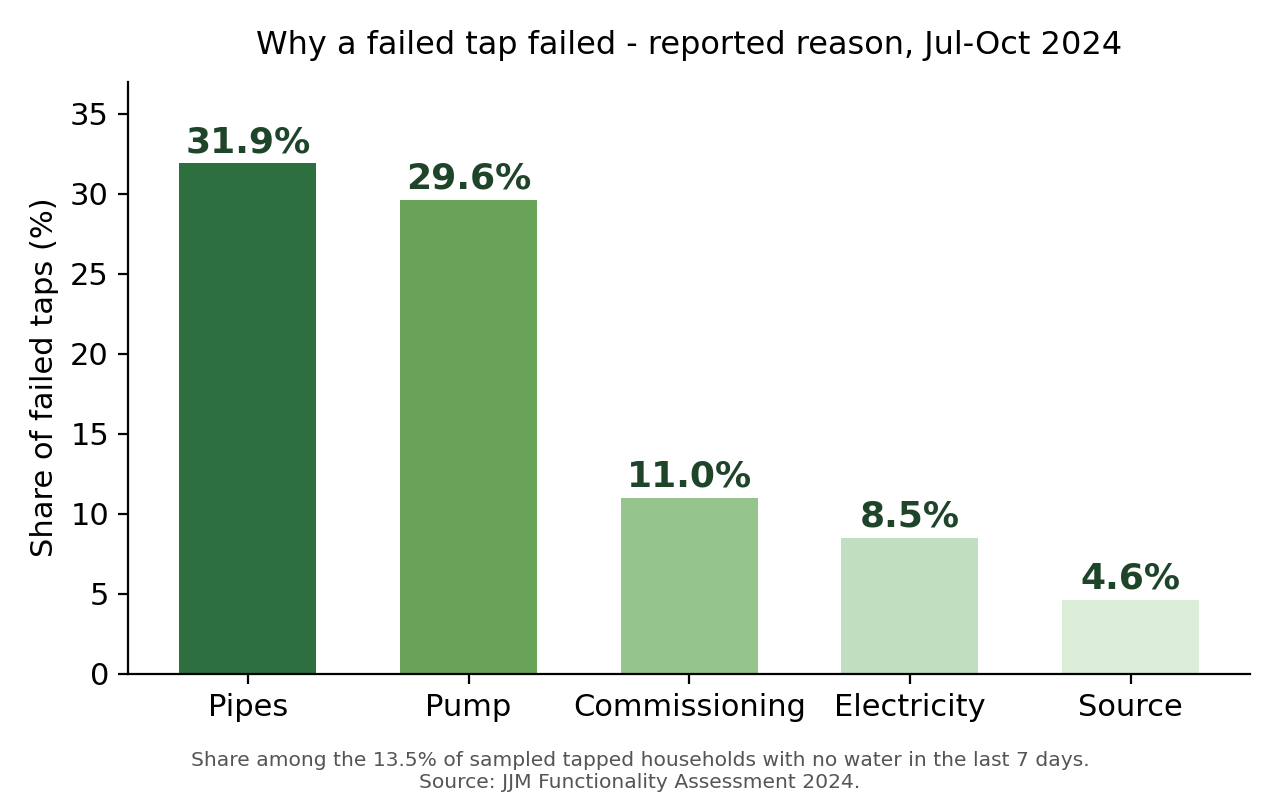
Reported reasons a tap failed, among sampled households with no water in the last 7 days, Jul-Oct 2024. Source: JJM Functionality Assessment 2024.
Two African systems that pay for uptime
Kenya runs a quiet experiment that India has nothing quite like yet. The Water Services Maintenance Trust Fund, documented in an Oxford-hosted impact report covering 2016 to 2021, pays professional maintenance providers against verified results. Over that period it completed 2,724 repairs across handpumps and small piped schemes, and in 2021 more than 98 per cent of repairs finished within three days. In Kitui County, handpumps under professional maintenance ran 99 per cent of the time against 86 per cent for community-managed ones, and a broken professional pump was back in one day against forty-three. Users are not passive here: they contributed USD 23,000 in 2021, and the non-donor, results-based share of the fund's resources grew from 19 per cent in 2017 to 86 per cent in 2021. For every user dollar, results-based funders put in about four. One provider, FundiFix, grew from 42 paying handpumps in 2016 to 93 pumps plus 24 small piped schemes by 2021. The wider Uptime consortium now serves about 1.5 million rural users across seven African countries.
Uganda chose a different shape: organisation first. Since 2017, six regional Umbrella Authorities have taken gazetted rural schemes under professional management - 571 schemes by 2022, with 303 under direct management. A 2020 national framework adds area-based performance contracts, where a professional provider runs all water facilities in an area under contract to the local board, users pay, and government subsidises rehabilitation. Uganda's tariff policy has said since 2009 that consumers should cover O&M costs in full. The honest caveat, from an Aquaya/USAID institutional review: point-source functionality estimates range from the ministry's 85 per cent down to about 60 per cent in independent studies. Professionalisation is a direction, not a finished result.
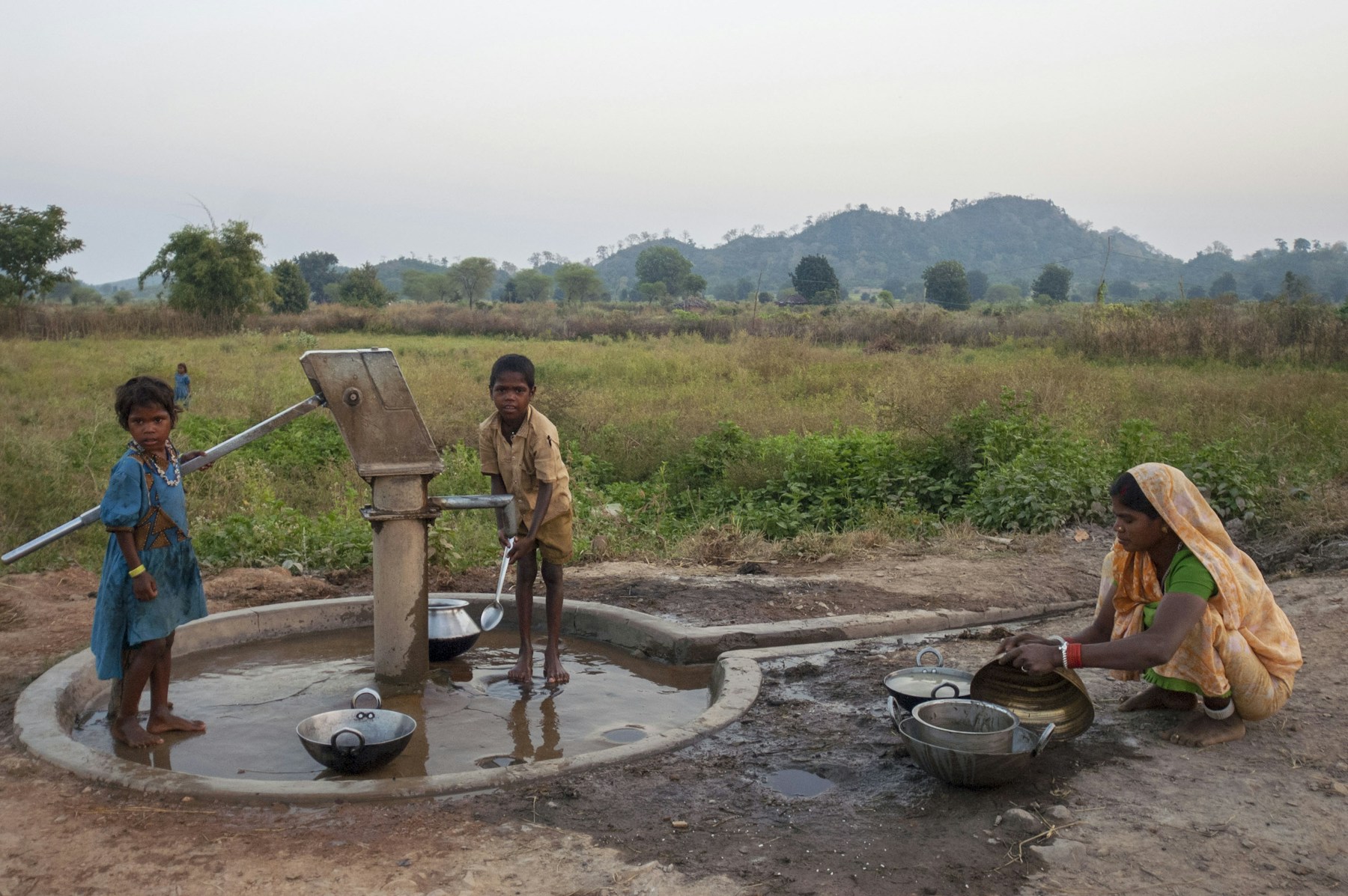
People draw water from a well in Kawardha, Chhattisgarh. Photo: Wietse Jongsma / Unsplash
India's paper architecture is suddenly specific
In March 2026, the Jal Jeevan Mission was extended to December 2028 as JJM 2.0, with a total outlay of Rs 8.69 lakh crore, explicitly restructured from infrastructure creation to service delivery. Household tap connections stand at 15.80 crore, 81.61 per cent of rural homes, against 3.23 crore (17 per cent) when the mission began in 2019.
The JJM 2.0 Operational Guidelines, released on 22 March 2026, read less like a scheme document and more like an org chart for a water utility sector. Every village gets a "Micro Utility" - the Village Water and Sanitation Committee as a standing committee of the Gram Panchayat - while a "Macro Utility" (the state PHED or a water utility) runs bulk systems. District Technical Units are assigned "contract management for O&M: service-level based, performance-linked." Handover of a scheme to the panchayat is gated: "a sustainable financial framework, including approved service delivery charge, dedicated bank accounts and accounting procedures, shall be established prior to handover." Every scheme must have a bottom-up annual O&M budget; accounts are ring-fenced; states are told to create a separate budget head; and any state financial support to utilities "shall be linked to measurable operational efficiency parameters." The annual village self-assessment (Jal Seva Aankalan) is designated, in the guidelines' own monitoring annexure, as a "KPI for fund release under JJM 2.0."
A money channel exists too. The 16th Finance Commission has recommended Rs 4,35,236 crore in rural local body grants for 2026-31, half of the Basic grant tied to water management and sanitation. The operative guidelines, issued 21 May 2026, say tied grants carry "flexibility... including O&M expenditures." That is the first time the finance-commission channel has explicitly named maintenance as an eligible use.
And the Centre-to-state tier has moved money on compliance once. On 31 March 2026, the Press Information Bureau reported the first compliance-linked release under JJM 2.0: Rs 1,561.53 crore for FY 2025-26 across five states - Uttar Pradesh (Rs 792.93 cr), Chhattisgarh (Rs 536.53 cr), Madhya Pradesh (Rs 154.02 cr), Odisha (Rs 65.31 cr) and Maharashtra (Rs 12.74 cr) - released after signed reform MoUs, GIS-based asset validation, design-norms certification and financial reconciliation. By then, twelve states had signed the MoU. PIB called it "a performance-based and compliance-linked mechanism." Reported is not treasury-verified, and one release is not a system. But the top tier of the architecture has operated at least once.
There is a deliberate tension in the national template. A ministerial policy dialogue on 27 January 2026 put it plainly: accountability for drinking water "cannot be outsourced or contractor-driven," and day-to-day in-village operations "must remain with Gram Panchayats and Village Water & Sanitation Committees." Only five states had adopted the Centre's 19-point O&M advisory at that date. The Centre's answer is community-first; the operator market is a state option, not the national model.
Four states, four different bets
Karnataka is the outlier with a notified payment design. Under government orders dating to December 2020 and an O&M policy in force since 2021, multi-village scheme operators are paid volumetrically: 50 per cent fixed, 50 per cent variable against measured quantity, quality and grievance turnaround, with excess energy use deducted from the monthly bill. The state is supposed to recover a bulk tariff from panchayats. The policy's own introduction admits the gap: panchayats currently pay nothing, and the entire O&M cost is met by the state department. A World Bank assessment in March 2023 recorded the same break - bulk collection "yet to be implemented" - though that evidence is dated. The Bank's US$363 million results-linked program for Karnataka rural water, approved 28 March 2023, ties disbursement to results including the O&M policy itself; whether any disbursement has actually flowed is unverified. So Karnataka has a notified design, a results-based funder on paper, and an unproven collection chain.
Uttar Pradesh made the opposite bet: bind the builder. Its O&M Policy-2026, promulgated by government order on 12 October 2026, obliges the EPC vendor to run the scheme for ten years after construction - not a defect-liability period, an operating obligation - under a tripartite agreement between the district mission, the vendor and the village committee. Payment follows Schedule of Rates with deductions tied to service-level benchmarks: 55 litres per person per day, 7-metre residual pressure, BIS 10500 water quality, targets for non-revenue water. Complaints must be resolved within 24 hours and supply restored within 48, with penalties, and abandonment can cost the vendor its performance bank guarantee. The policy is days old as I write; there is no operating evidence yet.
Assam's notified design is community-accountable with a tariff spine: a Rs 30 per household per month floor set by orders in October 2024 and July 2025, a one-year defect liability period, and a model where the village water committee itself contracts and pays private operators from collected tariffs, with periodic performance evaluation but no uptime-linked payment formula. Rajasthan, meanwhile, has consulted on a district-wide comprehensive O&M contract - ten years, 70 per cent fixed and 30 per cent KPI-linked payment - though the final tender had not been issued when I checked. Separately, Rajasthan's JJM retrofit tenders have bundled "ten years O&M after a one-year defect-liability period" into construction contracts since 2023-24; I found two independent aggregator records of that structure, one awarded, but the state e-procurement portal blocked my verification, so treat that as corroborated-but-unconfirmed.
These are contrasting designs, not a maturity ladder. They differ in scope, in who pays, and in status.
What has not happened yet
India tried professional maintenance once before, and it worked. In Morinda, Punjab, in 2010-11, a professional operator ran 22 piped schemes across 51 villages under a contract documented by the Water and Sanitation Program for the then Ministry of Drinking Water and Sanitation. Operating costs fell about 20 per cent, connections and revenue rose, and payment required community certification of satisfactory service. The contract was not renewed, reportedly after departmental staff opposed it. The pilot succeeded operationally and died institutionally.
Here is my hypothesis, labelled as one. India now has the measurement layer a performance-payment system would run on - village self-assessment as a fund-release KPI, daily transactional data on the Sujal Gaon app, real-time functionality data mandated from O&M contractors into district and state command centres. It has money channels - finance-commission grants with O&M flexibility, state budget heads, service delivery charges. It has at least one notified pay-for-KPI design (Karnataka) and one notified construction-linked design (Uttar Pradesh). What I could not verify anywhere in this review is a rupee reaching an O&M operator against a measured service outcome. The one tier that has moved money on conditions is the top one, Centre to state. Everything below that is prescribed or notified, not demonstrated.
The counterevidence deserves equal billing. Most taps work - 86.5 per cent is a good number, even if the remainder is still crores of households. Kenya's model runs on donor and blended money, about four funder dollars to every user dollar; whether it survives donors is unproven. Uganda's functionality numbers are contested by an order of 25 percentage points. And India's own design may not need an operator market at all: the Micro Utility plus service delivery charges plus finance-commission grants could fund village-run maintenance directly. That would be a fine outcome too.
But the lesson the global evidence keeps repeating is simple. Pumps fail for ordinary reasons, and they get fixed fast only when someone is paid to fix them against data someone else verifies. Kenya pays for uptime and gets 99 per cent. India has built the tap, written the architecture, and released the first compliance-linked crore. The open question for JJM 2.0 is whether a performance signal can travel the full chain - from a village tap, through a panchayat budget, to the person who turns the wrench.
Sources
Press Information Bureau: Jal Jeevan Mission extended as JJM 2.0 (10 March 2026) | JJM 2.0 reform-linked MoUs and first compliance-linked release (31 March 2026) | Policy dialogue on sustainable O&M (27 January 2026) | Framing of O&M policies under JJM (2 April 2026)
JJM 2.0 Operational Guidelines, DDWS (22 March 2026): jaljeevanmission.gov.in
Functionality Assessment of Household Tap Connections 2024: jaljeevanmission.gov.in
16th Finance Commission rural local body grant operational guidelines (21 May 2026): panchayat.gov.in
Water Services Maintenance Trust Fund Impact Report 2016-2021, Smith School, University of Oxford: ora.ox.ac.uk
Uganda institutional framework review, Aquaya/USAID REAL-Water: aquaya.org
Engaging Non-state Providers in Rural Water Supply Services (WSP for MDWS, 2013): World Bank
Karnataka O&M Policy, RDWSD: swachhamevajayate.com
World Bank press release, Karnataka Sustainable Rural Water Supply Program (28 March 2023): worldbank.org
Uttar Pradesh O&M Policy-2026 government order (12 October 2026): jjm.up.gov.in Shasanadesh dashboard
Assam O&M Policy for water supply schemes under JJM: phe.assam.gov.in
Responses
No responses yet - yours could be the first.
Get the notes
Occasional emails about what I'm building, what worked, and what broke.