
The Indian Canvas #150: Who Pays When the Road Kills?
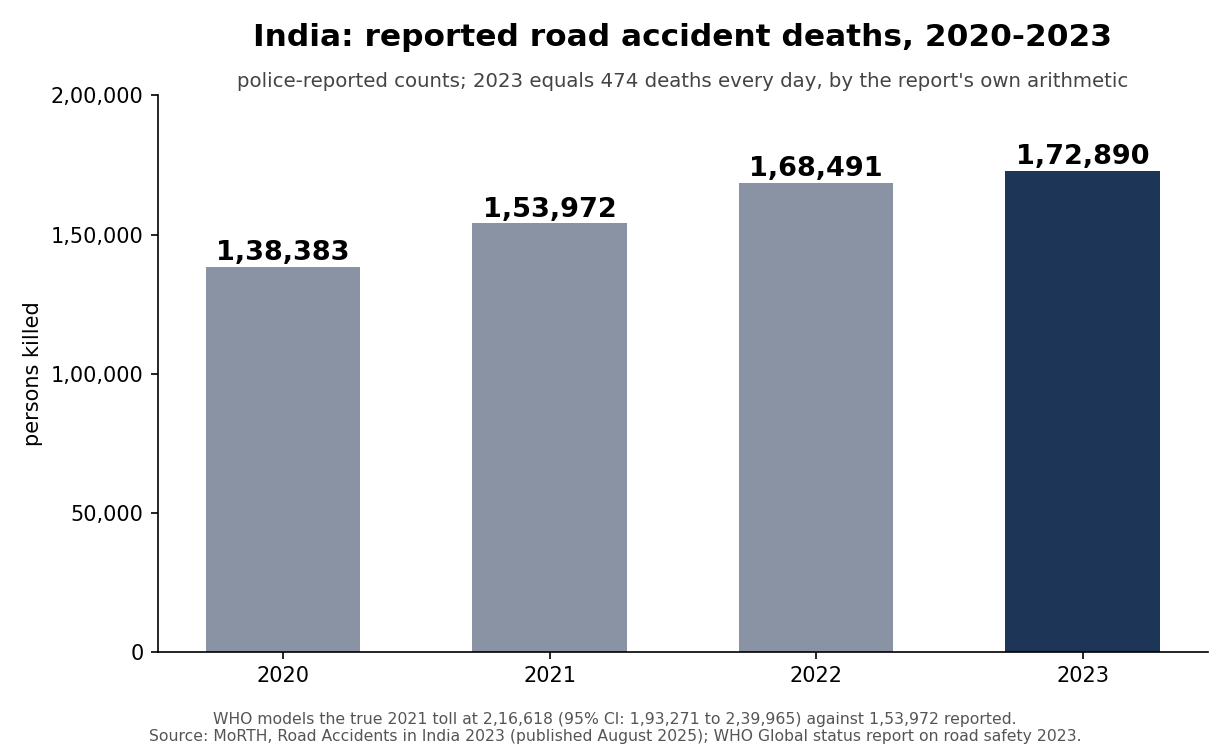
In 2023, India's roads killed an average of twenty people every hour of every day. That is not my arithmetic. It is the Ministry of Road Transport and Highways, in its Road Accidents in India 2023 report, published in August 2025, doing the division on its own numbers: 4,80,583 accidents, 1,72,890 people killed, and 4,62,825 injured in calendar 2023. One thousand three hundred seventeen crashes and 474 deaths a day, the report says, or 55 accidents and 20 deaths every hour.
The reported number has moved in only one direction since the pandemic year. From 1,38,383 deaths in 2020, the toll has climbed every year: 1,53,972 in 2021, 1,68,491 in 2022, and 1,72,890 in 2023, the highest in the report's five-year table. The World Health Organization believes the police-counted numbers understate the loss. Its 2023 global status report models India's road deaths for 2021 at 2,16,618, against the 1,53,972 reported that same year, a rate of 15.4 deaths per lakh of population.
Who is dying
The ministry's tables read less like an accident register and more like an actuarial profile of a working family. Riders of two-wheelers, the scooter and motorcycle that carry India's commute, were 44.8% of everyone killed in 2023, the highest share for the third year running. Pedestrians were another 20.4%. Between them, the person on the bike and the person on foot account for nearly two-thirds of the dead, and neither has a crumple zone. Two-thirds of the victims, 66.4%, were aged 18 to 45, the fourth consecutive year that young adults have dominated the toll; stretch the band to 60 and it covers 83.4%. The WHO's India office notes that the victims are often the sole bread-earners of their families. And 68.5% of the deaths were recorded in rural areas.
In the police reports the ministry compiles, over-speeding is entered as the cause behind 72.5% of the deaths in 2023. I want to sit with that word for a moment, because "cause" is doing quiet work here: it is the attending officer's attribution, not an independent finding. The same report's tables record that 67% of accidents took place on straight roads, and that 53.6% of deaths occurred on open stretches, locations with no human activity nearby. Those tables record what happened; they do not say why the crash had to be fatal.
Who pays today
The first payer is the family, and it pays in the oldest currency there is: a father or a son or a daughter who does not come home, and, where the victim earned, the income that came with them. Every other payer in this story pays after that one has already paid.
The second payer is the insurance system, through a mechanism most people learn about only in the worst week of their lives. If the vehicle that hit you is identified and insured, its third-party insurer pays the compensation a motor accidents tribunal awards. If the vehicle is never traced, the state steps in through a fund that used to be almost mocking in its generosity. Until March 2022, the Solatium Scheme of 1989 paid a hit-and-run victim's family ₹25,000 for a death. The Compensation to Victims of Hit and Run Motor Accidents Scheme, 2022, notified on 25 February 2022 and effective that April, raised it to ₹2,00,000 for a death and ₹50,000 for grievous injury, paid out of a new Motor Vehicles Accident Fund. Eight times the old number, and still a strange price for a person.
The third payer is the taxpayer, and the story of how the taxpayer came to pay for the golden hour is the most instructive stretch of this issue. Parliament amended the Motor Vehicles Act in 2019, and Section 162(2) of that amendment required the Centre to frame a scheme for cashless treatment of accident victims in the golden hour, the first hour after a traumatic injury, when prompt care is most likely to save a life. A pilot followed in Chandigarh in March 2024, but the national scheme waited until a Supreme Court bench of Justices Oka and Bhuyan summoned the ministry's Secretary in late April 2025 and asked, in the Indian Express's account of the hearing: "People are dying in road accidents. You are constructing huge highways but people are dying there because there is no facility. There is no scheme for golden hour treatment. What is the use of constructing so many highways?" The scheme was notified a week later, on 5 May 2025, with guidelines that June. On paper it is generous: treatment of up to ₹1.5 lakh per victim, for up to seven days from the date of the accident, at any designated hospital, with general insurers paying where the offending vehicle was insured and the Centre paying where it was not; ₹272 crore was budgeted for the uninsured cases in 2025-26.
The claims recorded so far are unevenly distributed, and the ministry's own numbers say so. The scheme went national as PM-RAHAT on 13 February 2026. In a written answer in the Lok Sabha on 30 July 2026, the minister tabled the ledger as of 28 July 2026: hospitals had initiated 12,727 claims, state health authorities had approved 9,601, and 7,871 claims had been settled, with ₹10.1 crore paid out in all. Three states, Gujarat, Madhya Pradesh and Assam, account for 9,715 of the 12,727 claims. Uttar Pradesh, which recorded more road deaths in 2023 than any other state, shows 344 claims initiated and 5 settled. Tamil Nadu, which recorded the most accidents that year, shows 7 claims initiated and none settled. These are claims at a July 2026 snapshot, not a measure of every victim's access to treatment. They show concentrated use, but do not establish why claims differ between states or how pending claims will be resolved.
And then there is the payer nobody bills: the economy itself. In March 2025, the road transport minister told an industry summit that accidents inflict an economic loss of 3% of GDP, and the WHO's India office carries the same estimate on its road-safety page. Treat it as an estimate, not an audited figure; even its shadow dwarfs every scheme in this article many times over.
Where deaths are recorded
Here is the distribution that complicates the police ledger. National Highways were 2.09% of India's road length and State Highways 2.9% in 2019, by the ministry's Basic Road Statistics; the 2023 report records 36.5% of that year's deaths on national highways and 22.8% on state highways. The years do not line up exactly, and the tables are not adjusted for traffic exposure, so that 59.3% share, my addition, cannot say how much of it simply reflects where the traffic is. But the minister himself has offered a blunter reading than any statistic. At the same March 2025 summit, Gadkari said most of the country's road accidents happen because of poor civil engineering practices in road design, construction and management, and held engineers largely responsible, pointing to substandard project reports. That is the minister's stated view, not an independent finding; it is still remarkable to hear the man who builds the highways say it.
The country that decided deaths were a design flaw
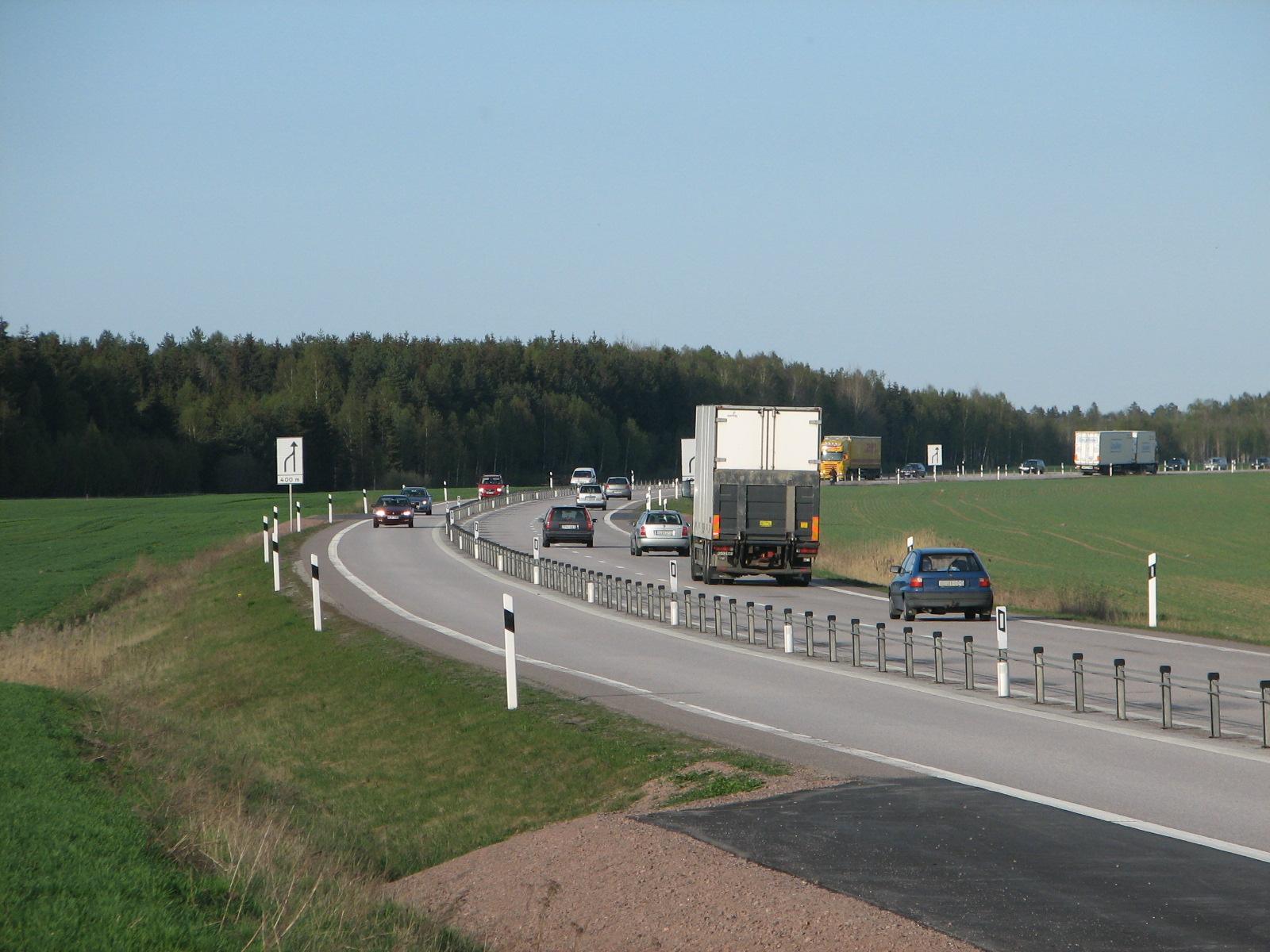
In 1997, Sweden's parliament adopted something it called Nollvisionen, Vision Zero: the proposition that no one should be killed or seriously injured in road traffic, ever, as a matter of design. Vision Zero accepts that people will always make mistakes and crash; what it refuses to accept is that the mistake must be fatal. Responsibility is shared between road users and the people who design, build and manage the roads, but when people keep dying, it is the system that is expected to change first. In practice this has meant wire median barriers down the middle of rural highways, to keep a moment's drift from turning into a head-on collision, 30 km/h limits where cars share space with people walking, and speed limits set with the human body's limits in mind; Trafikverket, the transport administration, describes median barriers as among the most important measures for meeting its targets.
Sweden also puts its promises in writing. Its first interim target was to halve road deaths between 2007 and 2020, to no more than 220; the recorded figure for 2020 was 204, and the serious-injury target was met as well. The current target, adopted in 2020, takes the average toll of 2017 to 2019 as its baseline and halves it again by 2030: no more than 133 deaths a year. And Sweden publishes its misses. The final official count for 2024, released in April 2025, is 213 deaths, 2.0 per lakh of population. When the preliminary figure of 210 was announced that January, the transport agency's director-general had noted in his press release that a steady path to the 2030 goal allowed no more than 188 for the year; the final 213 confirmed the overshoot. The final count for 2025, released this year, is 203. The numbers say nothing by themselves about what a Swedish design would do on an Indian highway. What they show is a country that set a public target, hit it once, is behind on the next one, and prints both facts in the same official voice.
Set the two countries on the WHO's single scale, its 2023 report and 2021 estimates: 15.4 road deaths per lakh people in India, 2.1 in Sweden, a gap of about seven times by my division, on the same methodology and the same year. Read it as an illustration of two different assignments of responsibility, not as a controlled experiment: the traffic mix, the roads and the reporting systems differ in ways no single rate can hold. What the comparison leaves open is the policy question at the centre of this issue: how much responsibility for prevention sits with road users, and how much with the people designing and managing the roads?
The question the road asks back
In the previous issue of this series, the question was who pays when the power company cannot. The road asks a sharper version, because here the bill arrives as a death, and India has arranged, mostly without saying so, for the family to pay it first. In 2023, at an average of twenty deaths an hour, the first payer was a bereaved household; families of eligible fatal hit-and-run victims, where the offending vehicle cannot be identified despite reasonable efforts, can claim ₹2 lakh under the 2022 scheme; where the vehicle is insured, the insurer pays what a tribunal awards, subject to liability and the policy; and since February 2026, the exchequer and the insurers together cover up to ₹1.5 lakh toward a week of treatment at designated hospitals, against a claims ledger that so far is heavily concentrated in a handful of states. Sweden's answer, adopted nearly three decades ago, puts the cost of survival into the road itself, in concrete and cable and lower speeds, before the crash. India has built the highways. The Supreme Court's question still stands over every one of them.
Sources
1. Ministry of Road Transport and Highways, Road Accidents in India 2023 (published August 2025). 2. WHO, Global status report on road safety 2023: India profile. 3. WHO, Global status report on road safety 2023: Sweden profile. 4. WHO India, Road safety. 5. PIB, Notification issued for compensation of victims of Hit and Run motor accidents, 27 February 2022. 6. PIB, Cashless treatment for road accident victims, 7 August 2025. 7. PIB, Gadkari at the Global Road Infratech Summit, 6 March 2025. 8. Lok Sabha Unstarred Question No. 1965, Road Accidents and Cashless Treatment, answered 30 July 2026. 9. Lok Sabha Unstarred Question No. 3171, Cashless Treatment for Road Accident Victims, answered 6 August 2026. 10. Indian Express, After many delays, Centre notifies cashless treatment scheme for road accident victims, 6 May 2025. 11. Transportstyrelsen, Nollvisionen. 12. Trafikverket, Tillsammans för Nollvisionen, May 2020. 13. Trafikanalys, Vägtrafikskador 2024 (official statistics, April 2025). 14. Trafikanalys, Vägtrafikskador 2025 (official statistics). 15. Trafikverket, Analysis of road safety trends 2022. 16. Transportstyrelsen, 210 personer omkom i vägtrafiken 2024, 14 January 2025. 17. Times of India, Road ministry starts pilot project on cashless treatment of victims in Chandigarh, March 2024.
Responses
No responses yet - yours could be the first.
Get the notes
Occasional emails about what I'm building, what worked, and what broke.