
The Indian Canvas #122: Five Midnights on the Subansiri
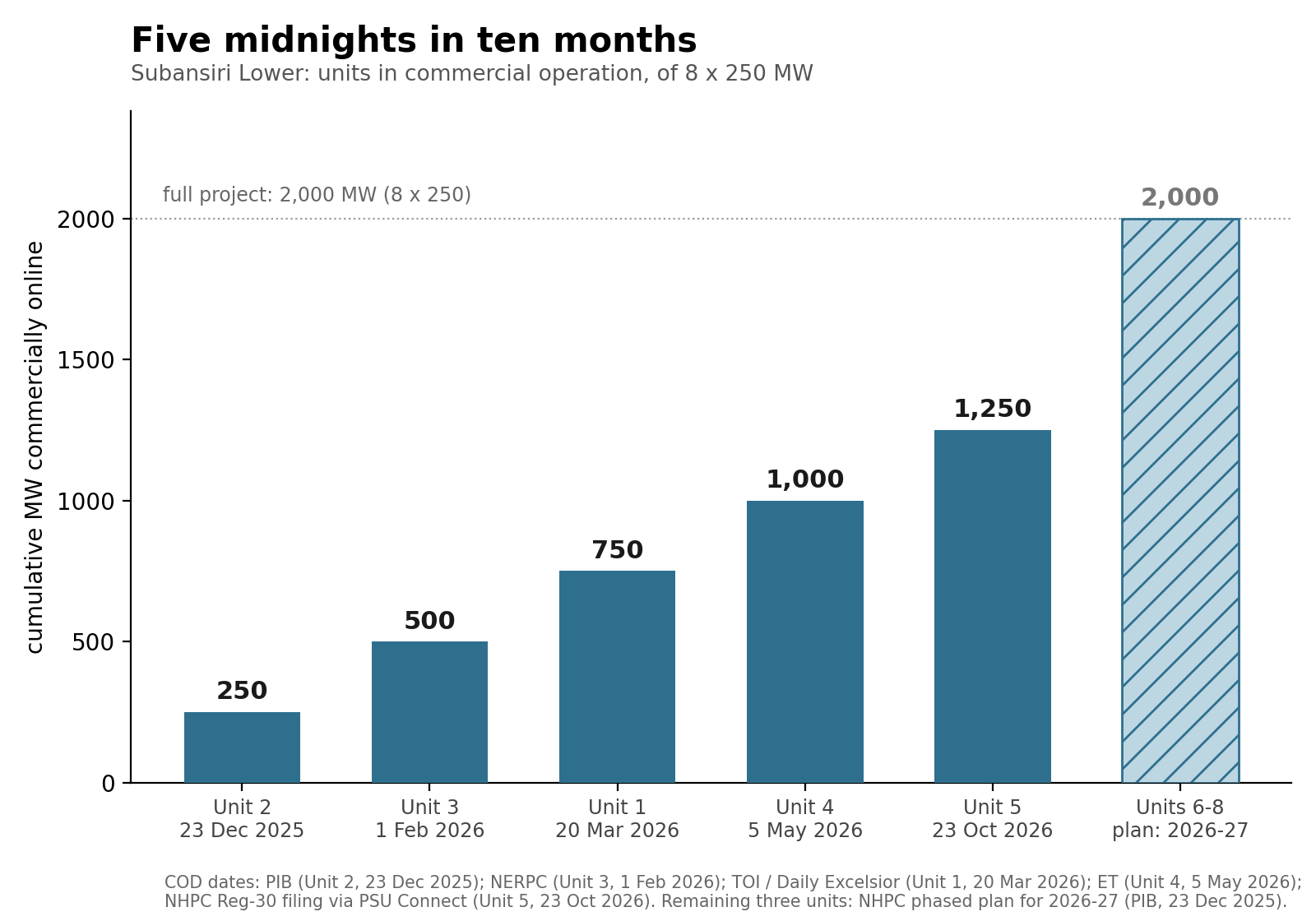
The paperwork is precise about the hour. At 00:00 on 23 October 2026, the fifth 250 MW unit of the Subansiri Lower Hydroelectric Project entered commercial operation, according to NHPC's filing to the stock exchanges. Five of eight turbines are now live - 1,250 MW of the 2,000 MW that India's largest hydroelectric project will eventually send into the grid. Three units remain, and their dates are still a plan, not a fact. But this point - five of eight units, well past halfway - is worth pausing on, because of how long it took to get here and because of what the grid it joins has become.
Subansiri Lower sits on the Subansiri river where it leaves the hills, on the border of Arunachal Pradesh and Assam near North Lakhimpur. It is a run-of-river scheme with pondage: a 116-metre concrete gravity dam - the largest in the North-East - backs up a reservoir of 1,365 million cubic metres, and eight head-race tunnels carry water to eight Francis turbines in a surface powerhouse. At full stretch it is designed for 7,422 million units of electricity a year. The powerhouse holds India's heaviest hydro generator rotors; the dam carries a 442 million cubic metre flood cushion, roughly a third of the reservoir kept empty through the monsoon to absorb what the river brings down.
Twenty-three years, four budgets
The timeline deserves stating flatly, because every side of the argument has earned its place in it. The construction contract was awarded in December 2003 and work began in late 2005. The Hindu's archive records the original completion target as September 2010, later pushed to 2012, then 2014. On 16 December 2011, construction stopped. Assamese groups - the All Assam Students' Union and the Krishak Mukti Sangram Samiti among them - blockaded the site over what they said the dam would do downstream: flood pulses from peaking generation, dry winters, seismic risk in a zone that has seen great earthquakes, damage to the river's ecology. NHPC maintained the design was safe - built, it says, to withstand a magnitude-8 earthquake - but the standoff held for nearly eight years, through committees, litigation and a National Green Tribunal review of the dam's design. In August 2019 the Assam government and NHPC signed a fresh memorandum of agreement; work resumed that October, after the NGT cleared the redesigned project. The cost tells the same story in numbers, though the two figures sit on different price bases and are not a like-for-like overrun multiple: Rs 6,285 crore estimated at December 2002 prices, now anticipated at Rs 26,076 crore at completion, per NHPC's own project page.
What restarted in 2019 finally surfaced in December 2025, when the Power Minister inaugurated the first unit - Unit 2 - by video link. Then the filings began arriving at a pace the project's history never suggested: Unit 3 on 1 February 2026, Unit 1 on 20 March, Unit 4 on 5 May, Unit 5 at midnight on 23 October. Each commercial-operation date takes effect at 00:00 hours, the filings say. Five midnights in ten months, after eight silent years.
The grid it was born into no longer exists
Here is the stranger part of the story. Subansiri was designed for an India where hydro was the clean workhorse and coal carried the rest. It arrives in an India that crossed 300 GW of non-fossil capacity in July 2026, is aiming for 500 GW by 2030, and is building solar and wind faster than anything else. Hydropower's share of installed capacity has slid from about 13 per cent in 2018 to 9.49 per cent - 52,065 MW of 548,858 MW - as of mid-2026, per NHPC's investor presentation. By headline share, hydro matters less than it did.
By function, it may matter more. Solar and wind generate when the weather allows; someone has to fill the valleys and absorb the peaks, every hour, at scale. The Central Electricity Authority projects India will need about 74 GW of storage by 2031-32 and has drawn a roadmap for 100 GW of pumped storage by 2035-36. A reservoir dam like Subansiri is not pumped storage - its run-of-river pondage is small and its releases are shaped by its licence and the watercourse - but it can play a version of the same position: megawatts that can be turned up, within those limits, when the evening peak arrives and turned down when the sun is out. The argument for finishing it is no longer "more power". It is "power that moves when asked".
The country that runs on this idea
One country has already built its entire electricity system on exactly that premise, and it is worth looking at closely. Norway runs 1,791 hydropower plants producing about 88 per cent of its electricity in a normal year, per Energy Facts Norway, the official portal of the Norwegian Ministry of Energy. The mechanism is not the turbines; it is the reservoirs behind them - about 1,100 of them, holding over 87 TWh, roughly half of all of Europe's reservoir storage in one country of five and a half million people. More than 75 per cent of Norwegian capacity is flexible: production can be raised or cut rapidly, at near-zero marginal cost, to balance a system increasingly full of weather-dependent wind and solar. The largest reservoir, Blasjo, holds 7.8 TWh - three years of normal inflow - and Norway's interconnectors to the Netherlands, Germany, Britain and the Baltics let that stored water steady grids far beyond its borders. The operating model, demonstrated at national scale for decades: reservoirs are the battery; the market decides when to discharge them.
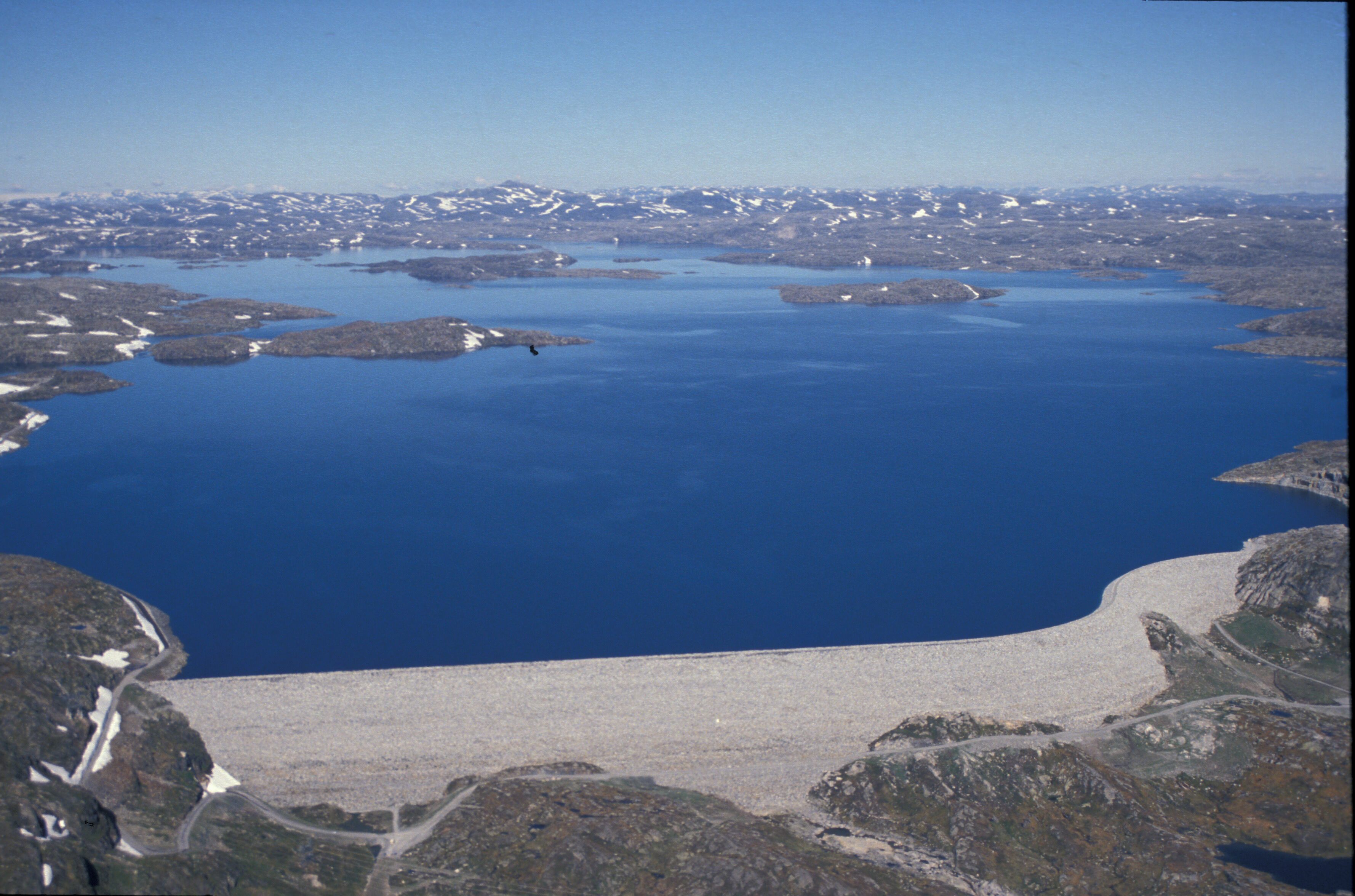
India is not Norway - it cannot store three years of inflow, and its rivers are shared, seasonal and contested. But the design principle transfers: as variable renewables grow, the value of a flexible megawatt rises relative to an average one. That is the frame in which Subansiri's second life makes sense, and the frame in which the government's parallel push on pumped storage - 320 projects identified, 345 GW of potential, per the Ministry of Power - reads as the same idea pursued deliberately.
One project in a long queue
Subansiri also should not stand in for all of Indian hydro; NHPC's own portfolio keeps it honest. The company runs 9,333 MW across 31 stations - Subansiri's 1,250 live MW is about 13% of that, and at the full 2,000 MW it would reach 21% - my arithmetic against today's portfolio; the eventual share depends on how much the portfolio around it grows. Behind it in the queue, dwarfing everything, sits Dibang in Arunachal Pradesh: 2,880 MW across twelve units, a hydropower-cum-flood-moderation scheme approved at Rs 31,876 crore. The North-East's rivers are where Indian hydro's remaining ambition physically lives, and every argument that stalled Subansiri for eight years will be had again there. Power from Subansiri's units is allocated across the North-Eastern, Northern and Western grids, per the regional power committee's allocation letters - the North-East keeps a share of what its rivers generate, but this was always a national project.
The caveats are real and belong in the record. Three units are still to come, and this project's plans have slipped before. The downstream concerns that stopped work in 2011 were answered with redesign, a flood cushion and Rs 522 crore of riverbank protection works, not with disappearance; the project's own documents describe winter flows to the river far below natural levels when generation is low, and the peaking regime downstream communities will live with is a managed condition, not a resolved argument. India is building storage at speed.
That is my argument, marked as one: the energy transition's scarcest asset is not generation, it is obedience - capacity that follows instructions. India spent two decades and four budgets learning how hard that asset is to build. The next time someone proposes a large dam in the North-East, the question will not be whether the turbines work. It will be whether anyone has the patience to finish one. On the Subansiri, at five midnights and counting, the answer is finally visible.
Sources
NHPC's stock-exchange filing via PSU Connect, 22 October 2026 - Unit 5 commercial operation from 00:00 hours, 23 October 2026; five of eight units live, 1,250 MW
Press Information Bureau, 23 December 2025 - first unit (Unit 2) inaugurated; project specifications, flood cushion, riverbank works, phased plan for remaining units in 2026-27
North Eastern Regional Power Committee, 30 January 2026 - Unit 3 COD from 00:00 hours, 1 February 2026; share allocation across NER, NR and WR grids
The Statesman, 2 February 2026; Times of India, 21 March 2026; Economic Times, 5 May 2026 - units two through four
NHPC Subansiri Lower project page - 8 x 250 MW, 7,421.59 MU design energy, cost Rs 6,285 crore (Dec 2002) to an anticipated Rs 26,076 crore at completion
PSU Watch, 24 August 2019 and Enerdata, 18 October 2019 - the 2011-2019 stall, the protests, the NGT process, the resumption; seismic design rating; hydro's 13% share in 2018
NHPC investor presentation, June 2026 - NHPC portfolio of 9,333 MW across 31 stations; Dibang 2,880 MW pipeline; hydro at 9.49% (52,065 MW) of all-India installed capacity of 548,858 MW
Energy Facts Norway (Norwegian Ministry of Energy) - 1,791 plants at 88% of normal annual production; 87+ TWh of reservoirs, half of Europe's storage; over 75% of capacity flexible; Blasjo reservoir
Ministry of Power via PIB, 19 October 2026 - 300 GW non-fossil crossed July 2026; 500 GW target for 2030; CEA storage projection of ~74 GW by 2031-32; pumped-storage roadmap
Responses
No responses yet - yours could be the first.
Get the notes
Occasional emails about what I'm building, what worked, and what broke.