
The Indian Canvas #115: Switched Off at Noon
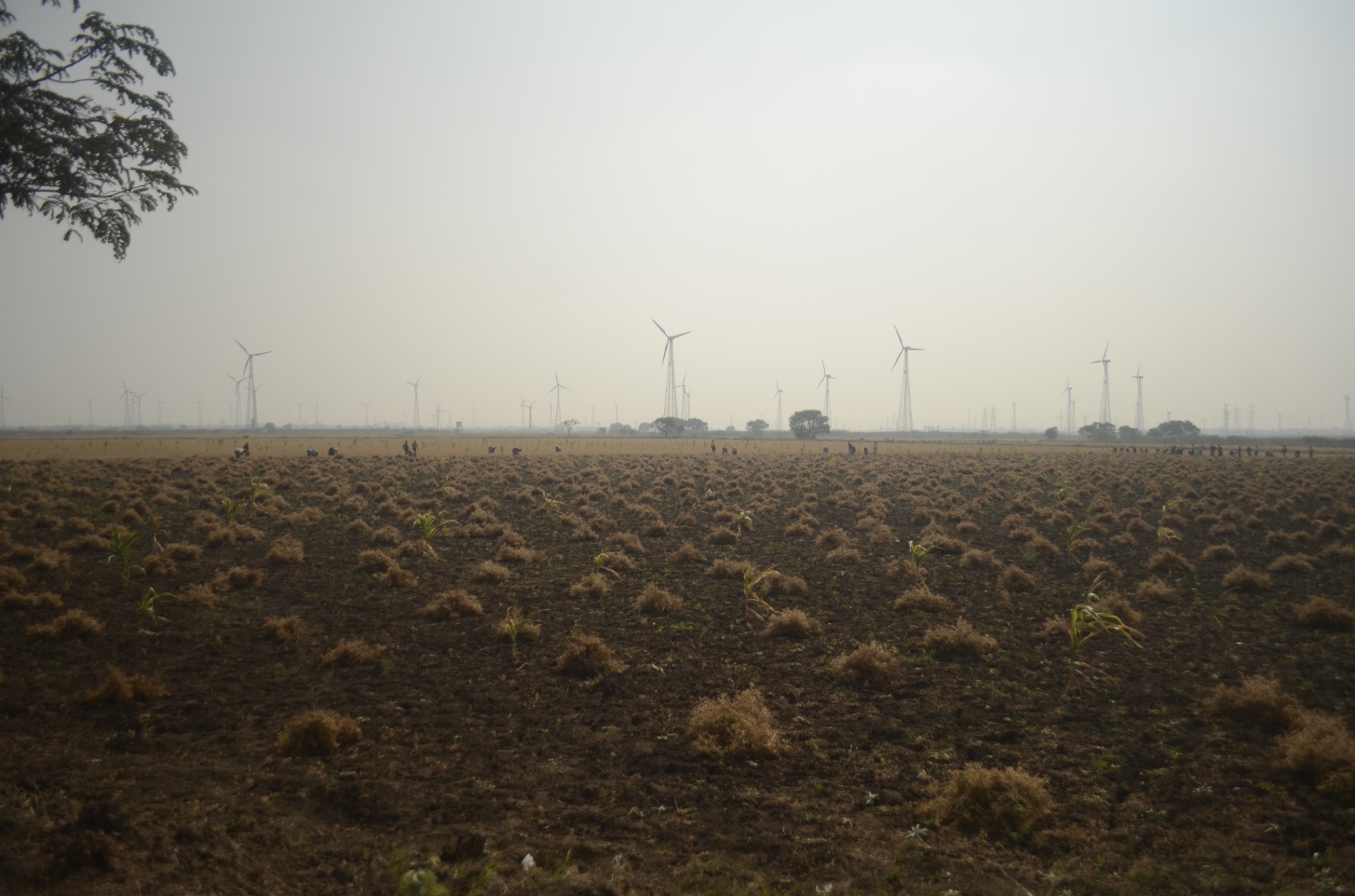
At noon on a clear December day in Rajasthan, twenty-six solar farms did something perverse: nothing. The sun was directly overhead, the panels were new, the buyers were signed - and the plants were switched off. All 4,300 megawatts of them, fully curtailed during daylight hours, because the wires that were supposed to carry their electricity to the grid do not exist yet. On 11 December, the Northern Regional Load Despatch Centre withdrew the temporary permissions under which these projects - built by companies including Adani, ReNew and ACME at a cost approaching Rs 20,000 crore - had been feeding in what little power they could. The Hindu reported the arithmetic: Rajasthan has about 23 GW of commissioned renewable capacity and 18.9 GW of transmission capacity to carry it. The newest 765-kV line, Khetri-Narela, freed up 600 megawatts. In the same breath, 4,300 megawatts of new generation claims were operationalised. The margin was gone before it arrived.
The bottleneck is the wire, not the sun
India's renewable buildout is genuinely fast, and the official numbers show it. The government told Parliament this July that the country had 288.58 gigawatts of renewable capacity as of 30 June 2026 - 162 GW of solar, 57 GW of wind - and that renewables' share of actual generation has climbed from 17% in 2014-15 to nearly 26% in 2025-26. Lenders deployed roughly Rs 5.08 lakh crore into the sector over just two financial years. But the same year that India added 38 GW of solar, it also threw clean electricity away. The energy think tank Ember calculates that India lost 2.3 terawatt-hours of solar generation in 2025, largely in the second half, as the system operator curtailed midday solar as an emergency measure to keep the grid stable - a loss equivalent to about 18% of an average month's solar output. Generation is compounding; the wires are not. That mismatch is now the binding constraint on Indian renewables, and Rajasthan's idle noons are what the constraint looks like from ground level.
A corridor in three phases
The Green Energy Corridor was conceived in 2015 precisely to fix this mismatch, in phases. Phase I was a Rs 10,141.68-crore scheme to build about 9,700 circuit kilometres of lines and 22,600 MVA of substations across eight states, evacuating roughly 24 GW. Its inter-state component finished in March 2020; the intra-state part, run by the states, is still not done a decade on. Four states - Rajasthan, Karnataka, Madhya Pradesh, Tamil Nadu - completed their works. The other four - Andhra Pradesh, Gujarat, Maharashtra, Himachal Pradesh - have needed extension after extension, stalled by right-of-way disputes, forest clearances and court cases, including the Great Indian Bustard litigation that has shadowed every transmission plan in the desert west.
Phase II was approved on 6 January 2022: Rs 12,031.33 crore, of which the Centre would fund a third, to lay 10,750 circuit kilometres and 27,500 MVA of substations across seven states, evacuating about 20 GW, all within five years - by March 2026. Here is where the story turns from slow to stark. On 16 December 2025, the Ministry of New and Renewable Energy told the Rajya Sabha that 91 packages had been approved under Phase II, 73 tendered and 67 awarded - and that not a single renewable project had been connected under the scheme so far. Minister of State Shripad Naik's written answer, quoted by the HinduBusinessLine, is the flattest sentence in this story, and the most damaging: "As per the information provided by the states, no RE project has been connected under GEC Ph-II so far." Karnataka, which missed the 31 March 2026 deadline, has asked for an extension to 31 July 2027. The five-year scheme reached its March 2026 deadline with the connection count reported, in December 2025, at zero.
Phase III expands transmission and adds storage
Which brings us to 30 September 2026, when the Union Cabinet approved Green Energy Corridor Phase-III: a total outlay of Rs 1,86,405 crore - Rs 1,36,378 crore for intra-state transmission to evacuate up to 135 GW, plus Rs 50,000 crore for 50 GWh of battery storage - with central financial support of Rs 54,082 crore, targeted for completion by FY 2032-33. Read the design closely, because it shows the government has been taking notes. Greenfield lines will be built through tariff-based competitive bidding, with private transmission providers owning and operating them on a build-own-operate-maintain model - not left entirely to the same state utilities that have struggled for a decade. The batteries sit at the generation end, aimed squarely at the midday-curtailment problem Rajasthan embodies. And the central assistance is explicitly meant to offset intra-state transmission charges, keeping green power cheap for the end consumer. As a piece of policy design, this addresses the diagnosed failures. The open question is not the blueprint. It is whether a system that took a decade to partially deliver 24 GW can deliver 135 GW in six years.
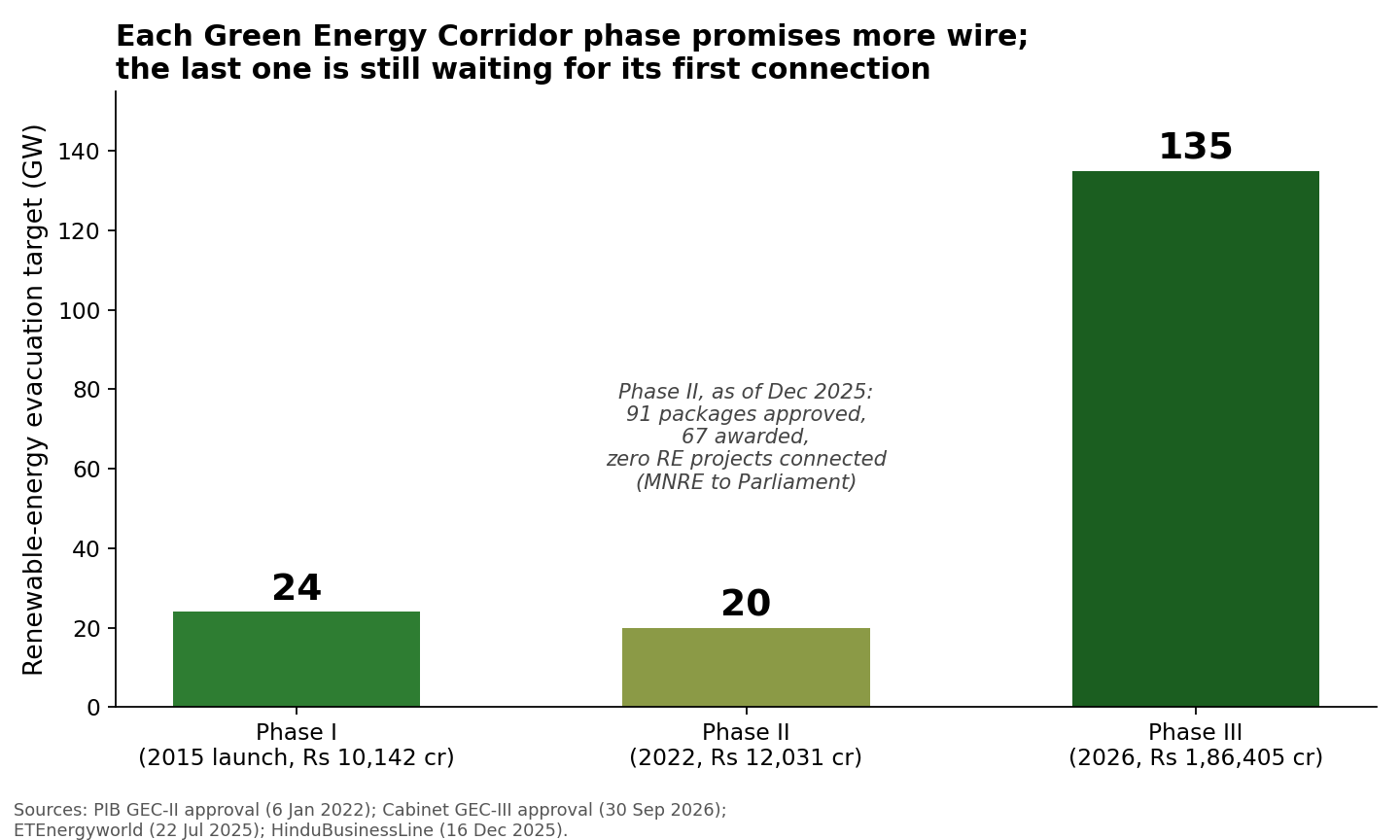
Each corridor phase promises more wire: 24 GW, 20 GW, then 135 GW of evacuation - while Phase II, as of December 2025, had connected zero projects. Sources: PIB (6 Jan 2022), Cabinet release (30 Sep 2026), ETEnergyworld (22 Jul 2025), HinduBusinessLine (16 Dec 2025).
What the rest of the world learned about wires
Three comparisons calibrate the bet. The optimist's case is Texas. Its Competitive Renewable Energy Zones programme - documented in ERCOT's own briefing to the US Department of Energy - built about 3,600 right-of-way miles of 345-kV lines for $6.9 billion, completed in January 2014, designed to carry 18.5 GW of wind that did not fully exist yet. Build the wires ahead of the generation, Texas wagered, and the generation will come. It did: the lines were open-access, the wind rushed in, and CREZ is now the canonical proof that transmission-led planning works when it is actually finished on time.
The warning is Germany. SuedLink, the 700-kilometre high-voltage direct-current line meant to carry 4 GW of North Sea wind to the industrial south, was first planned years ago for a fraction of its current budget. After resident protests forced the line underground - a choice that buys social peace at the price of years - it is now a roughly 10-billion-euro project scheduled for 2028, having slipped past 2022 and then 2025. Even Europe's most capable grid builders cannot schedule a corridor's arrival to match the decade's politics. India's right-of-way disputes and bustard litigation are its version of the same friction; Phase III's designers should read SuedLink as a scheduling document, not a foreign curiosity.
The scale benchmark is China, with a caveat that must travel with it. As of April 2024, China had 38 ultra-high-voltage lines in operation, "bullet trains for power" that move entire rivers' worth of electricity across provinces - one link alone carries 6.4 GW of Jinsha River hydropower to Shanghai, meeting up to 40% of the city's demand. That is what execution capacity looks like when a state builds transmission the way it builds high-speed rail. But the caveat matters: those lines were conceived to move hydro and coal, are being retrofitted to the renewables story, and run through a system whose permitting politics India cannot and should not copy. The lesson is narrow - wires first, generation follows - not the governance model that delivers it.
The test
So the credibility test for Phase III is not its headline number, eye-catching as Rs 1.86 lakh crore is. It is a single statistic, trackable by anyone, in the ministry's own answers to Parliament: the count of renewable projects actually connected under the Green Energy Corridor. That count - the number of projects connected under Phase II - was zero in the ministry's December 2025 answer cited here. Phase III's design - competitive bidding, private operators, storage at the source, charges offset for consumers - suggests the lessons of Phase I's right-of-way quagmire and Phase II's award-without-connection record have been understood. The transmission plan, the ministry says, is now prepared till 2030. The sun over Rajasthan is not waiting that long. Neither are the 26 farms that stood silent at noon last December - their panels ready, their buyers waiting, their wires still on order.
Sources
PM India, 30 September 2026 - Cabinet approves GEC-III: Rs 1,86,405 crore (Rs 1,36,378 crore InSTS for 135 GW + Rs 50,000 crore for 50 GWh BESS); CFA Rs 54,082 crore; FY 2032-33 target; TBCB/BOOM for greenfield.
The Hindu BusinessLine, 16 December 2025 - MNRE to Rajya Sabha: 91 packages approved, 73 tendered, 67 awarded; no RE project connected under GEC-II so far; Phase I ISTS done March 2020; four states extended.
PIB, 6 January 2022 - CCEA approval of GEC-II: Rs 12,031.33 crore, CFA 33%, 10,750 ckm + 27,500 MVA, ~20 GW in seven states, FY 2021-22 to 2025-26.
ETEnergyworld, 22 July 2025 - GEC-I (Rs 10,141.68 crore) delays in four states due to RoW, Great Indian Bustard litigation, forest clearances; four states completed.
The Times of India, 27 April 2026 - Karnataka misses 31 March 2026 GEC-II deadline, seeks extension to 31 July 2027.
The Hindu, 14 December 2025 - Rajasthan: 4.3 GW of solar fully curtailed in daytime; 23 GW RE vs 18.9 GW transmission; Khetri-Narela added 600 MW; NRLDC withdrew NOCs for 26 projects on 11 December.
Lok Sabha USQ 1756, 29 July 2026 - 288.58 GW renewable capacity as of 30 June 2026; RE generation share 17.00% (2014-15) to 25.97% (2025-26); Rs 5.08 lakh crore deployed by lenders in FY25-FY26; transmission plan prepared till 2030.
Ember, 27 January 2026 - India lost 2.3 TWh of solar generation in 2025 to grid-security curtailment (~18% of average monthly solar generation); 38 GW solar added in 2025.
ERCOT briefing to US DOE, August 2014 - CREZ complete as of 30 January 2014: ~3,600 right-of-way miles of 345 kV, $6.9 billion, designed for ~18.5 GW, open access.
Clean Energy Wire, 12 September 2023 - SuedLink: 700 km HVDC, 4 GW, ~EUR 10 billion, scheduled 2028; underground after protests delayed construction for years.
BBC, 15 November 2024 - China: 38 UHV lines in operation as of April 2024; Jinsha-Shanghai link 6.4 GW, up to 40% of the city's demand; network built first for hydro and coal.
Responses
No responses yet - yours could be the first.
Get the notes
Occasional emails about what I'm building, what worked, and what broke.