
The Indian Canvas #101: Twenty-Two Thousand Roofs a Day
Stand on a rooftop in Mehsana, Gujarat, on a February morning, and the first thing you notice is how much of the city lives on its roofs. Water tanks. Clotheslines. A grain of wheat drying on a gunny sack. And then, tilted at the winter sun, a solar array the size of a small car, bolted to a frame of galvanized iron. A few streets over, another. Then another. In February 2026, a photographer named Nizil Shah climbed up and took a picture of this skyline, and if you look closely you can count the arrays the way you would count trees in a young plantation. Mehsana is not a showcase. Nobody chose it. That is what makes the picture worth looking at.
Two years ago, almost none of these roofs had panels. In the decade before February 2024, all of India managed 7.94 lakh household rooftop installations. Then the Union Cabinet approved the PM Surya Ghar: Muft Bijli Yojana - Rs 75,021 crore to put solar on one crore homes, with the promise of up to 300 units of free electricity a month. By early August 2026, the scheme had crossed 50.06 lakh beneficiary households. In July 2026 alone, its best month ever, 5.06 lakh households came online - 16,328 roofs a day, a pace three times faster than the previous October. Officials of the Ministry of New and Renewable Energy say about 60 lakh households had benefited by the end of September, and that they hope to near the one-crore target by March 2027.
That is a genuine acceleration, and this column does not grade on a curve. Nineteen lakh households now receive zero electricity bills. More than twelve lakh households earned Rs 421 crore selling surplus power back to the grid in FY 2024-25, about Rs 3,500 a year each. Rs 28,024 crore in subsidy has landed directly in bank accounts. The scheme is, on the evidence of its own numbers, the fastest-growing household clean-energy programme ever attempted.
And that is exactly when a delivery chain starts to creak.
The chain
A rooftop solar system in India is not bought. It is processed. A household registers on the National Portal, picks one of 34,219 registered vendors, arranges money - often a collateral-free bank loan at 5.75 percent, pegged to the repo rate plus half a point - waits for the loan, gets the installation done, waits for the discom to inspect and commission the net meter, then requests the subsidy, which the government promises within about 15 days of the redemption request through PFMS. Seven handoffs: portal, vendor, bank, installer, discom, inspector, treasury. The household holds the risk at every one of them, because the household has usually already paid.
Each joint in that chain now has a dated failure attached to it. On 6 October, the Department of Financial Services wrote to the banks: public sector banks were taking 17 days on average to process a Surya Ghar loan, private banks 19, and the target is under 10. Mint, which reviewed the letter, reported the spread behind the average: Punjab National Bank clears in 12 days, IDBI Bank takes 44. Private banks have nearly exited the field - public sector banks carried 3.78 million applications worth Rs 86,646 crore, against 62,489 applications worth Rs 1,387 crore at every private bank combined. Kotak Mahindra Bank had received exactly one. In Kannauj, Uttar Pradesh, 550 beneficiary cases sat stuck at banks in early October; the district magistrate has separately ordered notices and an FIR against a vendor for negligence. In Agra, 836 consumers who had paid for installations found their subsidy blocked because vendors had not uploaded the installation data to the portal. Parliament's standing committee on energy, in a report tabled in March, had already flagged the pattern at national scale: underutilized funds, missed physical targets, and delays at precisely the joints named above - inspections, commissioning, net-metering, financing, subsidy disbursement.
The government is not pretending otherwise. Its own answer to a Lok Sabha question in August concedes "several complaints regarding empanelled vendors, delays in installation and subsidy disbursal," and lists its countermeasures: technical feasibility waived and approvals deemed up to 10 kW, the net-metering agreement folded into the portal application, vendor registration simplified, loans made paperless through Jan Samarth. Thirty-two states and UTs have scrapped application and net-metering charges. The October letter to the banks is the same posture applied to the slowest joint: the state, having built the digital rails, is now leaning on every institution that still makes a family wait.
The arithmetic
Here is the number that frames the next seventeen months. To reach one crore households by March 2027 from about 60 lakh at the end of September, the scheme must add roughly 40 lakh households in 182 days. That is about 22,000 installations a day, every day, including the days when loan files sit at IDBI for six weeks. The best month the scheme has ever produced averaged 16,328.
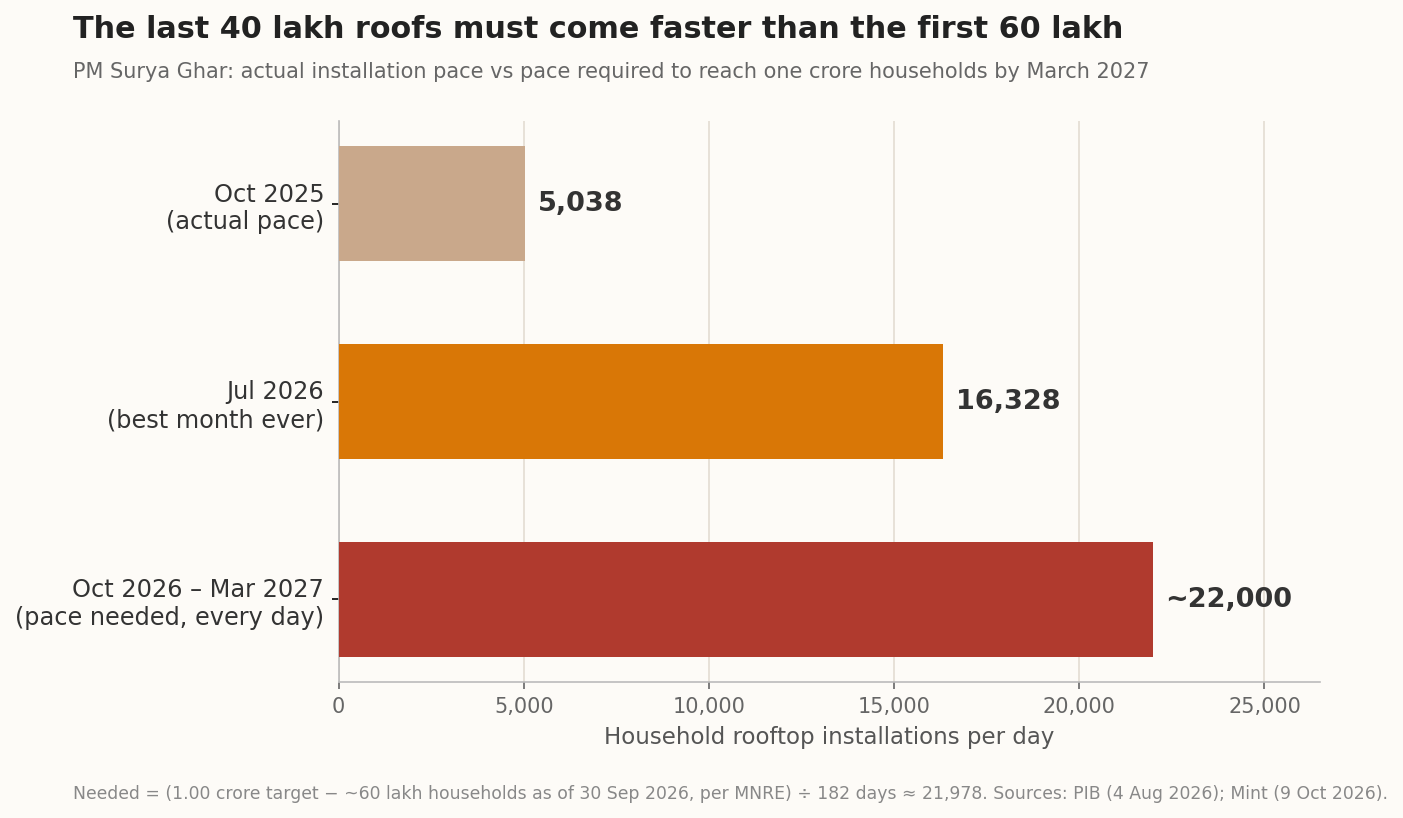
Actual pace vs the pace needed every day to reach one crore households by March 2027. Sources: PIB (4 Aug 2026); Mint (9 Oct 2026).
India has been here before, on a larger canvas. The country targeted 40 GW of rooftop solar by 2022 and missed it by a wide margin - a parliamentary panel called the target unrealistic while it was still on the books - even as utility-scale solar parks sprinted ahead. The reason is structural, and worth saying plainly: a 500 MW solar park is one negotiation, one land lease, one transmission connection. One crore rooftops is one crore negotiations - with one crore families, thirty-four thousand vendors, a dozen banks, and eighty-odd discoms. Rooftop solar is not infrastructure in the usual sense. It is retail. And retail is a delivery problem.
Two countries that solved the delivery problem
Australia has the highest uptake of household solar in the world, and its subsidy design contains a quiet clue. Under the Small-scale Renewable Energy Scheme, a home's entitlement takes the form of small-scale technology certificates. The household does not pay full price and wait for reimbursement. It assigns the certificates to a registered agent - usually the installer or retailer - which gives the discount upfront, on the invoice, and monetizes the certificates itself. The waiting risk sits with the business best equipped to hold it, not the family. The subsidy is realized at the till.
Bangladesh solved a different version of the same problem before most countries noticed it existed. Starting in 2003 as a 50,000-household pilot, the state-owned finance company IDCOL ran what the World Bank calls the largest off-grid solar programme in the world, bringing electricity to 20 million people. IDCOL did not wait for households to assemble the chain. It financed a network of partner organizations - NGOs and microfinance institutions with village-level staff - that sold the systems on credit, installed them, collected repayments at the doorstep, and answered for the equipment afterwards. Delivery was not the customer's homework. It was the product.
The two models share one design instinct: the household is never the one holding the bag while institutions move at institutional speed. Australia's installer absorbs the wait for the subsidy. Bangladesh's partner organization absorbed the entire process. India's scheme, for all its digital elegance, still asks the family to wait - for the loan officer, the vendor's upload, the discom's meter - and to keep waiting politely, because the subsidy arrives only after everything else does.
What I would watch
Here is my hypothesis, and it is a hypothesis, not a finding: the last 40 lakh roofs will be decided less by the size of the subsidy than by who owns the household's waiting risk. Every reform the government has made so far - the portal, deemed approvals, 15-day PFMS releases, the October letter to the banks - shrinks the wait. That is the right instinct, and it may yet be enough. But the Australian example suggests there is a second lever: not just making the wait shorter, but moving it off the family entirely, onto institutions built to carry it. A household that has paid and is waiting is a household that can be failed. A household that pays the discounted price on day one cannot be failed by a process it never sees.
So watch two numbers, not the install count. Watch the average loan turnaround - if the banks actually get under ten days, the chain's slowest joint has been fixed, and the ministry's letter will have done what letters rarely do. And watch whether the scheme lets any part of the subsidy move to the invoice, the way Australia does, instead of arriving as a reimbursement weeks later. The panel on the roof is the visible part of the machine. The machine itself is a queue, and queues are won or lost on who is made to stand in them.
Somewhere in Mehsana tonight, a family is checking its phone for the SMS that says the subsidy has landed. Sixty lakh families got that message. The scheme has seventeen months to send it to forty lakh more. The panels were never the hard part.
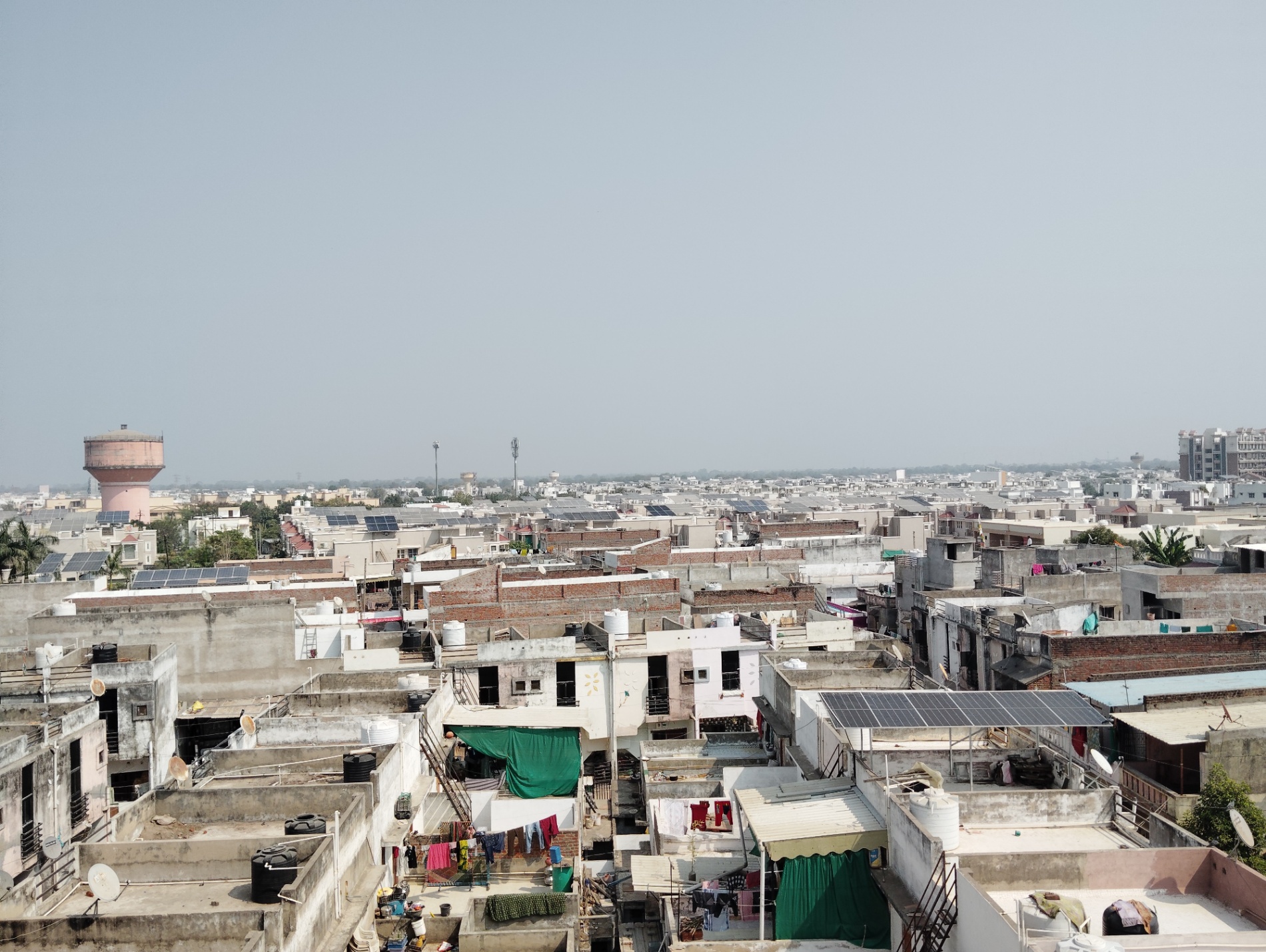
Rooftop solar arrays on homes in Mehsana, Gujarat. Photo: Nizil Shah, CC BY-SA 4.0, via Wikimedia Commons.
Sources
Press Information Bureau - Cabinet approves PM-Surya Ghar: Muft Bijli Yojana (29 Feb 2024)
Press Information Bureau - PM Surya Ghar crosses 50 lakh rooftop installations (4 Aug 2026)
Lok Sabha Unstarred Question No. 2834, answered 5 Aug 2026 (MNRE)
Mint - Finance ministry pushes banks to cut rooftop solar loan processing time (9 Oct 2026)
Live Hindustan - 550 beneficiary cases stuck at banks in Kannauj (Oct 2026)
Dainik Bhaskar - Kannauj DM orders notice, FIR against vendor
Clean Energy Regulator (Australia) - Rooftop solar and the Small-scale Renewable Energy Scheme
World Bank - Bangladesh Solar Home Systems provide clean energy for 20 million people (8 Apr 2021)
The Hindu - Parliamentary panel on missed renewable targets and rooftop shortfall
ET EnergyWorld - MNRE's 40 GW rooftop solar target unrealistic: Parliamentary panel
Responses
No responses yet - yours could be the first.
Get the notes
Occasional emails about what I'm building, what worked, and what broke.