
The Indian Canvas #119: Eleven Crore, Five Months Early
Sometime on the night of 23 October 2026, India's farmer registry crossed eleven crore entries. The Ministry of Agriculture and Farmers' Welfare announced it the next afternoon: a target the Prime Minister had set for 31 March 2027, met five months early. Eleven crore farmers now hold a Farmer ID, the unique digital identity the government calls Kisan ki Pehchaan - the farmer's own proof of who they are, built to open the door to schemes, bank credit, crop insurance and disaster relief without a file of photocopies.
I have spent the week reading what the registry actually is, because the announcement's framing - "a major milestone for digital agriculture" - tells you nothing about the machinery. The machinery is the story. What India is attempting is a live, federated register of every farmer, linked to the land they till and the crops they grow, meant to serve as the addressing layer for the entire farm welfare state.
What got built
The Farmer ID sits inside the Digital Agriculture Mission, approved by the Union Cabinet on 2 September 2024 with an outlay of Rs 2,817 crore, of which the central share is Rs 1,940 crore. The mission builds three digital public infrastructures, of which AgriStack is the farmer-facing one. Its three foundational registries - the Farmers' Registry, geo-referenced village maps and the Crop Sown Registry - are created and maintained by state governments, to common standards, with a copy cached at the Centre. Nineteen states had signed the implementation MoU at the time of the cabinet approval.
The architecture choices are precise and worth stating precisely. The ID is, in AgriStack's own documentation, "a functional ID, based on Aadhaar": seeded from Aadhaar for de-duplication, but a separate number for a separate purpose. It is dynamically linked to the farmer's land records, crops sown, livestock ownership, family details and schemes availed. Crucially, the land linkage is "for non-legal, planning and advisory, and scheme-delivery purposes only": a Farmer ID is not a land title, and the design says so in so many words. That is also the line that separates it from the property-card exercise in village residential land - the registry covers farmland and the people who farm it, not ownership documents for the abadi. Crops are recorded each season through a mobile-based Digital Crop Survey, piloted in eleven states in 2023-24 and intended to cover every district.
The rollout was phased: six crore IDs in 2024-25, three crore in 2025-26 and two crore in 2026-27, after pilots in one district each of six states - Farrukhabad in Uttar Pradesh, Gandhinagar in Gujarat, Beed in Maharashtra, Yamuna Nagar in Haryana, Fatehgarh Sahib in Punjab and Virudhnagar in Tamil Nadu. The finish came early. And the registry is already doing work: the ministry says more than six crore farmers have received direct benefits under various schemes through the Farmer ID-based delivery system.
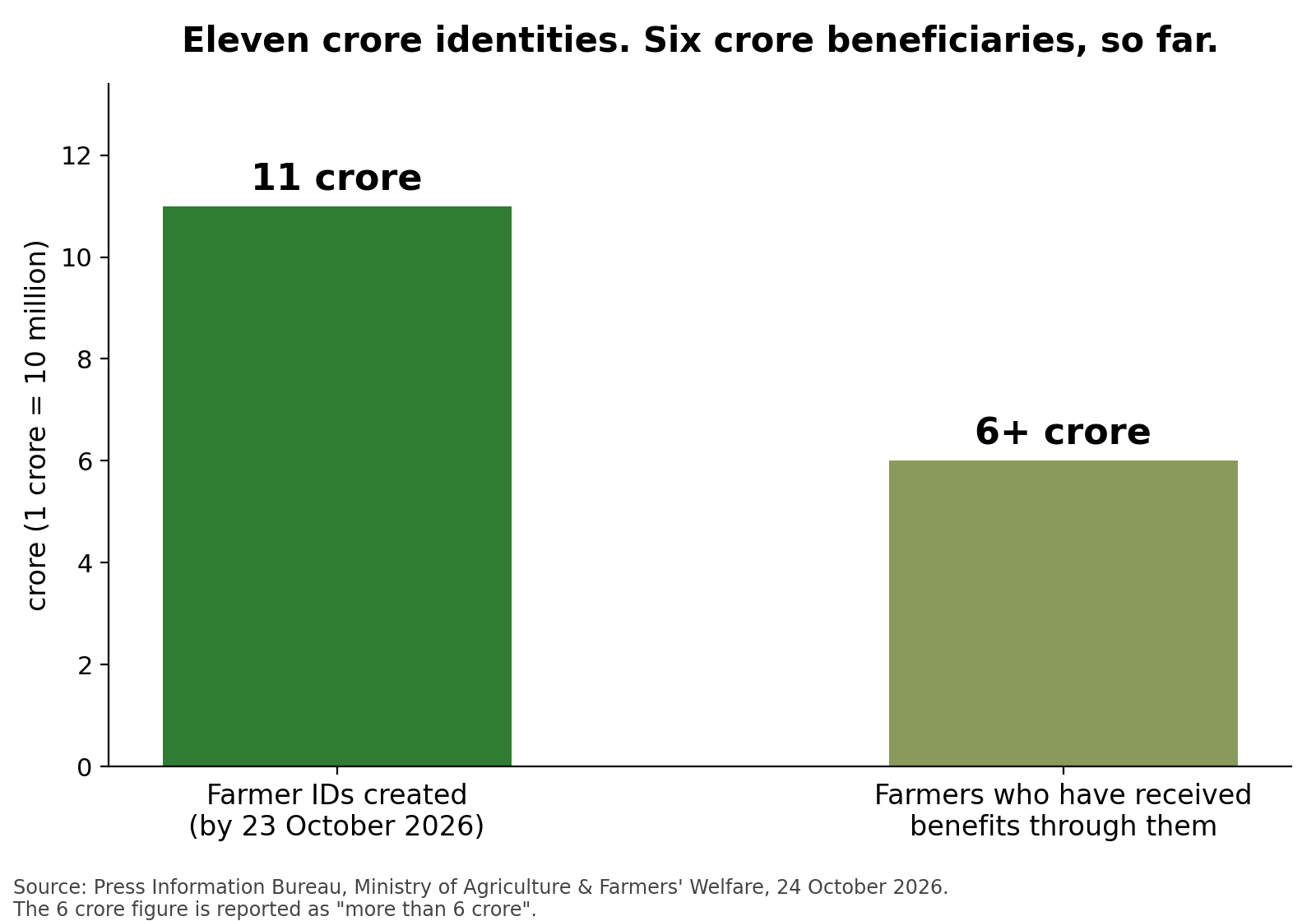
Farmer IDs created vs farmers who have received benefits through the Farmer ID-based delivery system. Source: PIB, Ministry of Agriculture & Farmers' Welfare, 24 October 2026.
The machine Europe has run for thirty-four years
One operating model for paying farmers against verified identities and verified land at continental scale has been running since 27 November 1992. That is the date of Council Regulation 3508/92, which established the Integrated Administration and Control System, IACS, as part of the first big reform of the Common Agricultural Policy, when Europe moved from guaranteed prices to direct income support and suddenly needed to know precisely who it was paying, and for which piece of land.
Today's IACS, described on the European Commission's own pages, manages and controls all area- and animal-based CAP interventions. Its components read like the inventory any such system needs: a land parcel identification system that identifies every agricultural parcel in the EU; a geo-spatial application on which the farmer marks their fields; an area monitoring system that watches crops through Copernicus satellites; a beneficiary identification system; and a control-and-penalty system. The annual rhythm is the real lesson. The farmer's aid application arrives pre-filled from last year's data; the farmer confirms, corrects or completes it; administrations run document checks, satellite monitoring and on-the-spot visits on a sample; payments follow the findings; and the cycle seeds next year's form. The CAP accounts for 386.6 billion euros of the EU's 2021-27 budget. Almost none of its area- and animal-based spending moves without the registry.
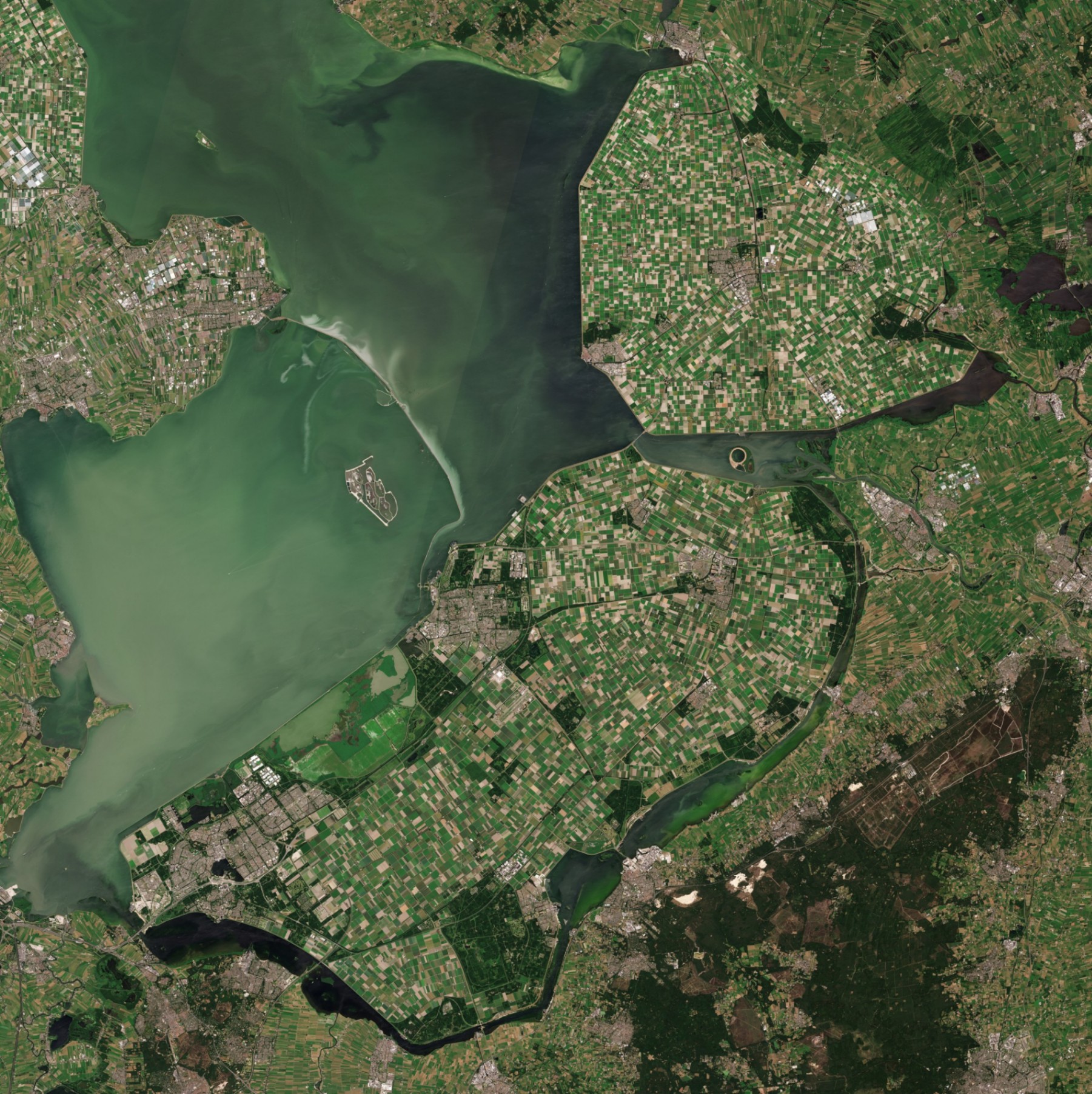
Flevoland in the Netherlands, seen by ESA's Sentinel-2. Every agricultural parcel in the EU is identified in the parcel registry that underpins area-based farm payments. Image: Copernicus Sentinel-2, ESA, CC BY-SA 3.0 IGO, via Wikimedia Commons.
Note what Europe did not do. It did not launch the registry as a product with a launch event. It built the register because the payments required it, then spent three decades making it boring. The technology changed - paper forms became geo-spatial applications, sample inspections became satellite monitoring - but the object never did: one identified farmer, one identified parcel, one verified annual claim.
The honest gaps
Three qualifications belong in the same breath as the milestone, and each is visible in the government's own documents.
First, the owners are in; whether the tillers join them depends on state policy. The 2024 cabinet decision said the registry "will include cultivators & tenant farmers, as per the policy of the State Government", and this week's announcement says states and union territories are taking specific steps to bring tenant farmers and actual cultivators onto the platform. Much of Indian tenancy is informal and unrecorded, which is exactly why it resists registration. But a registry of landowners is a different, smaller thing than a registry of the people who actually farm, and the distance between the two is where exclusion errors will live.
Second, the registry inherits the land records. The linkage is dynamic and the standards are common, but the underlying records are maintained by dozens of states and union territories in very different conditions. An ID tied to a wrong record will be confidently, efficiently wrong. The mission knows this; it is one reason the linkage is declared non-legal. But scheme delivery at scale will be tested on the weakest state's records, not the best.
Third, the privacy machinery has to catch up with the law. AgriStack's Consent Manager, built on the DEPA architecture, is described on the project site as something that "will evolve as the data privacy regulations are formally legislated." That text predates the Digital Personal Data Protection Act, 2023, whose rules MeitY notified in November 2025, operationalising the Act with an 18-month phased compliance timeline. A federated registry of eleven crore people's identities, land and crops is precisely the kind of system that law was written for. The consent architecture now has to perform to the law, not just anticipate it.
The bet underneath
Everything so far has been from the documents. This section is my argument, and I am marking it as one.
The white space here is not another scheme; India has schemes. It is the addressing system underneath them. Every familiar failure of farm welfare - duplication, ghosts, the tenant excluded because the record names the landlord, the claim that needs three office visits - is at bottom a failure to answer "who is this farmer, and what do they actually grow?" with data rather than paper. A verified registry does not fix the schemes. It makes their failures visible and their delivery cheap. The six crore farmers who have already drawn benefits through it are the early evidence, and Europe's experience says the payoff compounds quietly: the registry stops being a project and becomes the floor everything stands on. That is what the Rs 2,817 crore is betting on - not that delivery is fixed, but that fixing it is now possible.
Eleven crore entries is a census achievement, and India is good at those. The European lesson is that what matters is the rhythm that follows: pre-fill, confirm, check, pay, repeat, for thirty-four years and counting. The registry is built. Now for the rhythm.
Sources
Press Information Bureau, 24 October 2026: 11 crore Farmer IDs created five months ahead of schedule
AgriStack, Ministry of Agriculture and Farmers' Welfare (Farmer Registry architecture, functional ID, non-legal land linkage, Consent Manager)
European Commission: the Integrated Administration and Control System
Council of the European Union: the common agricultural policy explained (1962 origins; EUR 386.6 billion for 2021-27) and CAP timeline (1992 reform)
Council Regulation (EEC) No 3508/92 of 27 November 1992, Official Journal L 355 (establishing the IACS), via FAO's legal database
Responses
No responses yet - yours could be the first.
Get the notes
Occasional emails about what I'm building, what worked, and what broke.