
The Indian Canvas #102: A Card Is Not a Title
At a distribution camp in a Uttar Pradesh village, the property card arrives laminated. A survey number, a boundary map printed to the metre, a name. The family holding it has lived on that plot for three generations; every elder in the lane can testify to that, and until now, testimony is all there was. Rural India's farmland has had records for a century. The village itself - the abadi, the inhabited cluster where people actually live - sat outside the revenue map, owned by possession and memory. The card is the first time the state has looked directly at that land and written down what it saw.
The machine that wrote it down is genuinely impressive. Under the SVAMITVA scheme, launched on 24 April 2020 by the Ministry of Panchayati Raj, the Survey of India flies drones over village abadi land, anchors the imagery to a network of Continuously Operating Reference Stations, and produces boundary maps accurate enough to settle a dispute over a footpath. States verify on the ground, publish draft maps for claims and objections, and issue property cards - Gharauni in Uttar Pradesh, Sannad in Maharashtra, Adhikar Abhilekh in Madhya Pradesh. As of August 2026, drones have completed surveys in 3.31 lakh of the 3.39 lakh notified villages - 97.7 percent - and 2.72 crore property cards have been distributed. In a country where land administration usually moves at the speed of the record room, this is the fastest large-scale property documentation exercise in Indian history.
It is also heavily concentrated. Five states - Uttar Pradesh (1.04 crore cards), Madhya Pradesh (54.2 lakh), Maharashtra (39.7 lakh), Haryana (25.2 lakh) and Gujarat (12.7 lakh) - account for 87 percent of all cards distributed, by my calculation from the same annexure. Himachal Pradesh has flown drones over 14,285 villages and produced cards for 364 of them. Andhra Pradesh's drones covered 13,321 villages; the national annexure records cards prepared for 1,067 villages and leaves the distributed column blank. The scheme's original 2020 announcement spoke of 6.62 lakh villages in four years; the current notified scope is 3.39 lakh, and even within it, the map-to-card conversion runs at about 60 percent of villages. Some states built the full machine. Others bought drones.
What the card is, legally
Here the story needs care, because a property card is not automatically a property title. India runs on presumptive titling: records create an inference of ownership that a court can overturn, not a state guarantee of it. A socio-legal analysis by the Centre for Social and Economic Progress lays out the gap: for the card to be a legal ownership document, states must amend their revenue codes, and panchayats need legal authority to maintain and update the records afterwards. Uttar Pradesh did this work early - its Revenue Code and the Abadi Survey Record Operation Regulation of 2020 give the gharauni a statutory footing - which helps explain why UP's numbers lead the country. The same analysis flags what the scheme's design leaves out: homes outside the abadi boundary, families in unrecorded informal occupation, and women, whose names do not automatically appear on a card issued on documented possession that is usually in a man's name. And marking boundaries in a village is a political act, not a technical one; run it as a revenue-officer exercise, and it can be bent by the most powerful people in the lane.
Parliament has noticed the seams. In August, four MPs asked the ministry whether wrong demarcation during drone surveys had increased family disputes and litigation in UP, how many property cards banks had refused to accept as collateral, whether the gap between revenue records and actual possession made the data unreliable, and whether re-surveys would be ordered where residents complained of surveyor high-handedness. The ministry's written answers defend the verification process - draft maps, public objections, resolution before finalization, re-flying drones where deficiencies are found - and concede two quieter things: it does not maintain data on disputes and litigation, and it does not maintain data on how many cards banks have refused.
The number the card was printed for
The whole point of the exercise, the launch announcement said, was to "pave the way for using property as a financial asset" by villagers. So the number that matters is not 2.72 crore cards. It is this one: 11,147 loans, worth Rs 1,713.68 crore, disbursed against SVAMITVA cards as of August 2026. That is one loan for roughly every 2,400 cards in circulation, by my arithmetic. And the geography is startling: Rajasthan accounts for 8,808 of those loans - nearly nine of every ten rupees lent - while Uttar Pradesh, holder of 1.04 crore of the 2.72 crore cards, does not appear on the loan annexure at all. The ministry, the Department of Financial Services and state revenue departments say they are working through State Level Bankers' Committees to make cards acceptable to banks; some banks, the ministry notes, have begun lending. The two halves of the scheme - printing the record and putting it to work - are currently being built by different states.
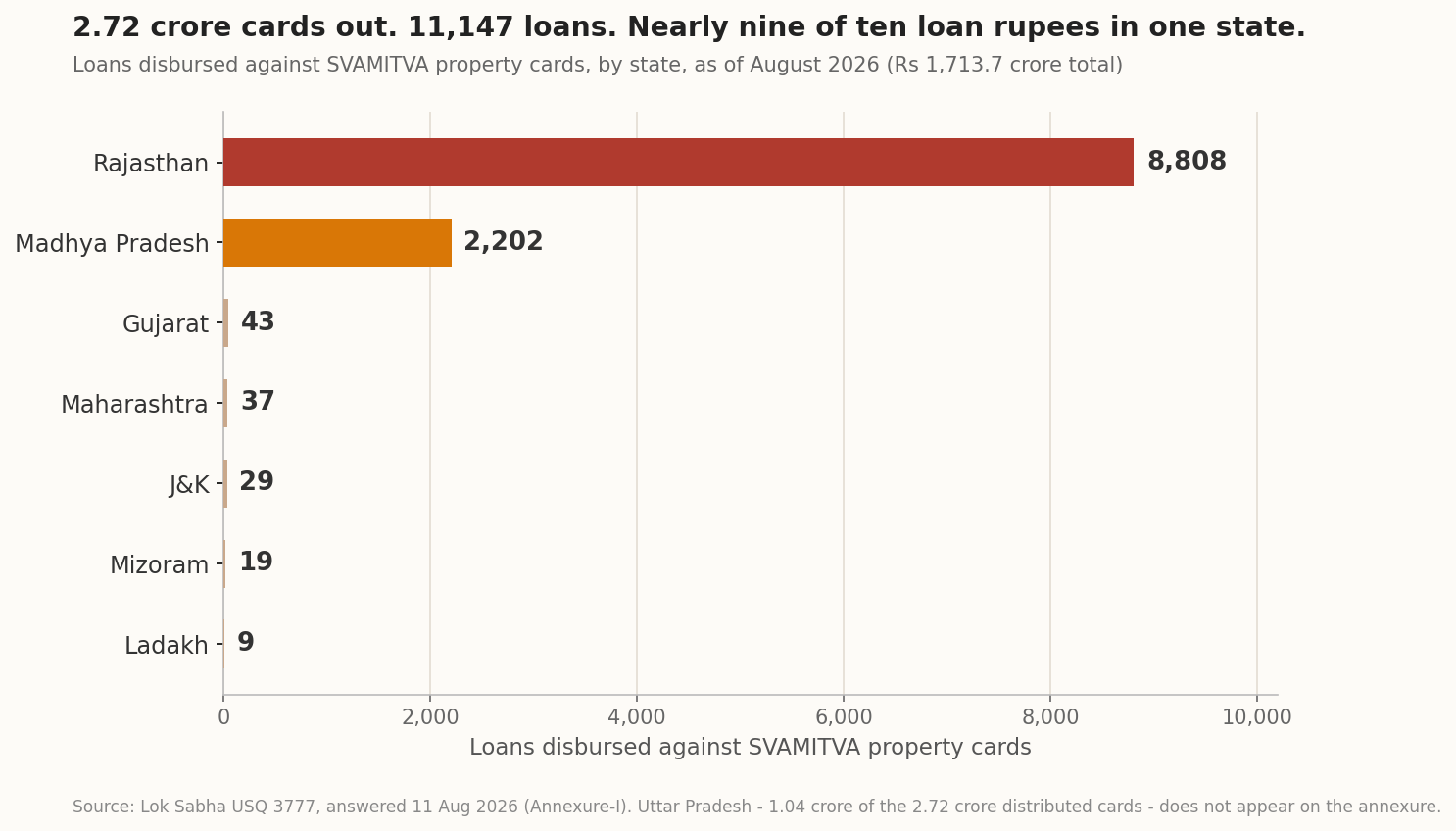
Loans disbursed against SVAMITVA property cards, by state, as of August 2026. Source: Lok Sabha USQ 3777 (11 Aug 2026).
The country that did the whole job
Rwanda is the reference case, and the numbers are worth dwelling on. Its Land Tenure Regularisation Programme registered every parcel in the country - 10.3 million of them - in a single, community-based national sweep that cost between $5.47 and $6.48 per parcel, a fraction of what formal survey systems charge elsewhere. Local para-surveyors walked boundaries with neighbours present; disputes were aired on the spot; and the programme was designed from the start to get women's names onto titles. SVAMITVA's draft-map objection process is recognizably the same idea, run at similar speed and national scale.
But Rwanda's evaluators, reviewing the programme for the UK government, ended on a warning that matters more to India than any of the success factors: the threats to the whole exercise were the sustainability of the land administration system, and its financial and judicial sustainability. A one-time registration is a photograph. Ownership is a film - sales, inheritances, partitions, mortgages - and unless someone is paid, empowered and legally equipped to keep updating the record, the photograph fades. Hernando de Soto's famous phrase for unrecorded property is dead capital. The harder truth his work implies is that capital does not come alive on the day the document is printed. It comes alive the first time a bank clerk, a buyer and a judge all accept the same piece of paper without blinking.
What I would watch
Here is my hypothesis, and it is a hypothesis, not a finding: SVAMITVA's first phase was a measurement problem, and measurement problems are what the Indian state does best - satellites, drones, portals, targets, dashboards. The second phase is an institutional-maintenance problem, and those are harder: revenue codes amended in the laggard states, panchayats with legal authority and budgets to keep records current, card formats that banks' credit departments will underwrite, and women's names on the document from the start rather than by later correction. The scheme has solved seeing. What it has not yet solved is believing - the chain of institutions that must each trust the card before it becomes capital.
So the card count is the wrong scoreboard, and I include the government's own press releases in that charge. The right scoreboard is the one in this issue's chart: loans against cards, by state. When Uttar Pradesh's 1.04 crore gharaunis start appearing on that annexure - when the state that prints the most paper starts converting it at Rajasthan's rate - the scheme will have crossed from documentation to property rights. Three generations of testimony got the family its card. What the card is worth will be decided at the bank counter, the registrar's desk, and the courtroom, none of which take a drone's word for anything.
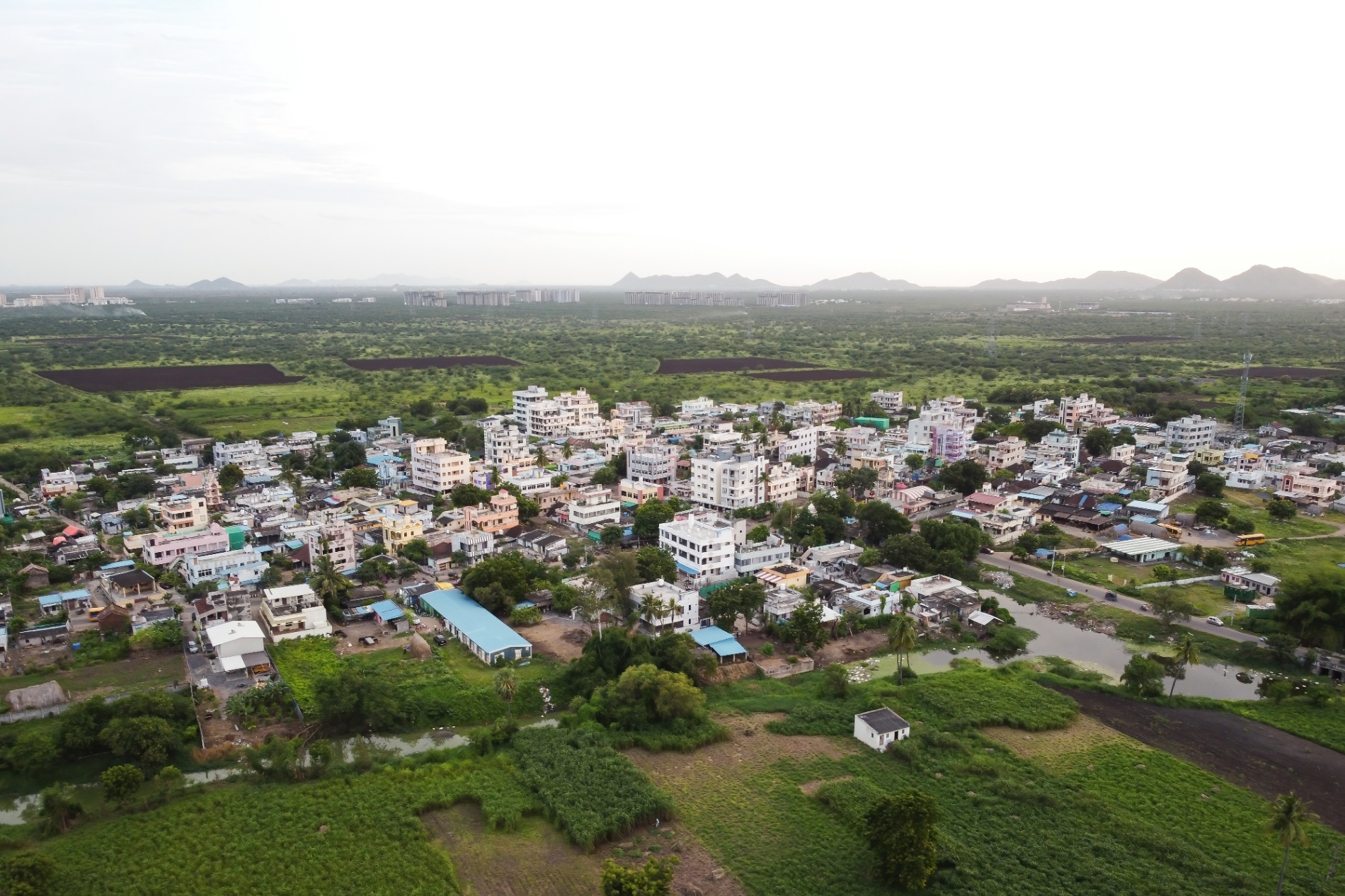
Velagapudi village, Andhra Pradesh, from the air. Andhra's drones have surveyed 13,321 villages; as of August 2026, cards had been prepared for 1,067. Photo: iMahesh, CC BY-SA 4.0, via Wikimedia Commons.
Sources
Press Information Bureau - SVAMITVA Scheme status and state-wise annexure (4 Aug 2026)
Press Information Bureau - PM launches physical distribution of Property Cards (9 Oct 2020)
Times of India - UP issues 1.05 crore SVAMITVA gharaunis (24 Oct 2026)
CSEP Working Paper 26 - SVAMITVA: A Socio-Legal Analysis (March 2022)
Responses
No responses yet - yours could be the first.
Get the notes
Occasional emails about what I'm building, what worked, and what broke.