
The Indian Canvas #123: Plugged In at Tuticorin
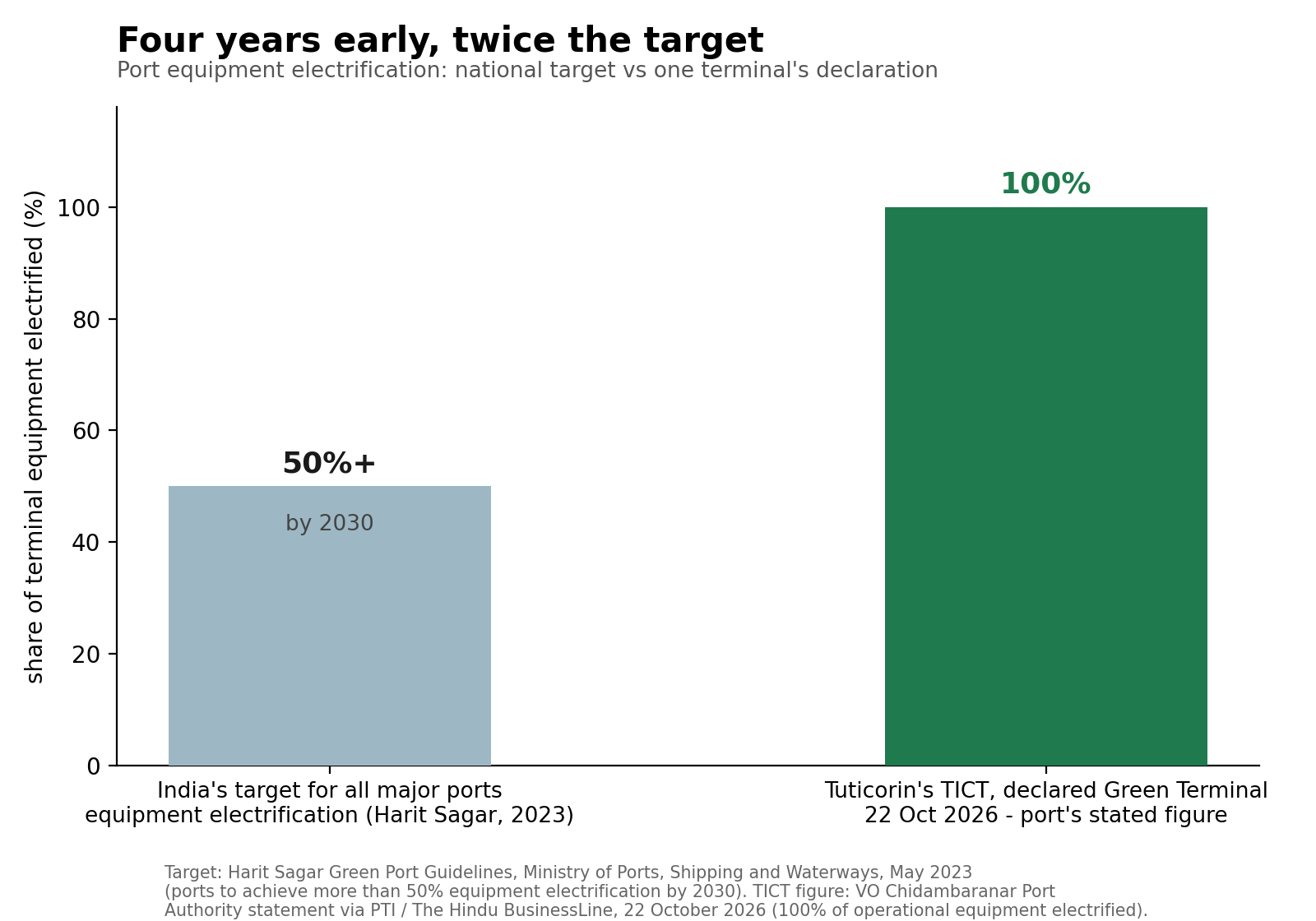
During a project review in Tuticorin this week, reported on Thursday, 22 October, the Union Shipping Secretary, Vijay Kumar, was going over VO Chidambaranar Port's project pipeline when he designated the port's private container facility - Tuticorin International Container Terminal, TICT - a "Green Terminal". The basis, per the port authority's own statement reported by PTI: 100 per cent of the terminal's operational equipment is now electrified. Earlier that week, on Tuesday, 20 October, the Secretary flagged off thirteen electric internal transfer vehicles - the squat trucks that shuttle boxes between crane and yard - to run the point in. Press coverage called it a first for India. The documented core is narrower: a terminal recognised under India's green-port rules after reporting all of its operational equipment electric.
Those rules exist on paper since May 2023. The Ministry of Ports' "Harit Sagar" guidelines ask every major port to electrify more than half its equipment and vehicles by 2030, suggest incentives for ships that can take shore power - queue priority, rebates on berth dues - and say that private operators running their fleets on green fuel or electricity "may be identified and recognized through green certification". The designation is that sentence, applied. TICT is operated by the J M Baxi group, the Indian terminal operator that Germany's Hapag-Lloyd bought into in 2023 - which makes this a private company's capital spending landing four years ahead of a government target.
What actually got switched off
A container terminal's emissions are not only about the ships. The yard runs on rubber-tyred gantry cranes stacking boxes, reach stackers, and the internal transfer vehicles shuttling between quay and stack - traditionally diesel, running nearly around the clock, metres from the water and not far from town. Electrify that fleet and the diesel exhaust and diesel fuel bill go with it. That is the half of the problem TICT claims to have finished.
The other half is the ship at the berth, auxiliary engines running to keep lights, pumps and refrigerated containers alive - and that half belongs to two of the world's most watched port regimes.
The ship half: California and Rotterdam
California regulates it outright. Under the California Air Resources Board's At-Berth Regulation, each covered vessel visit to a regulated port must control its berth emissions with an approved strategy - in practice plugging into shore power, with approved alternatives and exceptions built in - for the duration of the stay. The rule has been phasing in by vessel type: container, reefer and cruise ships since January 2023, ro-ro vessels and tankers at Los Angeles and Long Beach since January 2025, and all tanker visits from January 2027. The US EPA signed off the federal authorization in October 2023, which turned a state rule into the effective global design brief for any carrier calling at California.
Rotterdam is pursuing the same end through build-out. The Port of Rotterdam Authority wants shore power to be the standard for a significant share of shipping by 2030 and emission-free mooring by 2050, working through a coalition - port, terminals, shipping lines, grid operators - called CABLE, and bracing for the European Union's AFIR obligation that makes shore power mandatory for the big container and passenger ports from 1 January 2030. The mechanism is identical to California's, the philosophy gentler: lay the cable first, then oblige.
The yard half: Singapore's new baseline
For the equipment half, the global reference is Tuas. Singapore's Maritime and Port Authority is building the port that will eventually hold all of the city-state's container operations - 65 million TEU a year by the 2040s, almost double the 37.5 million TEU Singapore handled in 2021 - and its design baseline is electrified, automated yard cranes and battery automated guided vehicles moving boxes between yard and wharf, run remotely from a control centre. When the world's busiest transhipment hub treats diesel yard equipment as legacy, the direction of the industry is hard to miss.
Tuticorin's version is smaller and, in one way, harder: TICT is not a greenfield dream port but an existing working terminal, and electrifying around live operations is the unglamorous version of the same decision.
What the tag does not cover
Precision matters, because green labels in shipping inflate easily. The Green Terminal tag covers one terminal inside one port, and only its operational equipment - the cranes and vehicles. Ships berthed at VOC Port still burn fuel; the port's statement claims no shore-power supply, and its methanol bunkering facility and green hydrogen project are pilots, under review this week and labelled as such. The headline investment around the designation - an outer harbour of over Rs 15,000 crore adding 4 million tonnes a year of capacity - is under construction, a plan with momentum, not a fact. Its purpose is transhipment: winning back the Indian containers that today change ships in Colombo, a cargo-routing story that is separate from the emissions story told here. And the 100 per cent figure itself is the port authority's statement, carried by the press, not yet an audited number. The tag is real; its verification regime is the part still to be built.
The port authority, for context, has run this harbour a long time: VOC Port counts its trade links back to 123 AD, and its chairman puts current capacity at 82 million tonnes a year. Old port, new label.
The part worth copying
Everything above is documented; this last argument is mine, marked as one.
The lesson of Tuticorin is sequencing. The ship half of berth emissions is genuinely hard - it needs cables, grid capacity, ship retrofits and foreign regulators' cooperation, which is why even California is phasing it in over five years and the EU gave itself until 2030. The yard half can start with the terminal operator's own capital and a grid connection. India wrote that asymmetry into Harit Sagar in 2023 - a more-than-50-per-cent-by-2030 target plus public recognition for whoever goes all the way - and Tuticorin suggests "all the way" is available now, not in 2030. Twelve major ports run the same playbook under the same guidelines. The thing to watch is whether and how others follow - and whether the recognition comes with meters and audits, so that "Green Terminal" stays a measurement rather than becoming a mood.
Picture the Tuticorin quay this week: thirteen electric trucks starting a shift, and somewhere behind them, a diesel engine that didn't. That is what the early end of a target looks like: not a summit declaration, but a fleet that no longer runs on diesel.
Sources
PTI via ThePrint, 22 October 2026 and The Hindu BusinessLine, 22 October 2026 - the Green Terminal designation, the port's 100%-electrified statement, the 13 E-ITVs, the Rs 18,000+ crore review and the Rs 15,000 crore outer harbour plan
WorldCargo News, 23 October 2026 - TICT (a J M Baxi facility) announcing full equipment electrification
"Harit Sagar" Green Port Guidelines, Ministry of Ports, Shipping and Waterways, May 2023 - the 2030 electrification target, green certification of green-fuel or electric fleets, shore-power incentives
California Air Resources Board: Ocean-Going Vessels At-Berth Regulation - per-visit emission control requirement, phase-in dates, 2023 EPA authorization
Port of Rotterdam Authority: shore power programme - 2030 standard, 2050 emission-free mooring, CABLE coalition, AFIR obligation from 1 January 2030
Maritime and Port Authority of Singapore: Port of the Future - Tuas Port's electrified automated cranes and AGVs, 65M TEU target, consolidation of PSA operations
Hapag-Lloyd, January 2023 - stake in J M Baxi Ports & Logistics
Responses
No responses yet - yours could be the first.
Get the notes
Occasional emails about what I'm building, what worked, and what broke.