
The Indian Canvas #127: Two Clocks in the Cotton Field
On Friday, 31 October, the clock runs out on one of the more telling economic decisions of this year. Since 1 June, the Finance Ministry has exempted all customs duties on cotton imports, to improve availability for India's textile industry and lower input costs across the value chain. As I write this, no extension has been notified; in September, Moneycontrol reported the government was considering stretching the waiver to December, but that remains an unattributed report, not a decision. Mills want it continued. Farmers, watching kapas prices, want it gone, as growers in Nagpur said plainly this month.
Whichever way Friday goes, it is worth asking why the world's largest cotton grower needs an import waiver at all. That question has two answers running on two very different clocks.
The mill's clock
India's position in cotton looks commanding until you read the second line. The country ranks first in the world in cotton acreage - 114.84 lakh hectares, about 38 per cent of the global cotton area - but only second in production and consumption, according to the Press Information Bureau. In 2025-26, production stood at 290.91 lakh bales (provisional) against domestic consumption of 328 lakh bales. The gap is structural, and imports fill it. The waiver is the textile industry's pressure valve: spinners get fibre at world prices, and the enormous mill economy of Tamil Nadu, Gujarat and Maharashtra keeps running. It is a decision measured in weeks, announced for a five-month window, and renewable.
The decade's clock
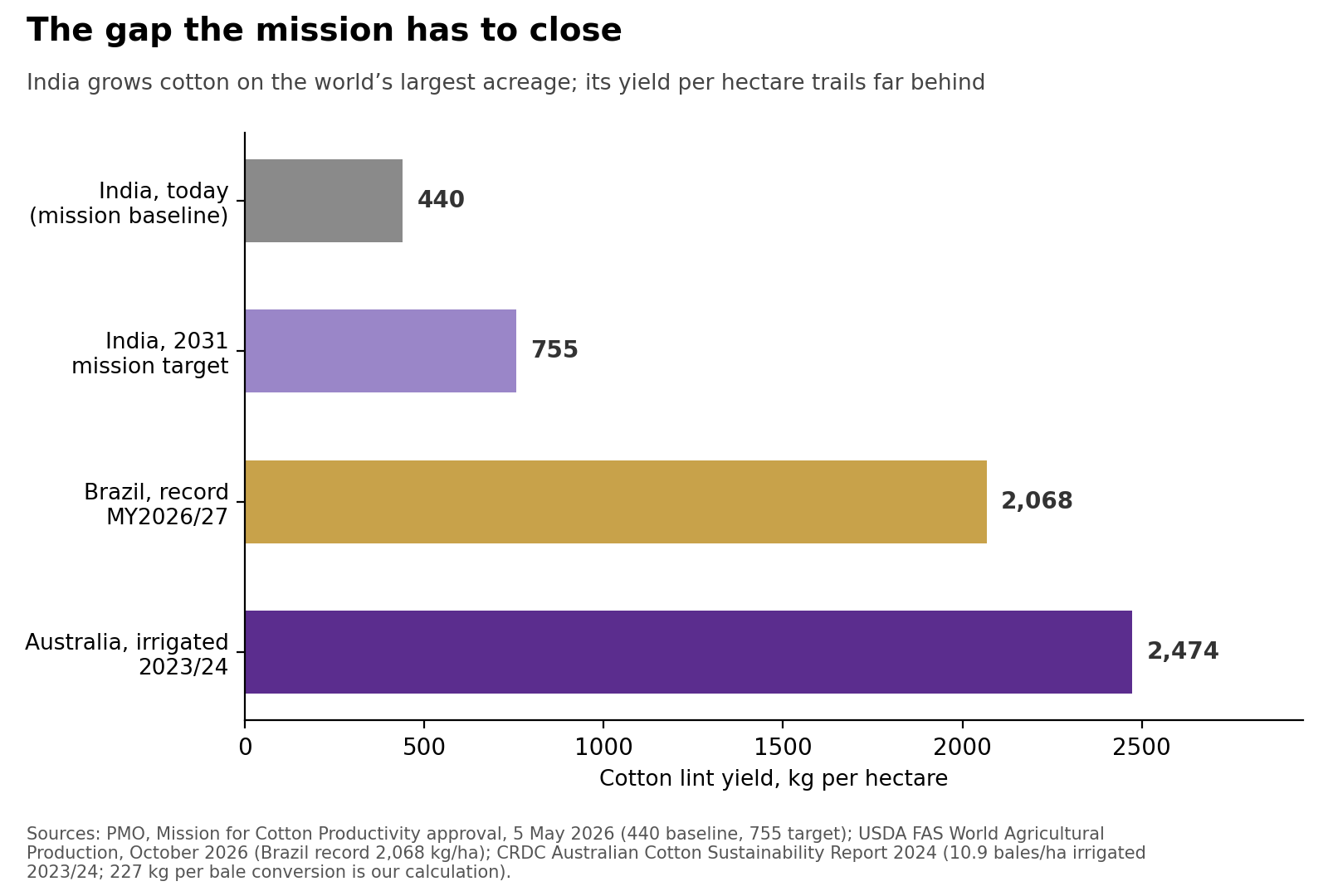
The second answer arrived in May, when the Union Cabinet approved the Mission for Cotton Productivity with an outlay of Rs.5,659.22 crore for 2026-27 to 2030-31. Its targets are specific: raise lint productivity from 440 kg per hectare to 755 kg per hectare and production to 498 lakh bales by 2031, benefiting roughly 32 lakh farmers. The instruments are agronomic, not tariff lines: high-yielding pest-resistant seeds, high-density planting and closer spacing, extra-long-staple promotion, modernised ginning, accredited testing, Kasturi Cotton Bharat traceability with trash below 2 per cent, and digital integration of market yards. Implementation sits with the agriculture and textiles ministries through ten ICAR institutes, one CSIR institute and ten AICRP centres, initially across 140 districts in 14 states and 2,000 ginning and processing factories.
The mission exists because the yield numbers are stark. That 440 kg per hectare baseline is roughly a fifth of what the best producers achieve. About 62 per cent of India's cotton area is rain-fed. USDA's Foreign Agricultural Service, forecasting 477 kg per hectare for India's 2025/26 marketing year on 11.4 million hectares, attributes the stagnation to low yields, higher production costs and increased susceptibility to sucking pests and bollworms.
What the top of the chart did differently
Australia grows cotton on a fraction of India's area and gets five times the lint from each hectare. Irrigated yields there climbed from 6.8 bales per hectare in 1993/94 to 10.9 in 2023/24 - about 2,474 kg of lint per hectare at 227 kg per bale - per the Cotton Research and Development Corporation's 2024 sustainability report. Brazil, a rain-fed giant like India, just posted a record 2,068 kg per hectare for 2026/27 in USDA's October 2026 world production circular.
The Australian mechanism is the one worth studying, because it is institutional rather than climatic. Water-use productivity has risen 52 per cent since 1997; growers now produce 97 per cent more lint per megalitre than in 1992, and whole-farm irrigation efficiency is 81 per cent, up from 57 per cent in the late 1990s, according to Cotton Australia. Behind those numbers sits CottonInfo, a joint extension program of the research corporation, the growers' body and the seed distributors, whose entire job is turning research into better farm decisions. India has the research establishment - ICAR, the agricultural universities, the Krishi Vigyan Kendras. What it has not had, on cotton, is the translation machine that carries agronomy into 32 lakh smallholdings and then measures whether it landed.
My read
From here on, this is my opinion, not the record. The waiver and the mission are both defensible on their own terms. The worry is the interaction. Duty-free imports have now appeared, lapsed and reappeared across two consecutive years - the exemption ran to 31 December 2025 before returning in June this year. A patch renewed often enough becomes policy by default, and policy by default dulls urgency: every month the waiver runs, the pain that the mission was designed to remove feels more tolerable. Meanwhile the mission's clock has barely started; its own baseline figures date to its approval, and its first real milestones - seed and high-density planting adoption across those 140 districts - are still ahead of it. Friday's decision matters less for what it does to cotton prices this winter than for what it signals about which clock the government is watching. If the waiver is extended again, the honest accompanying announcement would be a published schedule for the mission's first-year deliverables. One clock should not be allowed to run without the other.
Sources
Centre waives customs duty on cotton imports till Oct 31, DD News (Ministry of Finance measure), 31 May 2026
Cabinet approves Mission for Cotton Productivity with Rs.5659.22 crore outlay, PMO, 5 May 2026
Cotton sector overview, Press Information Bureau (first in acreage, 114.84 lakh ha, 62% rain-fed, production 290.91 vs consumption 328 lakh bales)
Cotton and Products Annual, New Delhi, USDA Foreign Agricultural Service, 2025
World Agricultural Production, USDA FAS, October 2026 (Brazil record 2,068 kg/ha)
Australian Cotton Sustainability Report 2024, Cotton Research and Development Corporation
Cotton's water use, Cotton Australia
About CottonInfo, CottonInfo
Centre may extend cotton import duty waiver, Moneycontrol, 8 September 2026 (unattributed report, not a notified decision)
Cotton farmers hope free import is not extended, Times of India, 4 October 2026
Responses
No responses yet - yours could be the first.
Get the notes
Occasional emails about what I'm building, what worked, and what broke.