
The Indian Canvas #120: As Good As Staying in Delhi
Every weekday morning in Partapur, on the edge of Meerut, a schoolteacher's son leaves home at 8:30, boards a Namo Bharat train to Sarai Kale Khan, changes to the Delhi Metro for Kalkaji Mandir, and makes his 10 am lecture at JIMS. He is usually back home by six. "It is as good as staying in Delhi," his mother told the Indian Express last week. Eighty-two kilometres of daily commute, collapsed into something unremarkable. That sentence - unremarkable - is the whole story of the Delhi-Meerut rapid rail this month. The trains are no longer the news. The riders are.
On 25 October, the Hindustan Times reported the National Capital Region Transport Corporation's latest ridership figures: average daily ridership on the corridor rose 98.8% in one year, from 47,745 in July 2025 to 94,936 in July 2026. The climb has continued since: September 2026 averaged 108,044 a day. Three days earlier the Indian Express had put the monthly series together - 63,999 in February 2026, 87,682 in March, across the one-lakh mark in June at about 1.02 lakh, roughly 1.13 lakh in August - and recorded the corridor's highest-ever single-day footfall: 1,68,510 journeys on 28 August 2026. The Press Information Bureau, marking three years of operations on 18 October, put the cumulative count at over 4.5 crore passenger journeys since inauguration. Three sources, three different figures - a July-to-July comparison of daily averages, a monthly series of daily averages, a single-day record - and each labelled for what it is, because they get conflated in the retelling.
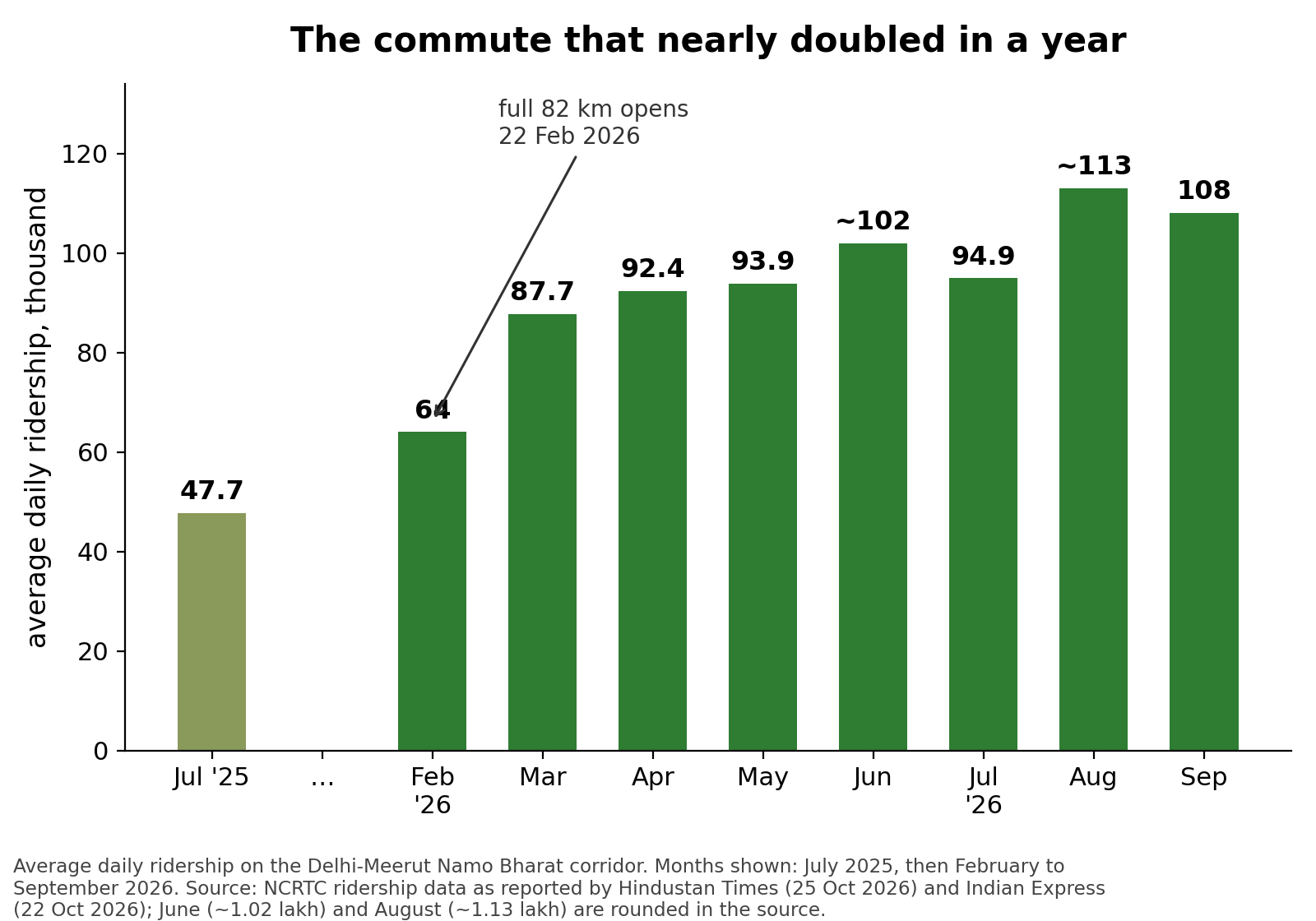
Average daily ridership on the Delhi-Meerut Namo Bharat corridor. Source: NCRTC data as reported by Hindustan Times (25 October 2026) and Indian Express (22 October 2026); June and August figures are rounded in the source.
What was actually built
The hardware matters because the ridership tracks it. Namo Bharat operations began on 21 October 2023, the day after the Prime Minister inaugurated a 17-km priority section between Sahibabad and Duhai Depot. The corridor then grew in phases - to Modinagar North in March 2024, Meerut South in August 2024, into Delhi proper with the Sahibabad-New Ashok Nagar section in January 2025 - until 22 February 2026, when the full 82-km Delhi-Ghaziabad-Meerut corridor was dedicated, with the Meerut Metro riding the same tracks. The NCRTC's design brief was specific: 160 kmph operations, trains every fifteen minutes to start with, 100 km covered in 45-50 minutes, and sixteen stations built to interchange with the Delhi Metro, Indian Railways, inter-state bus terminals and city buses. Five stations - Sarai Kale Khan, New Ashok Nagar, Anand Vihar, Ghaziabad and Begumpul - now carry more than 40% of all ridership, and they are precisely the interchange stations - an association, not proof of what drives the growth. When a foot overbridge connected Sarai Kale Khan to Hazrat Nizamuddin railway station, the Express reported in June, ridership at that one station rose about 30%.
The chart above rewards a second look. The inflection is not the inauguration in 2023; it is the completion in February 2026. Ridership did not reward the announcement. It rewarded the last mile being connected - or, more exactly, the first continuous journey.
The machine Paris has run since 1977
One operating model has been refining its answer to the question Namo Bharat is asking - how do you make regional rail a daily habit rather than an occasional trip - for nearly five decades. Paris in the 1960s had the same geometry as the NCR: dense core, sprawling suburbs, commuter trains that terminated at the city's edge and dumped their passengers onto an overstretched Metro. The response, per Île-de-France Mobilités, was to refuse the terminus: the RER's lines do not end in Paris but cross the capital underground, so a commuter rides from one end of the region to the other on a single train. The first section opened in 1969; in December 1977 the Châtelet-Les Halles junction joined east to west, and the through-running network was born.
Fifty years on, the RATP counts five RER lines, 249 stations and 600 km of track carrying about 2.7 million people a day; Île-de-France Mobilités puts the figure above three million. RER A alone - 109 km, 26 of them underground - is the busiest railway line in Europe, with peaks over 1.3 million passengers a day, and RER B regularly passes a million. Lines A and B are co-operated by the RATP and the national railway SNCF; C, D and E are SNCF's. And here is the honest part of the European lesson: ridership grew about 20% in ten years, and the growth itself degraded the service, forcing rolling investment programmes. A successful regional railway does not reach a finishing line. It becomes infrastructure that must be fed, forever, because people keep showing up.
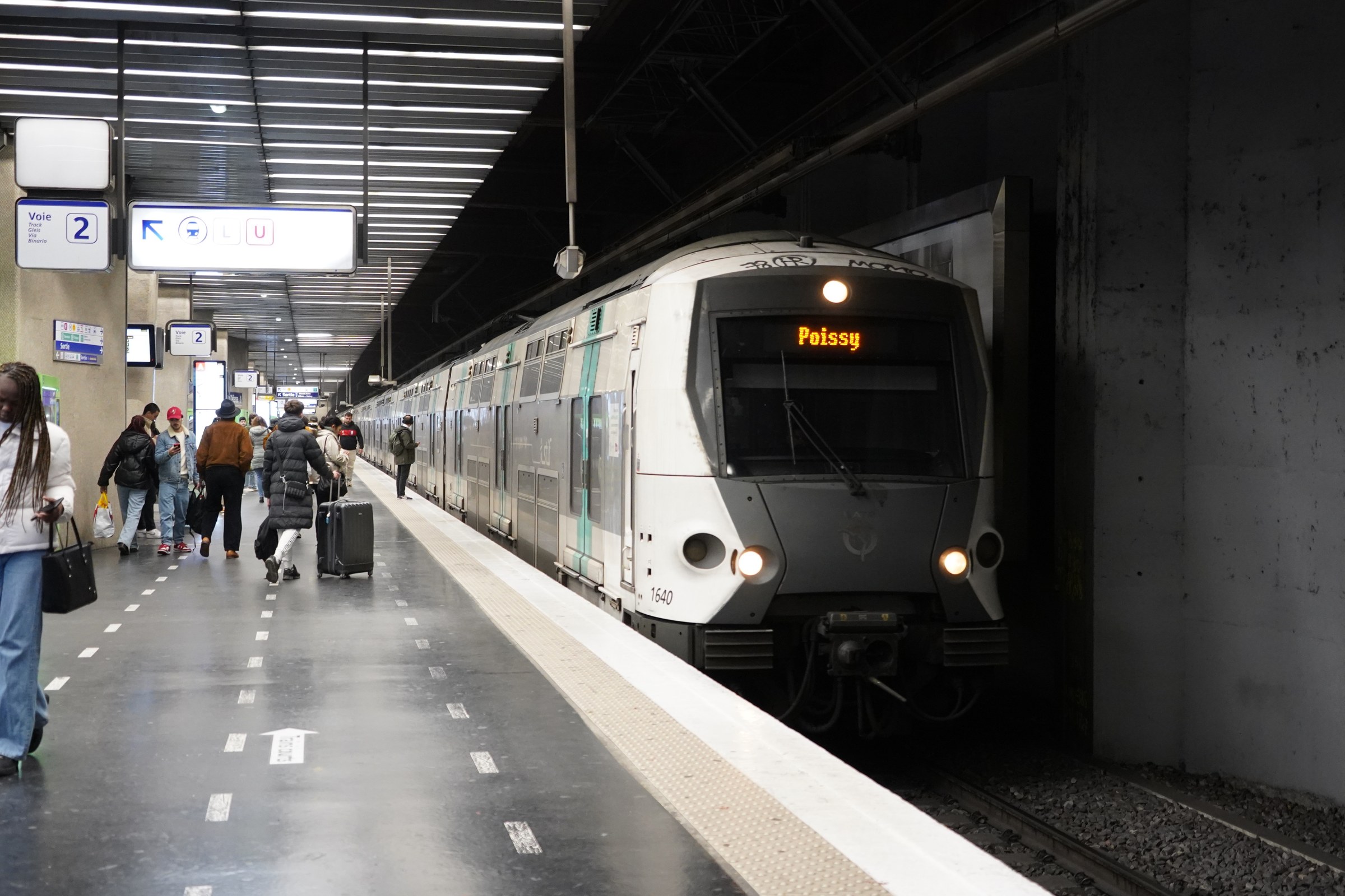
An RER A train arrives at La Défense, Paris. The RER's lines cross the capital underground instead of terminating at its edge - the design decision that made regional rail a daily habit. Photo: Remontees, CC BY-SA 4.0, via Wikimedia Commons.
Why riders stick
Read the Delhi-Meerut numbers against the Paris machine and a mechanism emerges. Frequency first: a train every fifteen minutes is a service you do not plan around; you just turn up. Through-running second: the corridor was designed so its three future lines will converge at Sarai Kale Khan and run onto each other without a change of train - the 1977 Paris junction, adopted at the drawing board. Transfers third: a commuter will switch systems exactly as many times as the switches are painless, and the station where ridership rose about 30% after a foot overbridge linked it to Hazrat Nizamuddin railway station points the same way, as does the NCRTC's parking for over 8,000 vehicles with live occupancy shown on its app. And all-day utility last: in July 2026, Sunday ridership fell only 15-20% below weekdays - NCRTC officials read that, correctly, as proof the trains carry students, patients, traders and wedding parties, not just office commuters. A railway used for everything is a railway people build their lives around. That is what "as good as staying in Delhi" means, translated.
The honest gaps
Three qualifications belong next to the headline. First, the projection gap: the Delhi Integrated Multi-Modal Transit System projected 7.4 lakh daily riders by 2028 - seven times the current average - but that figure assumed the wider RRTS network, and the two next corridors (Delhi-Karnal and Delhi-Gurugram-Alwar) still await approval, each needing five to six years after the nod. The Delhi Metro precedent says network effects do arrive; they have not arrived yet. Second, the monthly series is not a straight line: ridership crossed one lakh in June 2026, dipped to 94,936 in July, then rose again in August. Neither report explains the dip, so I will not either - but a habit-forming railway will wobble month to month, and the honest chart keeps the wobble in. Third, no data yet shows how many riders have shifted from private vehicles, or whether road congestion on the Delhi-Meerut corridor has actually fallen. Ridership is necessary evidence. It is not yet proof of the decongestion the corridor was sold on.
The missing middle
Everything above is from the documents and the data. This last stretch is my argument, marked as one.
Indian public transport has always had two gears: the city metro, frequent but slow over distance, and Indian Railways, fast over distance but indifferent to the daily rhythm of a region. The missing middle is the regional train - the thing a Meerut family can plan a Delhi education around. Europe settled this fifty years ago, and the RER's history carries a specific instruction for the NCR: the first line does not pay off as a line; it pays off as the seed of a network, and ridership compounds as junctions join. India's version is ahead of schedule on exactly one variable - people - and waiting on the other - the network. The 47,745 who rode in July 2025 have become over a lakh a day; the corridor found its riders before it found its sisters. Paris suggests the sisters are what turn a successful line into a transformed region. Approving them is the next kilometre of growth the ridership numbers are already arguing for.
Somewhere on the 8:30 out of Meerut, you can picture a student asleep against the window, ten minutes from Sarai Kale Khan. Picture him not as a statistic about the future of Indian transport but as an illustration of what the numbers already describe: a habit that has arrived - and that is waiting, like everything else on this corridor, for the next section to open.
Sources
Hindustan Times, 25 October 2026: RRTS ridership up by 98% in one year, NCRTC data (47,745 in July 2025 to 94,936 in July 2026; 108,044 in September 2026; phased-opening timeline)
Indian Express, 22 October 2026: Delhi-Meerut Namo Bharat hits record 1.68 lakh passengers in one day (monthly series; record 1,68,510 on 28 August 2026; Sunday dip 15-20%; DIMTS projection; commuter accounts)
Press Information Bureau, 18 October 2026: NCRTC marks three years of Namo Bharat operations (4.5 crore cumulative journeys; over 1.1 lakh daily; full corridor dedicated 22 February 2026)
NCRTC: project details (160 kmph; 15-minute frequency; interoperability at Sarai Kale Khan; corridor network)
Île-de-France Mobilités: the RER service - history and ridership (through-running design; over 3 million daily users; RER A peaks over 1.3 million; +20% in ten years)
RATP: RER lines (5 lines, 249 stations, 600 km, 2.7 million daily)
RFI, 16 December 2017: forty years of the RER (first section 1969; Châtelet-Les Halles junction December 1977)
Responses
No responses yet - yours could be the first.
Get the notes
Occasional emails about what I'm building, what worked, and what broke.