
The Indian Canvas #106: No Waiting Room
At some point on 15 September this year, a patient somewhere in India - statistically, most likely a woman - finished a consultation that took the country's national telemedicine service past fifty crore visits. The health ministry's announcement a few weeks later put the precise figure at 50,00,92,730 teleconsultations across all 36 states and union territories, and called eSanjeevani the world's largest telemedicine implementation in primary healthcare. The superlative is the ministry's; the count is hard to argue with.
Fifty crore is a number that needs unpacking, because almost nobody has heard of the service that produced it.
Two quiet machines
eSanjeevani is actually two services. The older one, rolled out in November 2019, is hub-and-spoke: a community health officer at an Ayushman Arogya Mandir - a spoke - connects a patient by video to a doctor at a hub in a medical college or district hospital. The second, eSanjeevaniOPD, arrived in April 2020, in the first COVID lockdown, when physical OPDs shut: patient-to-doctor consultations from home, ending in an ePrescription you can take to a pharmacy or a lab. The ministry's November 2020 release, celebrating seven lakh consultations and ten thousand a day, reads like a dispatch from another era.
The regulatory ground shifted just in time. On 25 March 2020, two days into the first lockdown, the ministry issued the country's first Telemedicine Practice Guidelines, finally letting any registered medical practitioner consult remotely and prescribe within defined limits. eSanjeevaniOPD went live weeks later. States scrambled to make its output real at the other end: Kerala and Tamil Nadu issued government orders directing that ePrescriptions be honoured, so a video call could actually end in medicine.
The network behind today's numbers: 1.42 lakh Arogya Mandir spokes, 19,473 hubs, 901 online OPDs, 2,41,923 registered healthcare providers, and a platform built and run for the government by C-DAC in Mohali, working in fifteen languages. On an average day it handles 2.5 to 3 lakh consultations; the record for a single day is 6,30,315. In financial year 2024-25 alone it delivered over 11 crore consultations, the ministry told the Lok Sabha in July. Everything about it is free to the patient.
The ownership pattern will be familiar to readers of the UPI story. The state did not buy a teledoctor product from a vendor and hope for adoption; it built the rails itself, put them in public hands, and let every state and medical college drive on them. C-DAC, a government R&D society, has done the engineering end-to-end since inception - which is why the platform speaks fifteen languages, plugs into Arogya Mandirs, and answers to a ministry rather than a quarterly earnings call. Whether that is why it scaled is a hypothesis I will label as such; that it scaled is arithmetic.
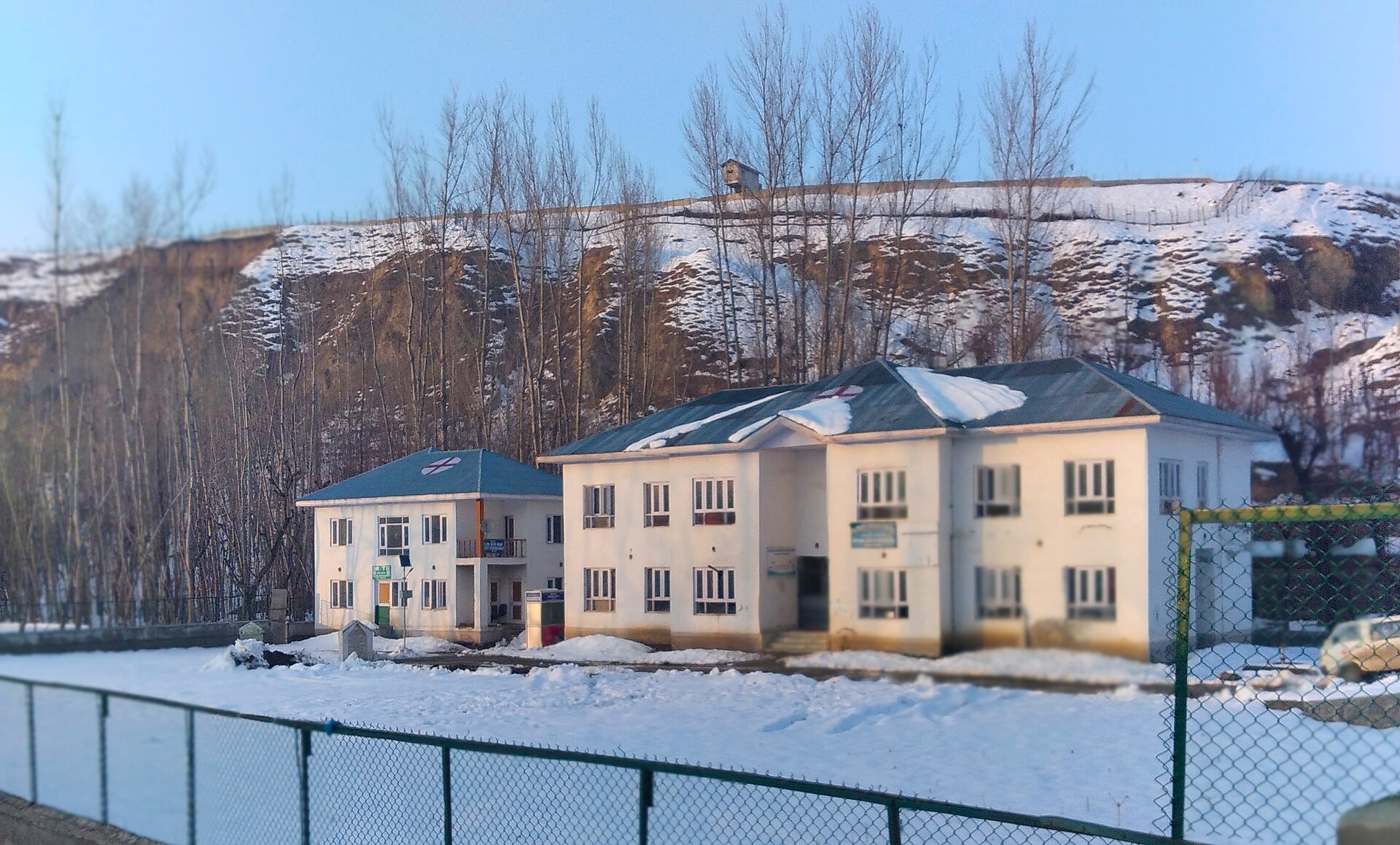
A primary health centre in Ichgam, Kashmir, in January. For spokes like this one, the nearest specialist can be hours away by road. Photo: Kamil Ali Bhat, Wikimedia Commons, CC BY-SA 4.0
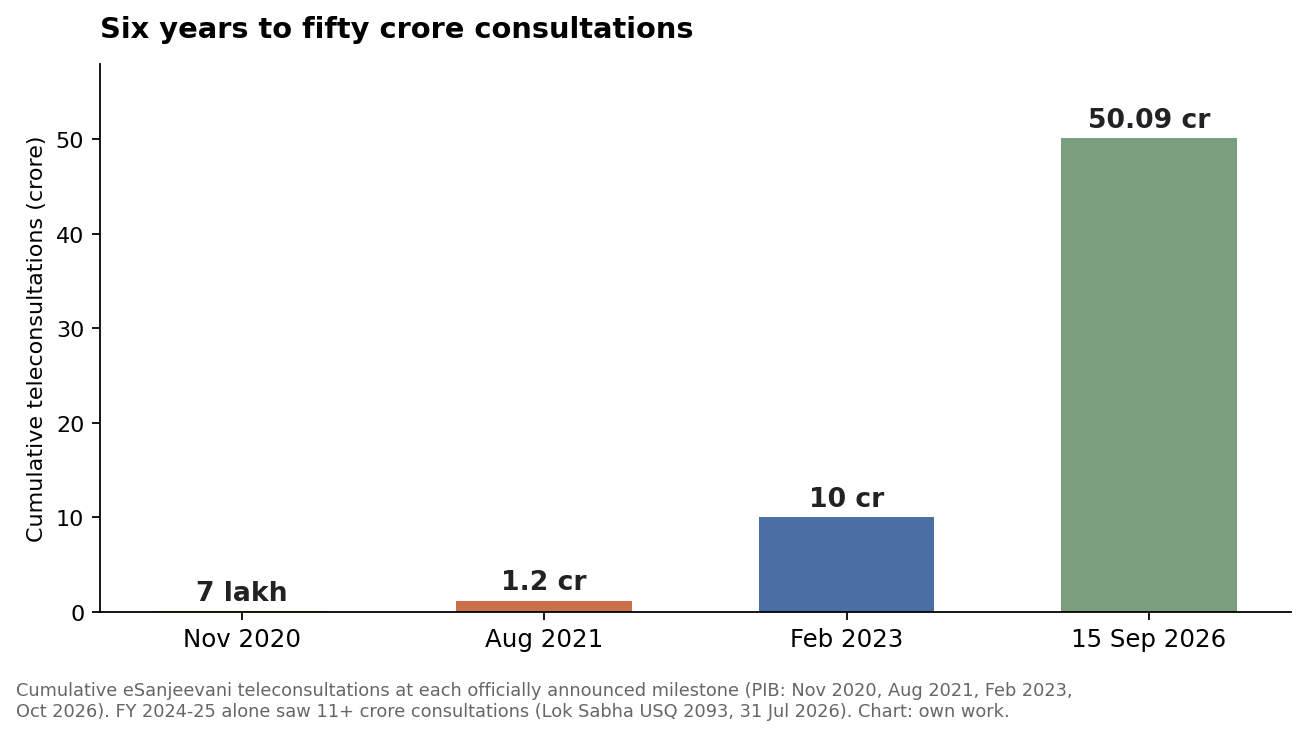
Cumulative teleconsultations at each officially announced milestone. FY 2024-25 alone saw over 11 crore consultations. Chart: own work, from the sources below.
Read the chart as acceleration, not just accumulation. The first 10 crore consultations took more than three years; the next 40 crore took about three and a half - nearly four times the rate, by my calculation from the milestone dates. Some of that is COVID's long tail pushing habits, but the curve kept steepening well after the last wave - through 2024 and 2025, when the physical OPDs were fully open again. The service stopped being a lockdown workaround and became infrastructure people choose on an ordinary Tuesday.
Who actually uses it
The most interesting numbers in the ministry's release are not the big ones. Women account for 57.14% of all consultations, the release says; 40.15% of consultations are for patients aged 46 and above, including 16.25% for senior citizens over 60. Picture who those users are: people for whom a hospital visit means a bus, a day off work, an escort, and a queue. The platform did not find a new population; it found the population that physical OPDs were taxing the hardest.
That is the real design insight of the hub-and-spoke half. India did not ask a villager in, say, rural Kashmir to download an app and find a private teledoctor. It put the screen inside the Arogya Mandir she already walks to, with a health worker she already knows standing beside her. The smartphone version exists, but the system's spine is 1.42 lakh physical touchpoints - telemedicine with a building at one end.
The machine keeps adding floors
The 2026 version of eSanjeevani is not the 2020 one. An AI-powered clinical decision support system now assists providers during consultations - work that won a Gold Award at this year's National Awards for e-Governance. The platform is integrated with ERSS-112, the national emergency response number, linking emergency dispatch to remote medical advice. And it has started climbing up the care ladder: patient-to-doctor specialist OPD consultations are live at AIIMS Jodhpur, AIIMS Jammu and AIIMS Patna, with AIIMS, JIPMER and PGIMER Chandigarh on the expansion list. What began as a way to keep primary care moving in a lockdown is becoming a layered national OPD - primary at the spoke, specialist at the AIIMS, emergency at the 112 line.
How does anyone else do this?
Two comparisons illuminate what India chose - and what it did not.
Brazil's Telessaude, a national programme since 2007, made a different bet: its core service is teleconsultoria - provider-to-provider support, where a Family Health team doctor in a remote municipality consults a specialist at a telehealth centre, plus tele-education and telediagnosis. Brazil's model strengthens the local doctor; it mostly does not see the patient at all. India's hub-and-spoke has the same instinct (support the frontline worker), but eSanjeevaniOPD went further and put the patient directly on the call, at population scale.
England digitised the front door instead. NHS England's latest figures show 6.5 million online consultation requests to GP practices in September 2025 - requests, note, that a practice then triages - alongside 20.1 million face-to-face appointments the same month. Online is now the most popular way to contact a GP in England; it is not how most care is delivered. That distinction matters: neither England's triage layer nor Brazil's doctor-support layer is a substitute clinic. India's fifty crore is something stranger - a parallel, free, public clinic that exists alongside the physical one, doing primary consultations the physical system never had the rooms or the doctors for.
What fifty crore does not tell us
Honesty requires a few caveats, and I will mark them as mine rather than the ministry's. A consultation counted is not a problem resolved; there is no public outcome data on what share of these visits ended in effective treatment, referral or reassurance. The quality question is real - a three-minute video call with a stranger is not continuity of care, and 2.42 lakh registered providers spread across 50 crore consultations is thin ice in places. And for all its scale, the service still reaches each Indian on average once every three years; the physical OPD system remains the main event. The defensible claim is narrower and still remarkable: the state built a consultation channel that did not exist, at a cost of zero rupees to the patient, and fifty crore uses later, the people using it most are exactly the people the old system charged the highest hidden price - in bus fares, lost wages and waiting.
The waiting room did not disappear. It moved to a phone in a sub-centre in the snow, and the queue got shorter for everyone who could not afford to stand in it.
Sources
PIB / Ministry of Health and Family Welfare, "eSanjeevani Crosses 50 Crore Teleconsultations", 6 October 2026 - 50,00,92,730 consultations on 15 Sep 2026; 1.42 lakh spokes, 19,473 hubs, 901 OPDs, 2,41,923 providers; 15 languages; 2.5-3 lakh daily, peak 6,30,315; women 57.14%, 46+ 40.15%, 60+ 16.25%; AI-CDSS, ERSS-112, AIIMS specialist OPDs; C-DAC Mohali; "world's largest" claim.
Lok Sabha USQ 2093, answered 31 July 2026 - 11+ crore consultations in FY 2024-25; 141,171 spokes, 19,173 hubs, 2,39,281 providers; aspirational-district coverage.
PIB, "eSanjeevani completes 7 lakh consultations", 7 November 2020 - hub-and-spoke rollout November 2019, eSanjeevaniOPD launch April 2020, ePrescription design.
PM India, 10 crore milestone, February 2023 and PIB, 1.2 crore, August 2021 - growth milestones used in the chart.
Ministerio da Saude (Brazil), Telessaude - teleconsultoria, teleinterconsulta, telediagnosis; complements in-person SUS care.
NHS England, 30 October 2025 - 6.5 million online consultation requests vs 20.1 million face-to-face GP appointments, September 2025.
Responses
No responses yet - yours could be the first.
Get the notes
Occasional emails about what I'm building, what worked, and what broke.