
The Indian Canvas #36: India's Machine Tool Imports Top Rs 20,000 Crore. Who Watches Them Wear Out?
Industry data reported by Newz Daddy puts India's machine tool imports above Rs 20,000 crore in FY26. On 6 October, Stockholm-based IPercept raised US$16.5 million for a device that says which part inside a machine tool is wearing out. India is not empty on machine monitoring: MachineWise, Leanworx and Intellithink all sell versions of it. The gap I would test is narrower, component-level diagnosis that works on any brand of machine. That is a hypothesis, and I could not check it with buyers.

Stock photo of metal gears, cropped by me. Not from an Indian factory and not an IPercept product.
Imported machines, and nobody watching the wear
Newz Daddy reports, citing IMTMA data, that India's machine tool production in FY2025-26 was about Rs 16,478 crore, up about 13%, while consumption crossed Rs 35,000 crore for the first time. Order bookings were about Rs 16,176 crore, up around 20%. Imports crossed Rs 20,000 crore, roughly 60 to 65 per cent of consumption. Newz Daddy is an aggregator, so treat the figures as IMTMA data as reported. They cover machine tools in general, not only CNC machines.
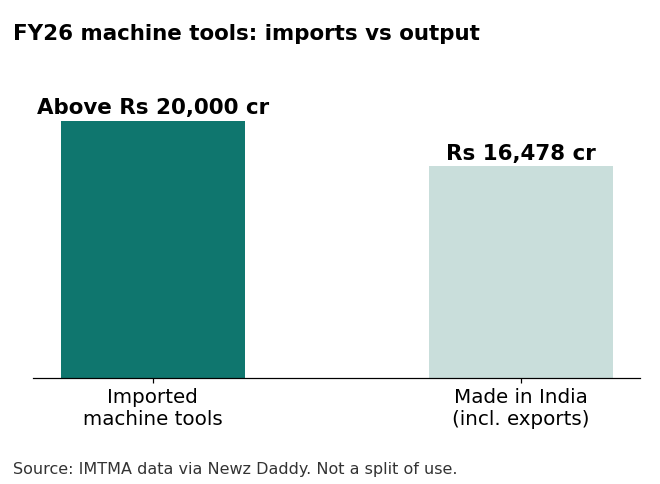
Chart by me from the figures above. The axis starts at zero. Production includes exports, so the two bars are not a split of what Indian factories use.
My reading: an imported machine often arrives with a closed controller and service from the maker's local office. A factory can end up owning many expensive machines whose wear it cannot see, and a breakdown means waiting for a part and a visit. That is an inference from how imported machines are usually serviced, not something the data shows.
What IPercept built
The Machine Maker reports a $16.5 million Series A co-led by Isogon Ventures and 2150 of London. Luminar Ventures, RunwayFBU, J12 Ventures and AI Fund, existing investors, also took part. It came 17 months after a EUR 5 million seed led by Luminar. A patented device is mounted on the moving part of a machine and measures motion at micrometre scale. It gives condition data for components such as spindles, ballscrews, guides and bearings. Company-reported: it does not connect to the machine's controller or the customer's IT, works across brands, and needs no historical data. The money goes to US operations, partnerships with industrial service providers and add-on apps. Those are plans, not results.
India already has machine monitoring
MachineWise says on its own site that it does CNC and OEE monitoring with predictive maintenance, using accelerometers at the spindle housing and bearing blocks, per-machine baselines and live spindle speed from the machine's control. It claims 150+ plants and 2,000+ machines and says it warns 48 to 96 hours ahead. All of that is company-reported, and the warning window is its own illustrative figure. Leanworx sells utilisation and OEE monitoring with a 30-minute do-it-yourself install. Intellithink of Bengaluru raised Rs 17 crore in seed funding led by Pentathlon Ventures, with Anicut Capital and Veltis Capital, according to The AI World. It lists JSW Steel, Adani and L&T among 50+ clients, but it monitors industrial machinery in general, not specifically machine tools.
So the older version of this idea, "nobody monitors Indian CNC machines", is wrong. What I could not establish is whether Indian buyers pay for diagnosis of individual components that works the same on any brand and without reading the controller, which is what IPercept claims, instead of accelerometers and baselines. That is where the hypothesis sits, and a dealer-only product or a private pilot would be invisible to me.
Who would pay, and where it could fail
IPercept's own route is industrial service companies reselling it, which is company-reported. In India that may point to machine makers' service arms and dealers, since a small job shop is unlikely to buy a sensor on its own. A pricing test, not a fact: a per-machine annual fee, with a free first month on one critical machine, judged against one avoided spindle replacement and the days of lost output.
The risks are real. Indian buyers already see cheap monitoring, and Leanworx's pitch is utilisation at a low price. A harder product has to show a failure avoided. IPercept has just raised to build US sales, and a funded foreign company may reach Indian service firms within a year or two. MachineWise may already cover enough of the need.
What I would do first
Ask three machine shop owners with imported machines and one dealer service head what they do today when a spindle or ballscrew starts to fail, and what they pay for existing monitoring. If they say a monitoring tool already warns them, there is no idea here. If they say they find out at breakdown, the idea is a service-led diagnostic for imported machines.
Sources and photo credits
Newz Daddy, The Machine Maker, MachineWise, Leanworx, The AI World. Photos on Unsplash with no stated location: cover by Maxim Tolchinskiy (@shaikhulud), a worker measures a metal rod with calipers; body by Allahverdi Israfilli (@alik_iso), a close up of a bunch of gears, cropped by me. Free to use under the Unsplash License. This is a research view, not a proven business.
Responses
No responses yet - yours could be the first.
Get the notes
Occasional emails about what I'm building, what worked, and what broke.